Archives For November 30, 1999

I have had the good fortune, in the last 4 weeks, to take workshop/seminars with two fantastic presenters. They were both representing Crossfit (which might be the best and/or the worst thing to happen to fitness in the last ten years, depending on your world view) and, between them, they taught me more about Pilates than I’ve learned in years. Okay, some of it I already knew, but I needed reminding – or I needed to hear the ideas put together in a way that I hadn’t heard/been able to hear previously. The net result was a renewed enthusiasm for teaching, and a really strong urge to translate my fresh understanding into helping the people I teach become STRONGER. I remember hearing a yoga teacher – the lovely David Sye, in fact – a few years ago saying that flexibility is great, but it is strength that holds us up as we age.

I am tempted to write this post talking about ‘we’, referring to Pilates teachers in the UK. Whilst I am confident that the following view represents more than my own thoughts and, in fact, involves some paraphrasing of others I will try to keep to ‘I’. I have thought for some time that Pilates teachers understand movement better than a lot of other exercise practitioners. I have wondered what the point of lifting weights was, other than vanity. I have thought that my understanding of the human body and biomechanics was probably superior to Joseph Pilates’ because I have the benefit of scientific advances and so much more technology to explain anatomy and movement to me. I have believed that Pilates would have done some things differently, had he lived longer, and known what science has shown us since his death. I have revelled in theory and terminology that complicates anatomy, and movement. I have over-analysed movement, and tried to understand musculoskeletal anatomy in excessive detail. I have imagined that I can tell which specific muscles might be working or not working when looking at movement, both efficient and less so. I have taught “evolved” Pilates….

More fool me, more often than not. Let’s be clear: I don’t believe that the various things I’ve owned up to have made me a bad teacher, and it’s certainly fascinating to delve into the marvellous complexity of human anatomy, yet I may be guilty of seeing the trees in detail, and thereby missing out on the beauty of the whole wood. The journey toward what feels like my current enlightenment (next step on the path to better understanding, perhaps) began with a lecture by Jaap Van der Wal: ‘Not by muscles and ligaments alone: The importance of fascial architecture for understanding the locomotion system.’ He opened my eyes to an alternative way of considering anatomy, based around the idea that movement shapes our form, rather than our form shaping our movement. One of the most compelling things that Professor Van der Wal said was; “the brain doesn’t know muscles, it knows movement”. It represented a great argument against isolated exercises, and felt like a strong validation of Pilates.

And so to my more recent revelations. The first was Kelly Starrett presenting the ‘Crossfit Movement and Mobility Trainer Course’. The first significant point is that Kelly is a phenomenal presenter, (and I would love to get him talking in front of a room full of my Pilates teaching peers) who talks with knowledge, confidence, experience and great panache. Bearing in mind that he was addressing a room full, predominantly, of Crossfitters, remarkably, as he spoke I kept thinking “that’s Pilates!”, and “That’s what Pilates was saying in the 1930s”. It seemed that, the truth is, the language of movement is actually much less complicated than I had previously been willing it to be. Some of the basic principles he spoke about: importance of midline stabilisation; the hip joint as the major engine in the body; the first joint that is loaded in a movement is the joint that will bear the most load; with the right movement and the right lifestyle we are perfect healing machines. He also made the point that humans are highly adaptable, and the consequence of this is that we need to practice good positions all the time. I had previously heard it asserted that it’s okay to slouch if you know how to organise yourself – to sit or stand properly. The trouble is, our adaptability means that we’re very good at the things we practice most, and this is exactly why the posture of someone who spends hours stooped in front of a computer terminal is so easy to identify. I spent yesterday afternoon in a lecture hall full of Pilates teachers and some of the postures on view were shocking…

The second was a gymnastics seminar at Crossfit Thames, with Carl Paoli, another great presenter, and teacher who, addressed decidedly un-Pilates movements (handstand push-ups, pull-ups, muscle-ups) but brilliantly illustrated how so many apparently different movements are closely related to each other – just as in Pilates. He also showed us how to identify movement faults in very simple ways and, equally, how to fix them in simple ways. How’s this for a simple principle?: “The hips are the main engine, the spine is the transmission, and needs to be stable to translate power to the second engine – the shoulders.”

Interestingly, as I’ve been writing this, I’ve seen fellow teachers posting links to some quite brilliant anatomy animations, and the voice in my head has been saying: “It’s not about the muscles!” I know how easy it is to give in to the temptation to look at something that is going wrong with a client’s posture, or movement and to try to work out what particular muscle isn’t working/is weak/is tight/is inhibited etc. But the brain does’t know about muscles, and I’m not cleverer than Joseph Pilates was. One of the most striking things about Kelly and Carl was that they clearly understand movement very well, and there’s the link with Pilates – he clearly understood movement well. He probably hadn’t heard about local and global muscles, he didn’t talk about stabilisers and mobilises, low threshold exercise and so on, but I suspect he knew, for example, that external rotation of the hip gives more torsion and, therefore strength, to flexion movements (and that principle is applicable to so many movements).

I don’t think that I can empower people by trying to identify what muscles they do, or don’t have working well. I can empower them by helping them to understand movement in simple terms, and to become stronger (by working hard), before I try to introduce subtlety.

In many ways, as a society, we seem to be fixated on age. There is the menace of the ‘ageing population‘, and the pressures on the economy, pension funds, and social services that this implies. Then there is the spectre, for many people, of how their age manifests itself in their bodies. It appears that the greatest anxiety for many, or perhaps the one which can be best exploited for profit, is facial ‘signs of ageing’ (The Anti-Ageing Skin Care Conference offers some intriguing sounding lectures…).

A Google search for ‘anti ageing products’ nets around 18 million results. Women (the advertising tells us) aren’t supposed to wrinkle with age – or at least they should  spare the rest of us the horror by taking steps to reduce the wrinkles. Similarly, men and women alike should quite possibly mask any grey hairs that may grow. So far, so superficial. What seems to be less of a taboo are the signs of ageing visible in the way people move (or don’t move, perhaps), and the way that people hold themselves. It strikes me as ironic that the effects of ageing that are likely to put a significant burden on society are not the ones that we focus on the most.  Perhaps that’s in part because there isn’t a lot of money to be made from encouraging older people to maintain their strength and mobility, and perhaps it’s because we have come to accept that getting older necessarily means that our bodies increasingly fail us. I’ve never thought to count the number of times that I’ve heard clients blaming aches and pains on age – I’m sure that if I tried to keep a tally it would number in the hundreds, at least.

Why is it that we’re so ready to accept that becoming older means physical disintegration? (WOW, in typing that I’ve just realised that ‘disintegration’ is dis-integration. That’s a compelling argument for centering as a fundamental of Pilates, and many other movement/exercise disciplines). I’m not seeking to deny biological truths, whatever they may be, but rather to ask whether or not we are inclined to give in too easily? Another way of asking this might be: Are we living longer than our bodies are meant to last, or are we failing to maintain our bodies adequately for our natural lifespan?

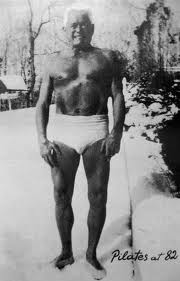
Joseph Pilates is an interesting example – legendary for his enthusiasm for posing, shirt off, showing an admirable physique aged 82. At this point I find myself wrestling with the notion of “…looks great for their age…”, which in a subtle way seems almost as tyrannical as the advertising I referred to earlier. I think Pilates looks amazing in this picture because he looks so robust – he looks younger than I expect a man to look at that age but it’s not to do with his face, or his hair, but rather the impression of vitality (whether or not that would be so apparent if he was fully dressed is another question). So, I like the idea that the notion of how age ‘should’ look in someone is not to do with skin texture, but with signs of life. I’ve certainly seen people with obvious signs of plastic surgery, or botox injections, that robs them of the appearance of life…

Pilates himself had an interesting take on age, and physical ageing. I have seen “We retire too early and we die too young, our prime of life should be in the 70’s and old age should not come until we are almost 100” attributed to him, though I cannot find the source. What we know he said, taken directly from ‘Return to Life’ is: “If your spine is inflexibly stiff at 30, you are old. If it is completely flexible at 60, you are young.” Romana Kryzanowska is one of his proteges who certainly embodied this philosophy, performing gymnastic repertoire on the Pilates apparatus into her 80s. At the same time, there is a wealth of information on the internet related to what a “gentle”, and “safe” form of exercise Pilates is, and that it won’t leave you “puffed-out”. The DVD ‘Pilates for Over 50s’ is available from amazon.co.uk, and whilst many of the reviews are positive, the one titled ‘Over 50s?! Over 70s more like!!’ speaks for itself. What should older people be expecting when undertaking Pilates? Many websites declare, for example, the benefits for bone density, yet I wonder if (in the UK at least) we are typically encouraging older clients to load their bones and joints sufficiently to make any meaningful difference.

I am forced to reflect on how I’ve approached teaching older people over the years, and my assumptions about what they will be capable of. I’ve taught many people over 70 in my 9 years of being a Pilates teacher, with a variety of orthopaedic problems. As a general rule I think it’s honest to say that my goals with most of those people were to maintain what strength and mobility they had, rather than to expect that there might be more. I’m sure that some of them enjoyed an improvement in flexibility, and balance in particular, but I cannot honestly claim that any of them got significantly stronger. Then I started teaching Li, a 73 year old women with a wonderful outlook on life (despite various daunting challenges to her health), who approaches her Pilates classes with vigour and gusto. I’ve rarely had so much fun teaching someone, and she has become both an enthusiastic advocate for Pilates, and promoter of our studio. I’ve found myself teaching repertoire to Li that I never imagined I would be teaching to a septuagenarian (Hanging Down on the Cadillac? – absolutely), and revelling in her appreciation of her own achievement.

Overall I hope that, when I’ve taken a softer approach to teaching some older clients (with perhaps less flexibility, or more orthopaedic challenges), it’s been a responsible choice, and appropriate too the individual. At the same time, have I let myself carry on in the same vein for too long, without offering the client the possibility of greater challenges? To return to the question: Are we living longer than our bodies are meant to last, or are we failing to maintain our bodies adequately for our natural lifespan? I think the answer might be a bit of both, and relates to Pilates’ own statement about age in relation to spinal flexibility – if we’re going to live for many decades shouldn’t we hope for optimal health throughout, and feel a responsibility to maintain our physical function to the best of our ability? (And as Pilates teachers, do we not have the responsibility to encourage our clients in this endeavour?)

Regular readers (might there be any?) won’t be surprised that I believe there is a nutrition component to this – avoiding pro-inflammatory grains and legumes will make us less prone to degenerative conditions. Dense (animal) protein will help us to maintain muscle mass – essential in recovering from illness, when the body demands protein for repair. Not to mention sun exposure, or Vitamin D supplementation to facilitate mineral absorption…. 

I am going to take Li, and the 86 year old woman in the clip below as my inspiration, and err on the side of adventure with my older clients. If I can be more relaxed about what is ‘safe’, and make Pilates more fun, perhaps it can help to have more wide reaching benefits – much like Pilates himself mat have imagined. One of the wonderful things about Pilates is that, I would argue, you have to really try quite hard to hurt someone with the great majority of the repertoire (I’m thinking of studio repertoire here), and this gives us huge scope to challenge and empower clients of all ages. Watch Johanna (especially around 0:44), and ‘believe in better’.

I just tried an internet search for “pilates low back pain” and Google returned 1, 380, 000 results. Google scholar also offers hundreds of ‘scholarly articles’ that touch on the subject. Amazon offers several DVDs of Pilates for low back pain, but their offerings are dwarfed by the hundreds of YouTube videos on the same subject. Another Google search for the same terms but in the News section suggests that in the last month English language newspapers and magazines have also had hundreds of articles on this subject. Coupled with my own experience of Pilates ‘fixing’ my low back pain, is it any wonder that I’ve spent years believing that Pilates offered the best solution for anyone suffering from this nearly ubiquitous affliction?

The Dummies.com website has a page, attributed to Ellie Herman on: ‘Easing Your Back Pain with Pilates‘ in which she explains that the causes of back pain are “faulty posture” and “sedentary lifestyle”. While we might like to suggest some other possible causes, I don’t suppose that many Pilates teachers would disagree with her – it seems like pretty basic stuff: you sit and/or stand badly, your postural muscles get lazy, you ability to stabilise your spine is compromised, and from there you’ll be very lucky if you don’t wind up in pain.

So, why is Pilates so good at helping relieve low back pain? Well, of course, it targets your ‘core’, deep postural muscles that give your lower back its stability. The less uncontrolled movement that you have in your lower back, the less likely it is that you will have pain. As your stability improves Pilates can help to develop efficient movement of the whole of your spine, encouraging good posture during a variety of activities. In addition, helping areas of relative stiffness to become more supple, and areas of relative ‘looseness’ to become more  stiff (stable) can help to bring more balance to our structure, and integrate our limbs into our trunk.

I was lucky enough to receive a pretty high level of training as a Pilates teacher (certainly by UK standards), and to work with some truly brilliant teachers from the UK and the US. I hope that I can reasonably consider myself to be well steeped in the principles of Pilates, and how to apply them when faced with clients with chronic pain and/or injury. I know about ‘working away from the pain’, and I’ve particularly enjoyed Ron Fletcher’s anecdote on that subject in his conversation with Kathy Grant (I referred to this DVD in a previous post) – Fletcher (a dancer at the time) explains that he went to see Pilates for help with a knee injury. Every time he went to Pilates’ studio he would be given exercises to do that had nothing to do, and Pilates would ignore Fletcher’s protestations that it was his knee that was the problem. After a few sessions Fletcher discovered that his knee was better.

So, I think my training has equipped me to help clients deal with back pain fairly well. I also believe that I understand a lot of the potential causes of back pain, as well as the importance of posture in maintaining a healthily functioning spine. I’ve been fixated (in my teaching) with hip mobility for years, and ‘get’ its importance relative to spinal stability and functional movement. I know, too, that most of us could do with working on upper back extension (and probably rotation and side-flexion too), and that the consequence of that will be less pressure on our necks. The list could go on, and that’s not really the point. In short, I felt that I had the basic understanding that I needed to do my job well, and that Pilates taught well was the ideal solution for all manner of problems. I certainly didn’t imagine that the world of strength and conditioning would have much more to offer in that regard.

More recently my perspective has been challenged. First of all by learning some of Mike Boyle‘s ideas (if you follow the link you’ll see just the kind of website that fit my prejudice completely – all it’s missing is advertising for protein powder) from his book ‘Advances in Functional Training’. (Actually this info is second-hand since it was my wife who bought the book and then explained it to me – I am nothing without her.) Boyle explains the body from the ground up as a series of joints that require, alternately, mobility then stability: ankle joint needs mobility, knee needs stability, hip needs mobility, lumbar/pelvic joints need stability, thoracic spine needs mobility, cervical spine (neck) needs mobility. Genius!

Being peripherally involved in a Pilates teacher training programme I understand how tricky anatomy and physiology can be to get to grips with, not least because it rarely seems to be straightforward, and how often students crave some dependable, simple answers. I’ve suffered the frustration, and seen it in many students too, of different books giving different answers for muscle functions. I know now that anatomy is an evolving subject, not a science in which all the answers have been found and set in stone. Thus, an explanation of what we need from our joints, expressed as simply as Boyle does, feels like a wonderful breath of fresh air. Mobility: stability: mobility: stability….It also seems to fit perfectly with ‘working away from the pain’ – you leave the problem area alone, and look for the adjacent compensations/weaknesses/stiffnesses. I think I had learned the same thing previously, but perhaps in a way that meant I didn’t see the wood for the trees – I knew it in pieces, and had never heard it said so succinctly. Lots of bits of information fell into place as I mused on this idea, and it’s become a constant reference point when I’m teaching.

Following that I was listening to a podcast recently in which the two hosts (one a strength and conditioning coach and the other an olympic weightlifting coach) were answering a question about exercising with a herniated lumbar disc. In discussing the question they came up with an equation something like: “If your hip joints are mobile, and your thoracic spine is mobile, you probably won’t have low back problems. If your hip joints aren’t mobile, and your thoracic spine isn’t mobile, you probably will have problems with your lower back at some point”. More genius! 

It’s just like Mike Boyle said! (Mobility, stability, mobility, stability….) Again, I knew already what they were saying, in fact I’ve probably been saying the same thing to clients for years, just not in such a clear and straightforward way. Perhaps I’ve just been lagging behind all these years, thinking I knew more than I did – certainly I need to view other disciplines with a little more humility than I have in the past. In any case, when trying to learn more about what I do for a living, casting my net wider has definitely been rewarded.

To return to the Ellie Herman piece on http://www.dummies.com, posture may well be a part of the picture, but there’s more to it, and you may be able to make a significant difference to your risk, or management of back pain, by going beyond her advice to:  “sit and stand up tall, keep your belly pulled in, and keep your shoulder blades pulling down your back”. Maybe even by listening to the advice of weightlifters.