Too much ‘creativity’.

As ever, the following is a reflection on the practice of Pilates that I am familiar with in the UK, and may not have any relevance/resonance for some, especially sticklers for classical Pilates.

I’ve attended workshops with Romana trained teachers (one in particular) and found that their vigorous adherence to ‘what Mr Pilates taught’ was rigid to the point of dogma, and not appropriate for the broad range of clients that I encounter. At the same time, it seems that we can sometimes forget/overlook the amazing range of repertoire that Pilates himself devised, and how effective so much of that repertoire is.

One of the consequences of living with (and being married to) another Pilates teacher is that many dinner time conversations revolve around shared experiences from our work. A frequent cause of frustration and, thus, topic for conversation, is a group teaching scenario whose dialogue goes something like: (client) “Can I do that exercise standing at the end of the Cadillac?” (teacher) “Sure, which one?” “It’s the one where you stand on the rotating disc and you hold the bar….and I think you bend forward, or something…” “Sorry, I don’t know that one.” “Yes you do. (Teacher X) showed it to me. It was really good.” “I’m pretty sure I don’t know which exercise you mean. What was it for?” “(Puzzled expression) For…? I don’t know – It felt really good.” “If you know why X gave it to you I might be able to figure out what it is – do you remember?”

This could go on for a while, but hopefully you get the gist. Let’s be clear – of course it’s great for clients to enjoy themselves and, in general, I’ve got nothing against people doing exercises that make them ‘feel good’. Then again, too many times I’ve seen people assuming horrible positions that apparently feel really good, teachers included (“Oh no, I would never let a client do this, it just feels really good.”).

There’s a couple of reasons, at least, for the above dialogue to be the cause of frustration. In the first place, while I wouldn’t advocate chapter & verse on whys and wherefores with every exercise, if we know the purpose or objective of an exercise, we have a much better chance of understanding and executing it well. On a couple of occasions when the client may have been able to recreate the feelgood exercise/movement, (typically involving a number of auxiliary props*) I’ve found myself wondering why a particular classical Pilates exercise wouldn’t have done just as well, if not better.

There may be many instances when it’s appropriate to adapt exercises, and also some occasions when it seems necessary to ‘invent’ something to meet the needs of a specific individual (just as Pilates himself did). Is that always the reasoning behind teachers ‘creating’ new exercises? I would guess that the answer is, quite often, no. Gray Cook addresses this in his article ‘Function?’:

We cannot prove this exercise will improve the way you move. It has not been shown to make you more functional. It has not been proven to create better performance or metabolism. It is simply the result of your trainer’s creativity and a surplus of time and equipment. It is an unscientific attempt to reduce your boredom with your current training program. This combination of equipment and movement is a way to entertain you and will distract from the objective tangible results you may not be getting.” (Gray Cook | Function? © 2011 Gray Cook, http://www.graycook.com)

Cook is writing about strength and conditioning coaches but his words seem to apply very well to Pilates (as do a lot of his writings, I can’t recommend him enough). To compound what he says, quite often it seems that there is no identification of, or desire for, specific and measurable results. In other words, aren’t we (no, our clients!) better off with a situation in which someone can say “I can see and feel that I’m able to move further and more easily in this range”, rather than “That stretch feels really nice for my back”?

The other side to this is that mystery exercises help to fuel people’s dependence on a teacher. Any time someone has no clear idea of the purpose, or desired outcome of an exercise the further along the road they are away from empowerment. Perhaps empowerment is not a goal that everyone has for their clients…. certainly it is at the heart of the philosophy at our studio. I’ve referred previously on this blog to conversations I’ve had with clients who’ve said something like “Teacher X has been working a lot on my neck”, when the client seems to think that Pilates is something that is done to them, and it feels like the same territory, to me, as teaching exercises that don’t have a clear intent. Never mind an identifiable name to make it readily repeatable.

One of the fringe benefits for me of having a teacher training program based in our studio is the presence of students working through manuals, practicing repertoire and reminding me of things that I’ve forgotten, because I don’t teach them regularly. The classical repertoire covers so much territory, and is so adaptable (especially in the studio) that I believe there are very few situations that truly require ‘new’ exercises. The classical repertoire, being recognisable and repeatable, also allows us to have some measures of our capability.

In other words, there’s nothing really wrong with Pilates, so we don’t need to be ‘fixing’ it with our creativity.

*There’s a side issue here of adding auxiliary equipment to exercises, to increase the ‘challenge’. Is there ever a good reason to put a foam roll on a reformer?
target-your-shoulders-with-pilates-reformer-routine.300x140

Image from pilates.wonderhowto.com

“No Days Off”

February 15, 2013 — Leave a comment

A couple of weeks back PilatesTree.com asked via Facebook “how much self practice do you really put in?”. It’s a really interesting question to ask professional Pilates teachers, not least because we so often seem to prioritise teaching over working on ourselves. When I first started teaching I used to “do” the class that I was teaching, and it took me a while to realise that this was a really good way to develop some bad habits (never mind that my mat was not the optimum place to be teaching from all the time..).

I’ve struggled for some time with conflicting ideas around Pilates teachers’ responsibility to be aspirational figures (see ‘What should a Pilates teacher look like?‘) and, of course, what we do should be more important than how we look. If we finish teaching a class and then adopt a collapsed posture we’re doing a lousy job of reinforcing what we teach. “Do as I say, not as I do” is rarely a powerful teaching message.

One of the consistent messages of primal/paleo lifestyle authors, and indeed Kelly Starrett, my movement sensei, is that it is our responsibility as human beings to optimally express our genes – to be the best version of Homo sapiens that we possibly can be. This seems eminently reasonable to me, and also a great basis for a slightly different question from the one above: “How often should we be trying to be better?” or better yet – “How often should we be practicing being amazing?”

The answer, naturally, is ‘every day’. Hence, there are NO DAYS OFF. Practice making permanent = we become good at what we do often, which brings us back to the post-class slouching Pilates teacher. A state of fitness is not the result of a couple of hours per week of exercise. That may well form a part of fitness, but if we practice being great for 2 hours a week, and then the remaining 110 hours (assuming a generous 8 hours sleep per night) practicing being mediocre, or worse, we don’t need NASA to tell us what the outcome will be.

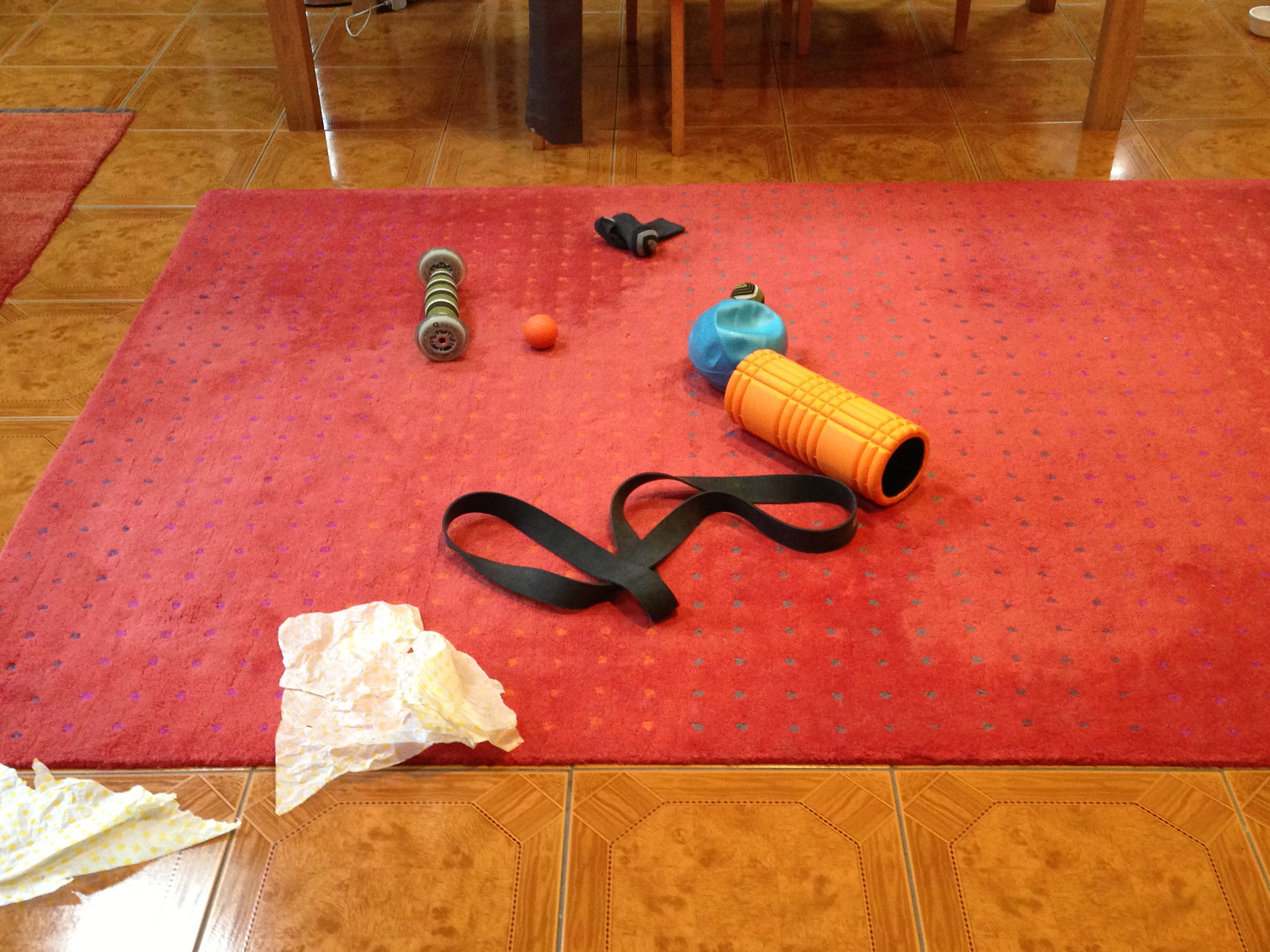
Typical view of living room floor (tissue paper is for the cats to play with).

Typical view of living room floor (tissue paper is for the cats to play with).

I was unusually reticent about answering the original question on PilatesTree….in part because I know that I can’t pretend to do anything resembling a Pilates class more than once a week. Preferring to answer my own question (“How often should we be practicing being amazing?”). As of this year, I do something in pursuit of being better as often as it crosses my mind, and this means at least every day. I don’t work out every day, but I try to practice something that I need to improve daily, whether that be a skill/movement, or mobility. I’m very lucky to be married to a woman who shares my passions/obsessions, and evenings in front of the TV usually involve one, or both of us rolling various body parts on sundry firm objects, or indulging in mutual ‘quad smashing’ (For a visual on how to do this to a massive weightlifter, or your loved one, click here, and remember: “Foam rolls are for children”).

Talk of my idiosyncratic home life may have me straying off the point. Here’s the thing: Yes, practice Pilates, yoga, boot camp, karate…whatever’s your poison (passion?), at least once per week AND practice being a better Homo sapiens every day. In the middle of a TV show I was watching the other night (I put my hand up here and acknowledge that I was making no effort to be better at the time), I heard the line “Clean water is a human right.” It sounded weird at the time – I think we’re often too quick to award ourselves rights (argh! Rabbit hole! Yes, ideally every living human should have access to clean water). Ethical quagmires aside, could we say that “an optimally functioning body is a basic human right”? I hope so, and if we’re agreed upon that, we have to remember that “with rights come responsibilities”.

We have the basic human responsibility to maintain our bodies in such a way that we are able to best express our genetic heritage.

In acknowledgement of the inspiration for this post, here’s Kelly Starrett. Not my favourite MobilityWOD video (and he no longer advocates icing) but maybe it can serve as a way in to the goldmine for you – he’s ALL about being better at EVERYTHING.

It’s a GPP system

My understanding (and I can’t remember whether this was gleaned from reading Pilates’ books, or hearing it said by one or other of the first generation teachers) is that Pilates’ intention was to create a form of physical training that, unlike the kinds of training he had done himself (boxing, for example), would ready one for any conceivable physical challenge. In a nutshell, General Physical Preparedness.

Along with the CrossFit Training Manual, I’ve been reading a fair amount of Gray Cook‘s writing lately, and both have some interesting things to say about specialisation.

“CrossFit considers the sumo wrestler, triathlete, marathoner and power lifter to be ‘fringe’ athletes, in that their fitness demands are so specialised as to be inconsistent with the adaptations that give maximum competency at all physical challenges.” To extrapolate that a little, none of those athletes can be considered truly fit. Heresy alert: Mo Farah is not fit!

In his lecture ‘Developing a Movement Philosophy‘ Gray Cook observes “Every time we specialise we give up our adaptability”, and later “any time we specialize, the human body at some point will start to break down.”

When writing here I invariably seem to get to the point of feeling the need to insert the “What has this got to do with Pilates?” sentence. Well, Pilates is meant to be promoting health – and I do like CrossFit founder Greg Glassman’s concept of ‘health’ being measured on a scale that runs from sickness, through wellness, to fitness – so hopefully Pilates is not simply promoting health, but specifically promoting fitness. (Why settle for being ‘well’, instead of ‘fit’, when ‘well’ puts us already half way to ‘sick’). Fitness requires adaptability, and as Gray Cook implied, specialisation is the enemy of adaptability – and here’s where Pilates steps up, because, again, it’s a GPP system.

At Pilates in Motion Studio we try to instil the idea in our clients that Pilates is a means to an end, not an end in itself. In a very broad sense, we could call that ‘end’ “living better“, and that’s precisely because Pilates is not a method to help us to get better a specific skill, or improve endurance in a particular activity (though of course those benefits may come), but because it should be preparing us for a wide array of challenges, from the mundane to the extraordinary.

By incorporating a mixture of movement patterns, in multiple planes, and by practising the principle of trunk stabilistaion while moving extremities (How many Pilates exercises revolve around this central concept?), we make ourselves more ‘robust to perturbation’ (as the biomechanists might say). Given a definition of fitness that incorporates a notion of adaptability, Pilates (perhaps with the addition of more load) practised with some periods of high intensity, provides a great foundation for general, not specialised, fitness.

The “Fast Diet”, also referred to as the “5:2” diet seems to be all over the UK media at the moment, accompanied by both very positive reviews, and expressions of concern about the dangers of encouraging anyone to fast.

I had this diet described to me as “fast for 2 days (actually, limit calories to 500/600 per day), and eat what you like for 5 days”. The man behind this is Dr Michael Mosley – and he made a television programme all about it, so it must be infallible. Apparently he found evidence that, aside from weight-loss, the Fast Diet is also associated with a range of other health benefits.

I have grave misgivings about any suggestion of ‘eat what you like’, because it seems to suggest that nutrition is unimportant. In other words, there’s an awful lot of ‘food’ around these days of very limited nutritional value. The idea (not Dr Mosley’s, I’m sure, but possibly widely-held nonetheless) that it’s okay to eat crap for 5 days, and then severely restrict your calories for the other 2, sounds like a recipe for very poor nutrition. And food, after all, is meant to nourish us, not simply supply us with calories.

I can’t help but listen to news items about diets without my Paleo-biased brain shouting “It’s what you eat, not how much or how often, that matters”. I’m also trying not to be a 197693_3967280097068_451202589_nfundamentalist about food. I do get a little stressed over vegan parents raising their babies as vegans. Equally, it would take very strong evidence (that I’ve seen no trace of) to persuade me that being vegetarian is as healthy (never mind sustainable) as being omnivorous . At the same time, occasional rants about soy products aside, if someone feels that the way they eat is the best for them, what business is it of mine? None, of course.
Back to ‘diets’. The biggest problem that I can see is that they always appear to be temporary. I may well be wrong, but I doubt that Dr Mosley is proposing that anyone follows the 5:2 ratio for life. This is why I really like the way that I’m eating these days (and why I’m always a little baffled by people asking me if I’m “still doing that diet”) – it’s great because it feels totally sustainable. I choose, generally, not to eat certain things, that were amazingly easy to give up. That’s it. Again, I’m trying not to evangelise.

I was exposed to another idea today (courtesy of Paleo Solution podcast episode 167), attributed to Greg Glassman, founder of CrossFit. It seems like a brilliant approach to body composition, health, and (probably) any other outcome one might desire from a diet. Essentially, set yourself some athletic goals that will really stretch you. The podcast mentions double-bodyweight back squats and a couple of other outlandish strength/gymnastic goals, but we can all figure out athletic achievements that will stretch our individual capabilities. Perhaps it’s mastering the entire Super-Advanced Reformer repertoire, or doing “Romana’s Mat Challenge” 4 times in a row, if Pilates is your thing (though I think a more profound strength challenge would be best). Maybe it’s preparing to climb Kilimanjaro for charity. The point is that, if your goal is sufficiently challenging for you, doing what it takes to reach it will inevitably involve eating appropriately, and making positive changes to your body composition. No 5:2, no GI, no Caveman, no South Beach, no Atkins, no Blood Type (and on and on and on and on)

Perfect! Nourish yourself to achieve amazingness, and enjoy the combined side-effects of better health, and the body composition you’ve dreamed of.

Adaptive Athletes

January 22, 2013 — Leave a comment

If I’m uninhibitedly honest, before last years Games, I used to view the Paralympics as a distinctly fringe event. Rather in the vein of “Ahh, that’s nice”, but of minimal personal interest.

Like many people, I suspect, last year was different, in that my family was making a point of watching many of the events on television (and trying to get tickets), learning the names of more athletes (no longer ‘Oscar Pistorious, and all the rest’), and becoming emotionally involved in many of the events.

A big part of what changed my perception of the Paralympics, was seeing GB track cyclist Jody Cundy’s reaction to his disqualification. You can see the full unedited version of what happened here, or the short version (all swearing, no back story) here. Suddenly I understood that, for the athletes involved, this was absolutely as serious as the Olympic Games is for anyone competing there, and that the level of training and commitment is at least equal. (I can only apologise for failing to grasp that previously).

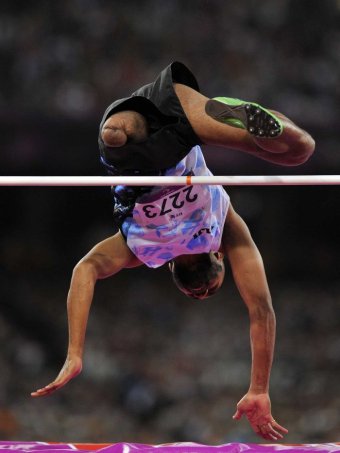
Iliesa Delana clearing 1.74 metres (Courtesy of Australian Broadcasting Corporation)

Fiji’s Iliesa Delana clearing 1.74 metres
(Courtesy of Australian Broadcasting Corporation)

Over the ensuing days I was consistently awed, humbled, and moved by what I saw of the Paralympics. Some of the highlights for me were the men’s F42 high jump (for single, above-the-knee amputees), and the blind long jump (I can’t imagine many things more terrifying than sprinting and jumping into space blind). The fact that the relay runners with cerebral palsy are required to exchange the baton within the same distance as the ‘able-bodied’ athletes should have made some of the latter, who failed to get the baton round the track, feel distinctly inadequate.

In the following months, aside from the BBC’s ‘Sports Personality of the Year’ awards, paralympic sport seems to have drifted back out of the public consciousness, perhaps to be largely forgotten until 2016. Happily for me, the lustre of last year’s Paralympics, and my associated perception of ‘disability’ sport, has recently been restored by the video below.

The story of CrossFit Rubicon, in Virginia, both rekindled my esteem for ‘disabled’ athletes, and helped to reset my perspective, such that ‘disabled’ (finally) feels like un entirely inappropriate word. The owner of the gym makes it clear that the words ‘handicapped’ and ‘disabled’ are not acceptable within the gym, and he describes those athletes working out there, who may be without one, or more, limbs as ‘adaptive’. This seems like a wonderful way of acknowledging the obstacles that people may have had to overcome to be turning up at the gym to exercise, without bringing any negative connotations. I’ve always had an uneasy feeling about the name paralympics – the ‘para’ sounds to me like it refers to paraplegic, defined in Wikipedia as: “an impairment in motor or sensory function of the lower extremities”. The idea of impairment seems completely misplaced in relation to both the athletes from last year’s Games, and the men and women at CF Rubicon.

So how’s this for an idea? The Adaptive Olympic Games, instead of Paralympic Games. I think that labels are often useful for clear communication, and find that many of the attempts in the last few decades to ‘reclassify’ things with less pejorative, or stigmatising language  serve mostly to make communication less clear. ‘Adaptive’ seems to admirably walk the line between clarity, and a description that doesn’t suggest ‘less than normal’.

The video’s not short (27 minutes) but deserves the “heart-warming”, “life-affirming”, “uplifting” cliches of many a Hollywood film poster. If you watch, I defy you to be unmoved by the spirit of these adaptive athletes.

Videos from Channel 4, and http://www.journal.crossfit.com

There’s not enough THRUSTING

In a recent conversation with a personal trainer, he made the observation that the components of functional training are: “pushing, pulling, lunging, squatting and twisting”. Similarly, Mark Sisson refers to PEMs (Primal Essential Movements): Squats, Pull-ups, Push-ups & Planks.

A search of the web for components of functional exercise offers up the following “4 Pillars of Human Movement” (coined by ‘fitness maverick’, JC Santana): Standing and locomotion; Level changes in the body’s centre of mass (e.g.. squats, lunges etc.); Pushing & Pulling; Rotation.

Dr. Richard A. Schmidt (author of various books on motor control and learning) defined the six basic human movements as: squat, bend (deadlift), lunge, push, pull and twist.

CrossFit’s Training Guide describes Functional movements as those: “…that mimic motor recruitment patterns that are found in everyday life….Squatting is standing from a seated position; deadlifting is picking any object off the ground.”

You’re probably getting the gyst, and may be wondering what this has to do with Pilates. Well, Pilates is about teaching movement, and hopefully we can all agree that it’s a much better idea to be teaching functional movement over non-functional (isolation) movements.

One of the common themes to these lists is the presence of hip extension, which the CrossFit Training Guide (yes, I’m preparing for my Level 1 certification…) describes as”..the foundation of all good human movement” adding: “..without powerful, controlled hip extension you are not functioning anywhere near your potential.” Perhaps as a result of what I’ve learned from regular sessions of CrossFit, I’ve become somewhat obsessed with hip extension, and aware that the great majority of people that I see, both in classes and in the street, seem to be lacking ‘normal’ hip function.

Surely this is where Pilates should be coming in, and spanking everyone into good function? There’s lots of hip extension in Pilates, certainly when it comes to the equipment repertoire, (not so much in the mat work), so what am I on about? Here’s the thing – we typically approach hip extension, in Pilates, from a static trunk position. Take leg springs lying supine, or feet in straps on the reformer – both great exercises for teaching people how to move at their hip joint without compensating with their spine – but not allowing full hip extension. This doesn’t teach us that much about being upright. In addition, legs move in relation to the trunk, and there is very little Pilates repertoire that requires us to extend our hip joints by doing the opposite (trunk moving in relation to legs, or both moving simultaneously).

It’s been amazing to me to discover, both in myself and other Pilates teachers, how common the inability to dynamically extend the hips seems to be. When I was first asked, from a standing position, to flex at my hips and my knees, keeping my trunk stiff (something like the appropriate position from which to pick an object up from the ground), and then extend at my knees and hips to return to vertical, I couldn’t seem to do it without adding in some kind of spinal articulation. The short version of that rather wordy sentence is: ‘ I couldn’t thrust my hips’. Wanting to consider myself moderately virile, that’s a pretty humiliating discovery.

One of the things that I consider it my job, as a Pilates teacher, to convey to the people I’m teaching, is how to avoid substituting moving with their spines for moving in their hips – yet there I was, incapable of avoiding that substitution, when asked to do an unfamiliar hip movement. This is the crux – do we, or does Pilates, do a good job of teaching people to effectively use their hip extensors when they’re not lying down?

It’s not as if there’s an absence of standing work in the studio (again, mat work is a different story), and maybe I just don’t teach enough of that repertoire – though there’s a lot more squatting and lunging involved in my classes than there used to be. Working from the basic premise that spinal articulation exercises are only to promote flexibility (thus facilitating stability), I wonder if we don’t tend to overemphasise articulating the spine, at the expense of efficient, powerful hip extension. You may argue that powerful hip extension (‘PHE’, from now on) isn’t a part of optimal posture, but I’m willing to bet that someone that has the facility for PHE has a reasonable alignment of their pelvis on the top of their legs. I was tempted to insert pictures at this stage, but it feels too objectifying. Suffice it to say that I was watching a promotional video (from a very well-known manufacturer of Pilates equipment) for a new piece of equipment. The model, who in fairness may not be a Pilates practitioner (though I know of a number of Pilates teachers whose shape is similar), had a pronounced angle at the front of her hips in standing, that speaks to me of lack of hip extensor activity – again, this feels like a common sight to me – generally more noticeable amongst women, but that may simply be down to clothing. In contrast, the elite female CrossFitters seem not to exhibit the same posture, but are ‘flatter’ through the front of their hips. Typical CrossFit movements: dead-lifting, squatting, kettle-bell swings, even gymnastic movements at speed like pull-ups and rope climbs, are dominated by PHE.

Could it be that we could help more people improve their hip function overall, and their posture specifically, by incorporating more standing (& lying) PHE?

For suggestions on how to achieve this (without doing CrossFit) please look out for a forthcoming project, that aims to help make Pilates easier, simpler, and possibly, dare I say it, more effective. Readers of this blog will be the first to know about it.

Rushing toward the end of the year (and having successfully negotiated the projected end of the world, unscathed) I’m probably not alone in contemplating resolutions for the next year. I’ve already made a commitment to be a ‘dryathlete’ for January –  no, NOT triathlete, my days of indulging in daft endurance challenges are behind me – the Dryathlon is a brilliant fundraising wheeze for Cancer Research UK, and will fit in nicely with my Whole30 plan.

I feel confident that I can go without alcohol for a month – I’ve done it before, just as I’ve done a Whole30 before (No: dairy, sugar, grains, legumes, alcohol. Yes: meat, fish, eggs, vegetables, fruit, nuts, seeds – hell yeah!), these are not radical changes, and don’t represent a significant challenge.

There are plenty of other instances when I’ve found myself not doing something that might represent positive change, and I’m trying now to evaluate my reasons. I notice immediately, casting my eye back over the previous sentence, that I ‘found’ myself not doing something – how’s that for disowning behaviour? On the whole, I’m not referring to very significant life changes, or behavioural changes, but rather the small things that might make a difference to a single day, and accumulate over time into more substantial benefit. For example, if I practiced skipping every day (I’m really crap at skipping – do not ask me to do a double under yet) I’m sure that I would get better at it relatively quickly. I do practice from time to time but, if it crosses my mind to do so, my usual gut reaction to that ‘practice-skipping’ thought is, at best “tomorrow”, and at worst “f**k it, I’m not in the mood”. There you are: compelling reasons not to be better… Why is it that those negatives seem so powerful? Perhaps it’s just me, and I’m inherently lazy. Yet, even as I write that, my mind is compiling a long list of evidence to support the case for my not being lazy, and I can’t accept that notion.

Along with the evidence from my own teaching practice, I hear plenty of tales from the coach that I see regularly of clients that are resistant to making small changes to their lives – small changes that might have a large effect. It appears, too, that the great majority of people who seek treatment of a specific problem from a physiotherapist or other health practitioner do not do the exercises they’re given as homework. I’ve come across this phenomenon so many times that the people that do their home exercises take me by surprise. Often, on suggesting dietary changes to someone with a chronic condition, or body composition goals, I’ve seen the mental shutters come firmly down. I’ve tried to give up on making such suggestions, as nutrition seems to be as contentious a subject as politics or religion, (but I still wonder… does anyone truly believe that they may become malnourished if they don’t eat bread for a few weeks?)

I’ve strayed a little bit from the point – who am I to say that dietary changes would necessarily be positive? I don’t limit myself to failing to engage in physical challenges that would be good for me. How often have I travelled on public transport, with the option of either reading something, or playing some stupid game on my ‘smart’ phone, and chosen option B? I’ve not read any books of the “7 habits of highly successful…” ilk, but if I did perhaps I’d learn that one of them is that, faced with that internal “shall I make the small effort required to do X, or not bother?” dialogue, really successful people will typically make that little extra effort. It may well not be my destiny to be really successful, so I’m not going to worry about that, but I am resolving to make the negligible effort to do something useful with my available time, rather than taking the pointless option. It seems like such a simple thing, yet I know it will be a hard resolution to keep. I just need to hold fast to the truth that there are no compelling reasons not to make positive changes, or to take positive actions: “later”, “f**k it”, “tomorrow”, “I can’t be bothered” certainly will not qualify. As Frank Forencich writes in ‘Change Your Body, Change The World‘: “When it comes to making substantive changes to minds, bodies or lives, easy doesn’t work. Easy doesn’t transform….Easy doesn’t save time; easy is a waste of time.”

The thing with new year’s resolutions is that they always seem to be finite, like my dryathlon will be. The real challenge, then, is to make avoiding the easy path into a life strategy, rather than a new year’s resolution.

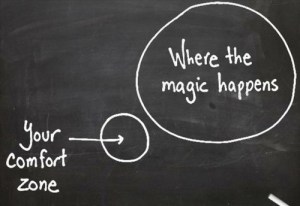
where-the-magic-happensImage courtesy of blog.unstash.com

One doesn’t have to search very long on the web to find critiques of CrossFit, there are many, and many of them valid. This seems to be largely down to the fact that it allows (fosters, perhaps) an obsession with the number of ‘reps’, or the time taken to do the workout, over practicing good technique. In essence, the idea of learning skills and then challenging one’s ability to remain skilful under duress is a really interesting idea. If you read any of the CrossFit training literature the same message is frequently repeated – form is everything. There is not an official edict that says “Finish the workout at all costs, never mind your technique”. Unfortunately, this point seems to have been missed by a number of certified coaches who fail to scale workouts appropriately for different people, and fail to teach the imperative of proper technique. CrossFit then earns a reputation for being dangerous, and causing injuries.

I will agree with anyone who suggests that becoming a certified CrossFit coach should be a little harder, but the arguments against Crossfit based on poor coaching are the same as the Daily Mail “How pilates can make your bad back worse..” type articles. Once you get passed the eyebrow-raising headline, the article essentially says ‘if you have a poor teacher, things may not work out too well’. As another blogger (whom I’m afraid I cannot credit, sorry) put it: “Crossfit is not dangerous. Bad coaching is dangerous. Poor movement is dangerous. Ego is dangerous.”

Enough about the problems with/for CrossFit (‘CF’ hereafter). This is about why I love it.

Maybe teaching Pilates for as long as I have (coming up to 10 years) had made me slightly jaded. The pressures of running a business during one of the longest recessions of my lifetime might have played a part too. Before I discovered CF I was still a firm believer in the possibilities of Pilates to work, something like magic, in transforming the lives of people with chronic pain, and other physical challenges, but I had fallen out of love with Pilates, a little. (That may also have something to do with my perception of the dominant trend away from building strength and fostering empowerment in UK Pilates teaching). In stumbling upon CF, and recognising their common threads, I’ve rediscovered my original zest for Pilates.

Aside from the philosophical similarities with Pilates that I referred to here, CF consistently teaches me about myself, in a way that no other discipline or type of exercise has. I’ve run marathons in the past, and done long training runs as part of the preparation, and I certainly found myself looking inward then. It’s probably true that I’ve suppressed some of the memories of what I may have seen. What I remember was the struggle to find a way to overcome physical fatigue, and some pain (and, to be fair, the stakes were high – nobody wants to train for 6 months to run a marathon, and then fail to finish). It also took a long time – both the activity, and the recovery. The soul-searching that I might do during a CF workout is different, and it’s a more humbling experience. On a number of occasions I’ve wanted to give up on finishing a workout, not because I was too physically tired to continue, but because my mind was telling me that I’d had enough. It was quite a surprise for me to discover that (with the motivation of, for instance, seeing my wife carry on when I wanted to stop) I’m capable of pushing myself beyond my previously perceived limits, which opens up a variety of new horizons.

There’s a camaraderie in doing CF workouts with others that I’ve never found in Pilates – perhaps because you’re more likely to be exploring the limits of your capacity. I’ve seen plenty of official marathon t-shirts with slogans that imply that being a marathon-finisher puts you in an elite group. Whilst the sentiment resonates with me, I also find it somewhat obnoxious. At the same time, there’s something about sharing the experience of a workout like Diane (Deadlift 225 lbs, Handstand push- ups, 21-15-9 reps, 3 rounds for time), especially doing it together, that forges connections. (CF is widely recognised for its community-building aspects).

Kristan Clever’s Diane at the 2012 CrossFit Games regionals

If you watched the video, there’s a clue to the humbling element of CF – not only is my ‘Diane-time’ about 10 times slower than the woman featured, it’s also slower than my wife’s (who of course has minimal interest in how long it took). It’s a curious feeling to set about something, believing myself to be bigger and, therefore, stronger, but to find that my wife is actually stronger than me. She’s a very accomplished Pilates teacher, and I admire her teaching a lot, but it doesn’t compare to the feeling of witnessing her steel herself, and push back the limits of her physical capability. For her too, more often than not, it seems that it is pushing past mental boundaries, that extends the physical ones. I’m finding it hard to adequately describe – there are moments at the end of a workout when, gasping for breath, I see deeper into myself than I have done during other physical pursuits. I wonder if it’s too much of a leap to suggest that it helps me make a connection to my primal self – the one that was born to run and hunt and struggle for survival…

Your Health

December 4, 2012 — Leave a comment

I heard recently that the NHS in the UK spent £8.6 billion on prescription drugs last year. Four of the top five most prescribed drugs are used to treat ‘lifestyle diseases’ – cardiovascular disease, diabetes etc. More recently I heard a news item about a suggestion that patients needing treatment for those kinds of illnesses should have to pay toward their treatment, on the basis that their condition is self inflicted.

All arguments about the practicalities of implementing such a system aside, why does it seem that many of us are willing to accept that ill health is inevitable, and beyond our control? There are plenty of scholarly books/articles written on the subject of ‘civilisation’ being our downfall as a species. The further we get from our origins as a species, the more prone we become to physical degeneration. The very things that make our lives easier are the things that make us more prone to sickness. As Frank Forencich writes (in ‘Change Your Body, Change The World‘): “by engineering our environment to take care of our every physical need and desire, we have simultaneously disempowered ourselves and bought disease upon our bodies.” (It’s perhaps worth noting part of his solution: “..we need to find creative and interesting ways to make our lives harder, in some cases much harder.”) Have our disconnection from our origins, our comforts, and medical interventions allowed us to believe that ill-health is somehow a natural state?

Since I began writing this, a few weeks ago, I’ve heard a few more snippets of information that have fed my thoughts on this subject. I heard a trailer for a radio programme concerning research conducted on animals, to investigate treatments for Alzheimers, diabetes, and obesity – estimated to cost the UK tax payer £35 billion/year. Separately, listening to episode 160 of The Paleo Solution podcast, I learned why ‘low GI’ foods are a hindrance to losing body fat. (It’s obvious really, and I should have figured it out before – our bodies need our blood sugar level to drop below certain levels in order to trigger the release of fat as an energy source. If you eat food that will specifically elevate your blood sugar level over a prolonged period you will be inhibiting your bodies ability to mobilise fat for energy).

The trailer for the above radio programme described scientists using their experiments on mice to find “treatments” for these diseases. Treatments that perhaps might be more effective than recommending diabetics eat low GI foods, one hopes…. But why ‘treatments’? It feels like an acceptance of the inevitability of these diseases to set about developing drugs (procedures, perhaps?) to treat them. If we don’t accept that our bodies have built in obsolescence, or that it’s ‘natural’ to become sick (please don’t!), then there has to be an alternative. How about honestly facing up to what behaviours lead to these problems, and giving people advice and support to change these behaviours – maybe then we’d find that it’s all the ‘treatment’ that is required.

Maybe everything comes back to money. There are so many vested interests in making us believe that we do not have control over our own bodies, and health – All those industries: the media; pharmaceuticals; food; ‘health food’ & supplements; fitness etc. This all adds up to a potent mix of misinformation, and contradictory information, that may well leave most of us with our heads spinning, or the impetus to bury them in the sand. In terms of diet alone – ‘fat is bad for you’; ‘carbohydrate makes you fat’; ‘saturated fat is very bad for you’; ‘red meat causes cancer’; ‘sugar is bad for you’; ‘reduce calories to lose weight’; ‘everything in moderation’; ‘calories don’t matter’ – not to mention all the miracle healing foods: cranberries, goji berries, acai etc. If you face serious struggles with body composition there is a minefield of advice in the media, of questionable value. And then in the supermarket: ‘fat free’; ‘no added sugar’; ‘low GI’; ‘high in fibre’; ‘heart-healthy’; ‘wholegrain’; ‘one of your 5 a day’ (funny that fruit and vegetables never get labeled with nutrition information… If you’re buying a packaged food item that makes this claim, I’d be deeply suspicious of its nutritional value).

This could become a tedious list very easily, so I’ll try to change tack. In short, the barrage of advice and consumer pressure all seems to add to a collective sense that we are somehow programmed to malfunction, and that the answer is either pharmaceuticals, surgery, or buying the right food product. This isn’t helped by government advice, both in the UK and the US, perhaps the rest of the developed world too, that is patently unsuccessful. How many people are following that advice and becoming fatter, or sicker? The lack of declining obesity rates should answer that.

In pursuit of an overall project of owning responsibility for our own health, along with remaining physically active (as I imagine you all are) – Pilates; lifting weights; walking; running; climbing; jumping, and all of that good stuff, here’s a challenge for you (I’ve just decided it’s called the “Don’t Play With My Food” challenge):

For the next 7 days only eat food that has not been packaged in plastic, tins, polystyrene or cardboard boxes (glass is allowed, as are cardboard trays for fruit, eggs etc.). The beauty of this is that you won’t need to look at ingredients lists, or nutrition information – you’ll be eating real food that doesn’t require labelling. Please let me know how you get on via the comments…

The answer is “Yes”.
The question is one of my unfavourites, in a Pilates context – “What’s the breathing for (insert exercise name here)?” The answer is most definitely, “yes (you do need to breathe)”.
Of course, Breathing was one of Joseph Pilates’ fundamentals for his method. Attention to one’s breath can foster greater mind-body connection, and sense of ‘centre’ (presentness, if you will). And it’s also true that there may be a specific breathing pattern that will facilitate some movements, especially during the warm-up phase of a class. Equally, teaching someone ‘posterolateral costal breathing’ may encourage more mobility in their thoracic spine, and allow for greater control of lumbar spine stability. Undoubtedly valuable assets in Pilates, and life generally.
Not to mention that breath focus can be a powerful tool for relaxation. I like it if I’m having trouble sleeping – hopefully it’s a given that sleeping and a Pilates class are not complementary activities.
So, to clarify, I’m not trying to suggest that breathing should never be mentioned in a Pilates class. There are plenty of arguments for referring to it, especially in the early stages of a class.

My frustration arises when focus on breathing starts to hinder movement – because Pilates is fundamentally a movement discipline. I’ve seen many instances (back when I used to cue breathing patterns a lot) of people that were new to Pilates paralysed by confusion over when they’re ‘supposed’ to breathe. I’ve also seen teachers in training practicing what should be flowing movements, on the equipment, but stuck in space whilst they take the time to breathe in, so that they could then do the next part of the movement on an exhalation (because that’s how you’re ‘supposed’ to breathe…)

Again, I can think of good reasons for mentioning breathing during a Pilates class. When I first started teaching, cueing breathing was like a mantra that helped me remember the choreography of some exercises (Now I imagine that I can suggest a harmonious rhythm of movement and breath by the tone of my voice). Some people may need reminders to breathe in order not to grip and brace; other reasons I’ve mentioned above. All well and good in their place.

I’ve heard from teachers, who’ve trained with first generation teachers, that Pilates himself was only specific about breathing patterns with a couple of exercises, and otherwise simply wanted people to inhale and exhale fully. He surely wouldn’t have wanted anyone to focus on breathing to a particular prescription at the expense of enjoying the movement. If I try to rank the things that I believe are fundamental to Pilates, shortly after movement comes personal responsibility – and here’s my other beef with constant cueing of breathing: the more control the teacher assumes, the less their clients are likely to feel responsible for their own well-being. If the impression is created that particular movements have to be accompanied by particular breathing, will people be able to remain robust in situations that don’t allow time to consider when to breathe?

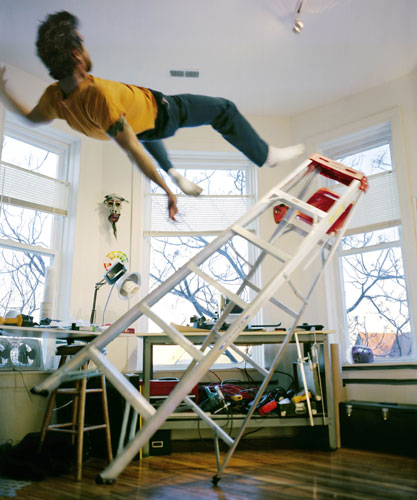
Photograph: Kerry Skarbakka/Barcroft Media

“Damn, should I land on an in-breath, or an out-breath?”