Many different people have tried to find their own niche in the world of Pilates, fusing with, or adding elements of other disciplines; or perhaps trying to make their classes specific preparation for another sport, or activity. (Yes, I have seen ‘bikinilates’ advertised). I think this may be missing the point, but more of that later.
There are also signs that some teachers feel that Pilates is not enough in itself – that it needs to lead to something more – and I’d number myself amongst them. One of my teachers and trainers early in my Pilates career, James d’Silva, has created the Garuda Method, which was advertised at one stage along the lines of “where Pilates ends Garuda begins”. (One might debate the idea of Pilates ‘ending’ somewhere, I can imagine some sticklers for tradition and the original work rejecting the idea wholesale.) For me, CrossFit begins, not where Pilates ends, but overlapping, and happily coexisting. Perhaps this is the time to answer the ‘What is Crossfit?’ question.

The answer is: “Constantly varied, high intensity, functional movement.” (…”Functional movements are universal motor recruitment patterns; they are performed in a wave of contraction from core to extremity; and they are compound movements -i.e. they are multi-joint.”), from ‘Understanding CrossFit’ by Greg Glassman.
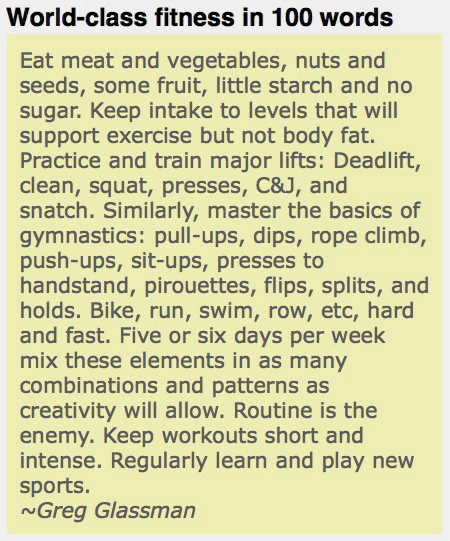
Greg Glassman is the creator of CrossFit and, like Joseph Pilates, a maverick figure with a solid conviction that what he is doing is valuable and should be disseminated as widely as possible. The strongest link that appears to me between the two disciplines is in the intended outcome. My understanding has always been (though I can’t find it in either of Pilates’ books, I’ve heard it from first generation teachers) that Pilates’ intention, after years of practicing a variety of different disciplines, was to create an exercise program that was non-specific. In other words, his exercises were for overall fitness, in readiness for whatever challenges life may bring. More recently the concept of GPP – general physical preparedness – has emerged, and this is central to CrossFit methodology. One trains a wide variety of activities in order to be prepared for as wide a variety of potential challenges as possible. Glassman seems to be fond of the idea of preparation, in as much as one can, for the “unknown and unknowable”.

I cannot think of a single Pilates exercise that works a joint or muscle in isolation, and the idea of a “wave of contraction from core to extremity” sounds exactly like Pilates. Joseph’s own principles for his method were: breathing; whole body movement; and whole body commitment. I haven’t come across anything in writings about CrossFit specifically related to breathing, but it is very much to do with whole body movement, and total commitment. In a divergence of the two methods, Pilates prescribed his exercises lying or sitting to “relieve your heart from undue strain” (from ‘Return to Life‘). This is one of the areas that leaves some of us feeling that Pilates alone is not enough, and CrossFit workouts certainly put significant strain on the cardiovascular system. (Whilst I think the tired “no pain, no gain” slogan is a crass one, I believe it’s true to say that you can’t have adaptation without stress.) In this context CrossFit also profoundly effects breathing, and full use of lung capacity. Anyone who has tried high intensity exercise will most likely be aware that breathing to full capacity doesn’t require cueing…

The video is self-explanatory, if you jump straight to 3:20 you’ll see how well her lungs are functioning. (In case anyone is concerned, the video above is of an elite athlete performing at an advanced level. This does not represent the kind of work that beginners would be asked to do.)

Many Pilates exercises involve maintaining a stable trunk (spine) whilst moving arms and/or legs. Typically the weight of the limbs and their movement act as a challenge to that stable trunk position. Similarly, one of the fundamentals of many CrossFit movements is ‘midline stabilisation’ – the idea that, particularly under load, you keep your trunk stiff, and move from your hip and shoulder joints. The only difference between the two is that Pilates doesn’t add load to the same degree. Had he been faced with current levels of osteoporosis, for instance, who’s to say that Joseph wouldn’t have favoured picking some weight up?

Another element that CrossFit and Pilates share is an emphasis on precision. Sadly, if you make only a cursory search of the internet, you will find plenty of alarm expressed over the dangerous nature of some CrossFit workouts – and, indeed, plenty of YouTube video clips of people doing very demanding movements with eye-wateringly poor form. Just like so many articles about Pilates being bad for you, I don’t believe that this is a reflection of CrossFit, but one of either poor coaching, or simply poor performance. Just as Pilates insisted on his exercises being done with precision, both videos of training seminars, and conversations with Crossfit luminaries make it clear that ‘Form is everything’. In fact, one of the particularly interesting challenges for me is that CrossFit workouts ask questions along the lines of: ‘We know that you can lift that heavy barbell off the floor with good form, now can you do that multiple times, quickly, with good form? And how about keeping your form and doing that when you’re gasping for breath because you’ve just been doing another challenging movement at speed?’
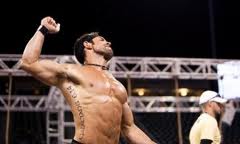
Rich Froning – ‘Fittest Man on Earth’
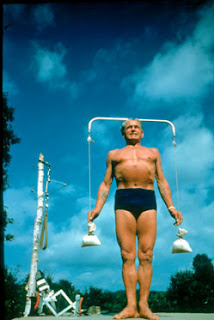
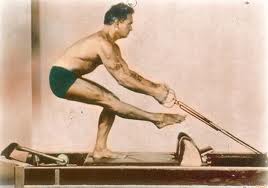
Joseph Pilates – tattooed health visionary

What else is there to lead me to the conclusion that Joseph Pilates would have embraced CrossFit? Followers of both methods will attest to the remarkable transformations in body composition, energy levels and overall well-being that are there for the taking. He didn’t seem to be interested in  great analysis of his method: one of my favourite Pilates quotes (as recounted by Ron Fletcher) is, in response to a question about the purpose of an exercise, “It’s for the body!”. CrossFit celebrates becoming faster, stronger, more agile – and does not dwell on the exact mix of muscles required. Perhaps most significantly Joseph, tattooed as he was, would have fit right in with a great number of CrossFitters, for whom ‘ink’ seems de rigeur.

I’m convinced that Joseph would have been involved in a movement like CrossFit, had he the chance. The truth is, while I couldn’t bring myself to give the post this heading, I believe (with apologies) that ‘CrossFit is the new Pilates’.

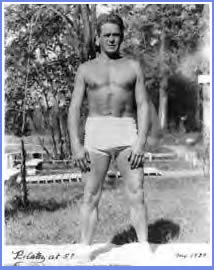
IT WORKS.

If you can maintain a ‘whole body’ approach, and avoid getting bogged down in complexities, but just get on and do it, Pilates really works!
An osteopath that used to work closely with a studio that I teach in would frequently refer his patients to the studio. Rather than giving them instructions for specific things to work on, he would advise them to “just do Pilates”. Presumably he knew that nothing extra was required.
I know, as a teacher, it’s easy to get caught up in the minutiae, or to become engrossed in trying to ‘fix’ a particular issue in a client. Of course, Pilates is a holistic practice. And the ‘edge’ that we may have over some medically trained practitioners is exactly that.

We could probably debate for ever how much Joseph really understood, on an anatomical or bio-mechanical level, about what he was doing. As I’ve asserted previously on this blog, whatever progress we think we’ve made since the 1940s, Pilates understood movement. This allowed him to devise a whole array of effective exercises, along with some foundation principles, that helped people to pattern good movement in their bodies. I think I tend to take this for granted, since my ‘Pilates miracle’ happened a good few years ago now. This miracle was going to a studio, at first once, and then twice a week, and working through a routine – not strictly the same exercises every time, but a consistent warm-up, and then trying to address my whole body whilst applying the fundamental principles (even before I knew that this was what I was doing).

Since then I’ve had plenty of opportunities to witness clients experiencing revelations about their own bodies, discovering that they can manage pain much more easily, increasing their range of movement and all the other things that we might expect from Pilates. More recently I’ve had a stronger reminder of Pilates’ elegant simplicity, in the transformation of one of my wife’s students. Perhaps one of the reasons that I noticed something particular in her case is that, while she has a history of various injuries, they were never the ‘object’ of her classes. When she started taking studio classes there was definitely room for improvement in how she stood, and the front of her body showed more muscle development than the back (We have shared a few laughs since at my early attempt to express, delicately, “your buttock should be more distinct from your thigh”).

Six months or so on, her transformation has been remarkable – the change in her posture is easy to see. Has she been following a particular program to address this; or having ‘new’ exercises invented for her? Not at all. What she has done is attend classes two or three times a week, been diligent about working on doing some mobility work on the joints that needed it, learning the exercises/movements that are especially appropriate or valuable for her, and getting on with doing Pilates.

And it’s been successful.  

If you can maintain a ‘whole body’ approach, and avoid getting bogged down in complexities, but just get on and do it, Pilates really works!

How did cheap and dirty become delicious?

(This post owes a huge debt to “It Starts With Food” by Dallas and Melissa Hartwig – buy it for yourself, and for everyone else that you care about…)

Millions of years before food scientists existed, our ancestors developed ways of helping them distinguish, and then remember, between good sources of nutrition, and bad. Sources of quick energy tasted sweet; sources of dense calories tasted fatty; and salty tastes were a sign of foods to help hydration, or maintaining hydration.

The net result: we are ‘hard-wired’ to seek out sweet, fatty and salty foods. It’s worth mentioning that the fruit our early ancestors ate was probably a fraction as sweet as the fruit we enjoy – we’ve had hundreds of thousands of years to select the sweeter mutations and make them dominant in their species. Fat sources would have been unprocessed, and salt simply found in more sodium-rich foods.

Everything our ancestors needed to nourish themselves was available in nature.
We all know that food can elicit an emotional response, and if our brain is receiving the signals that we’re being nourished it will release dopamine and endorphins. Thus, our ancestors would not only be nourished, but would feel good too.

Fast-forward to around ten thousand years ago, and our less-distant ancestors developed agriculture – allowing for production of food by a few for many to consume, and the potential to store food for long periods (never mind, for now, that this food was less nutritionally dense than more traditional hunted/gathered food).

I only mention agriculture because it allowed for all sorts of development, not least the study of sciences. Not needing to hunt or gather, some of those ancestors of ours had the time to indulge in more lofty pursuits. So, in more than one sense, agriculture gave us food scientists.

Fast-forward again, this time to the middle of the twentieth century, and manufacturers of food products had the knowledge and facility to exploit our hard-wiring to generate masses of profit. All that was necessary was to make food products that were sweet, fatty, or salty, or (ideally) a combination – doughnuts, potato crisps…..

These food products tasted amazing, and ticked the boxes that our DNA was programmed to recognise as nutritious input.

Here’s the best part, and the answer to the opening question. Real food (animals, fish, vegetables, fruit) can be costly to come by, might require a lot of looking after, careful handling and so forth. Those crops that lend themselves to an industrial scale of production (grains, corn, rape, soy, sugar beet etc) do so because they’re much less complicated they can be mechanically harvested and require minimal care in their handling en route to processing. Therefore they’re relatively cheap, and never mind that they’re a poor source of nutrition, the food scientists have an array of additives, or means of manipulating them so that they can be turned into ‘super-normal’ (super = beyond) tasting sweet, salty or fatty foods – way beyond what nature could conceive.
What effect does that have on our emotional response to food, mentioned above? Natural/real food, with its modest level of sweetness, fattiness, or saltiness, rapidly loses the ability to get our brains excited enough to release those feel good chemicals. How could it compete with ‘super’ ‘Frankenfoods’?

Have a look at the ingredients of, say, a packet (tube?) of Kellog’s sour cream and onion Pringles:

Dehydrated potatoes, vegetable oil, vegetable fat, rice flour, wheat starch, sour cream & onion flavour(hardened vegetable fat, onion powder, sour cream powder, dextrose, flavourings, sugar, sweet whey powder, lactose, milk protein, potato starch, food acids:citric acid, lactic acid and malic acid), emulsifier:E471, maltodextrin, salt, modified rice starch

Might any of those ingredients look like food? Sugar and salt, probably; dehydrated potatoes, maybe; modified rice starch….?

Where does this stuff come from…..

“Disc centrifuge for vegetable oil refining are widely used in continuous degumming, neutralizing, dewaxing, and washing of vegetable oils, such as peanut oils, colza oil,palm oil,oliver oil,sunflower oil,cottonseed oil,corn oil etc.”

Makes for an interesting contrast with ‘first cold pressing’, no?

                                                                                                               Modified starch making machine                            For more on rice starch click here

Mmmmm, ‘spray process’.

(It was an eye-opener having a brief search for suitable pictures, especially if one is viewing them from the ‘food’ & ‘industrial’ are two words that don’t go together perspective)

Perhaps this was my subconscious at work – I thought of Pringles as an example before I remembered their advertising strap line: “once you pop, you can’t stop”. They make a virtue of the fact that their food product is addictive…. Plus, it’s cheap to produce, dirty (in that, if shown them all individually, you probably couldn’t identify any of the ingredients, apart from sugar and salt), and (doubtless, to many) delicious.

Why would you want to eat real food ever again?

If that’s what we’re offering then we’re setting the bar too low.

Many people take up Pilates and find that it opens up new vistas of possibility that they never imagined. I’m very lucky in that, having started Pilates to address a lingering back problem, I discovered that I’m capable of physical accomplishments that I’d never imagined before I injured my back. Pilates meant that I stopped identifying myself as someone with a back problem; never have problems putting on my socks; never worry that an uneven pavement will send me into spasm; and don’t make stupid mistakes because I’m distracted by endless nagging pain (stupid mistakes, sure, just not ones I can blame on pain…) It also provided the doorway to me taking up yoga, having classes in circus skills, and weightlifting.

This good fortune informs my entire approach to Pilates, based around the idea (possibly expounded upon previously) that it is a means to doing other activities with greater ease. If I’m feeling glib I’m inclined to say that Pilates is for being better at living.

Pilates is a means to an end, not an end in itself.

One of the pleasures of my job is hearing clients report that, for instance, their golf swing has improved, or that running feels less of an effort, or that they can pick up their grandchildren without fear of injuring themselves. Hopefully they are opening their eyes to more and more possibilities.

Unfortunately, there are plenty of people who take up Pilates for one of the usual reasons – chronic back/neck/shoulder/hip/knee pain – and, finding that it helps, decide that Pilates is a miracle that they must keep in their lives forever, and do no other form of exercise. Anything other than Pilates (not being a miracle) might cause a relapse into the world of chronic pain. Being pain-free is clearly great, but is it enough? Is pain-free the same thing as thriving? Surely not. Pilates for taking control of one’s life – YES. Pilates for feeling indestructible – YES. Pilates for freedom – YES. Pilates for fear – NO. Pilates for dependency – NO.

I love the idea of an ‘ancestral’, or evolutionary template for living – are we made to be pain-free, or are we made to be amazing?

It’s impossible to force people to have aspirations, and I can’t pretend that I would ‘sack’ any client who’s not embracing all the possibilities that greater strength, control, body awareness, and so forth, may offer. If a client believes that they have hurt themselves doing a particular activity – running, tennis perhaps – I hope that they will be motivated to resume that same activity, and this is what I believe Pilates has to offer. I suspect that running relatively high mileage (combined with poor technique, awareness etc.) contributed to my back injury, but I still loved running. It was a liberating discovery that I could apply what I learned from Pilates to running, and not worry about my back at all. Fear, and the experience of chronic pain, can be hard things to overcome, and I would hope that Pilates could be integral to anyone returning to all/any activities feeling better and stronger than they had before injury. Again, we cannot force aspirations onto our clients, but perhaps we can play a part, by example ourselves, or with the example of others. Do we encourage anxiety by prohibiting particular movements, or activities? Or do we open the door (with appropriate scaling of exercises) to the possibility of more? A physiotherapist friend, Warrick McNeil, says: “There are no contraindications, there are just movements that you’re not ready for yet.” I love this attitude because it can be so liberating, and that’s one of the beauties of Pilates. One might argue that someone with a spondylolisthesis should never be doing high load back extensions – I’ve seen experienced Pilates practitioners with spondylolisthesis doing a full Swandive over the ladder barrel – because Pilates has given the strength, control, and confidence to manage such movements. (Experience says it’s necessary to spell things out: this was after years of Pilates, not weeks or months).

If you’re a teacher, will you encourage your clients to be satisfied with walking, instead of crawling; or will you show them that flying is possible?

The abridged version: Okay, Pilates has helped you to feel mastery of your body – now go out and do fun, energetic, perhaps even amazing, things.

As may have been previously mentioned: It’s really safe.

I’m slightly disappointed to be revisiting this subject quite so soon, yet a couple of tales that I’ve heard recently of people ‘being injured’ in Pilates classes finds me dragged back to the subject. Paraphrasing a quote I’d noted down in relation to writing on another subject: “Pilates is not dangerous. Poor teaching is dangerous; poor movement is dangerous; ego is dangerous.” I can’t answer for how many people are out in the world calling themselves Pilates teachers and making poor/irresponsible decisions that may put their clients at risk – yet I suspect (and hope) that there aren’t very many. (Teaching that is less than entirely effective is, I suspect, very much more likely than teaching that is dangerous).

Injury: physical damage, or hurt (according to my dictionary). In what context might one be injured? I’d suggest a number of ways, such as: mishandling equipment, or being caught in the way of someone else mishandling equipment; collision with, or assault, or even ‘adjustment’ by someone else; continuing with an activity that your body/brain is signalling you should stop; failing to understand, or follow instructions that are given to you.

I like to attend a weekly intermediate/advanced level yoga class. When I started I had only limited experience but I’d heard good things about the class, and the timing suited me. So the first thing that I did was tell the teacher about my yoga experience, and ask his permission to attend the class. If I try to do a full backbend, and push through something that doesn’t feel right, it’s entirely my responsibility. If I attempt a handstand without properly watching the demonstration because I think I already know it all, and then strain my shoulder, it’s inaccurate to say that  I’ve been injured in a yoga class, it’s my ego and poor practice that has caused the injury.

By the same token, to say “I injured myself in a Pilates class” carries with it the implication that Pilates was somehow responsible for the injury. Were you assaulted by the teacher? Did a classmate drop some equipment on you? Could it be more likely that your ego persuaded you to take on a movement that you weren’t ready for? Or that you did something (through lack of concentration, or poor understanding, or misplaced zeal) other than that which you were advised to do?

I think I may have written this previously – I don’t believe it’s possible to hurt yourself doing Pilates. It’s the not-doing-Pilates that carries a risk, especially if you’re in a Pilates class.

There are probably as many explanations for what Pilates teaches as there are teachers, or practitioners. One of my favourites is personal responsibility. In affecting the way that our clients relate to their own physical selves, I hope that we can teach them that their health is something that they are in charge of. There may be an array of medical professionals and therapists who can help us to manage our health, but in the end, only we are responsible for our own bodies.

It’s really safe.

No, honestly, it is really safe.

I’ve been regularly surprised by conversations with fellow Pilates teachers in which safety concerns over a variety of exercises have been raised. I made the “it’s really safe” assertion in a recent conversation with another teacher  who immediately baulked at the idea and suggested a number of exercises or positions that she felt might put a client in danger. Perhaps we need a caveat, or qualifying statement here –

If the client is taking responsibility for themselves, and if the teacher isn’t making reckless decisions, Pilates is really safe.

To paraphrase a recent Daily Mail article (‘Pilates can make your bad back worse’), Pilates may be bad for you if you have a poorly trained, or irresponsible teacher. No real surprises there – I can think of few physical endeavours in which that wouldn’t be the case.

In another Mail Online article (‘Beware the Pilates Pirates’) I read that: “Enthusiasts often injure their sacroiliac joint….The bottom lumbar vertebra is another common weak point.” Now, the main thrust of this article is, again, that anyone thinking of taking up Pilates would be smart to check on the teacher’s qualifications, which I’m all for. At the same time, there is a down-side that the seed of an idea may be planted that Pilates is something to be fearful of – never mind that I’ve been teaching for nearly a decade and am entirely unfamiliar with those supposedly frequent sacro-iliac injuries.

What can really restrict the potential benefits that practicing Pilates may bestow on people, is teachers reinforcing the idea that it’s a potentially dangerous activity. In much the same way that focusing on a client’s injury or weak point can serve to hold them back, giving clients the notion that they are unsafe seems highly likely to hold them back. I’ve lost count of the number of times someone has told me that teacher X has told them that they shouldn’t move in a particular way, or do a particular exercise, for fear of hurting themselves. To labour the point with specifics, I’ve heard truly bizarre stories such as a whole room full of clients being warned against holding a soft ball between their knees during a shoulder bridge, for fear of knee dislocation.

Is there something about thorough training in how to deal with, or contraindications for, a wide array of injuries, conditions and ‘special populations’, that can make us fearful of moving our clients? This feels like a tricky argument to make, since not taking care is clearly not an appropriate course of action, and ignorance is still less desirable. Yet how many of our clients will, in the course of their daily lives, perform movements that look more complex/unstable/loading than most ‘safe’ Pilates repertoire?  I suspect that too much emphasis can easily be placed on what could go wrong whilst exercising, and then we risk embedding fear in our clients, thus holding them back. The result is, perhaps, that people challenge themselves more in their ‘normal’ activities than they do in class – in which case, how are we helping them? It’s a bit like not encouraging people to do high load (‘threshold’, if you prefer) exercises because they haven’t fully mastered the low load exercises they’ve been taught – it doesn’t help them to be stronger in a particularly applicable way.

I have comprehensive insurance as a Pilates teacher, with a maximum payout of £5000000, and it costs significantly less than £100 per year. What does this tell us? Pilates is a safe activity. One of Kelly Starrett‘s definitions of functional movement is that “You come out unharmed”. As Pilates teachers, what are we doing if not trying to teach functional movement? I find it very hard to believe that anyone injures themselves doing Pilates – if such a claim is made then I suspect that it’s closer to the truth that an injury occurred during a Pilates class, while the person was not doing Pilates but instead, some wonky imitation of it. Is this their teachers fault? If they allow their clients to endlessly do wonky imitations of Pilates without verbal and /or tactile cues, and explanation, yes; if the client has ignored/failed to hear advice against such poor movement then the responsibility for their body and any injury lies squarely with them.

I started writing this some time ago and things (Olympics, for example) got in the way of writing for a while. During a conversation with my wife last night (after she’d spent the day teacher training), I had a moment of clarity – one of those ideas that was lurking in the back of my mind and suddenly became crystallised: Moving is not dangerous, not moving most definitely is.

All that lying down.

The claims made for Pilates’ benefits are myriad – it is astonishing that it can, apparently, offer the wide array of outcomes that one can read about on the web. Before I give the wrong impression, let  me be very clear (again) that I’m an enthusiastic advocate of Pilates, and have both personal and professional experience of the remarkable changes it can help to make in many people’s lives.

One website I visited contends both that Pilates can help prevent osteoporosis, and that it will not stress joints. (Perhaps I’m wilfully misinterpreting, but surely stress is what promotes bone growth…?) This seems to relate directly to what, I would contend, is a flaw in Pilates (as it is often offered to the public). How much time do people spend lying down, both in mat and equipment classes ?

Revisiting some of those frequently listed benefits: How do we improve posture? We make muscles work more effectively (dare I say stronger?). How do we improve ‘core strength’? The same answer. How do we relieve back pain? Isn’t it the same answer? And helping prevent incontinence? Surely the same again. Of course there is a component of lengthening and releasing overworked muscles, and we can’t overlook working on breathing patterns, and developing physical awareness. All of these things are adaptations, and one of the most potent ways of triggering adaptation is stress, as expressed in the concept of hormesis. Explained as follows on www.innovitaresearch.org, a website offering information related to ageing:

In response to stress, an organism is expected to go through three distinct phases: alarm reaction, resistance phase, and exhaustion phase. According this schema, the adaptability can be developed during the resistance period. This notion is in line with the evolutionary view on the survival for the fittest theory, for which the only possible way to attain the survivability is through the organism’s metabolic and defensive adaptation to deleterious stress.”

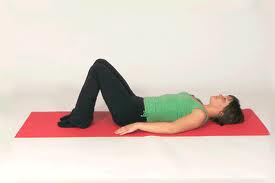
 There are excellent reasons to spend some time in a Pilates class with the participants lying on their backs – using the floor as feedback for developing postural awareness, safely introducing loading of the trunk stabilisers, and introducing loaded hip extension, for example. Occasionally I set out to teach a mat class without any lying down, but generally speaking any mat class I teach will involve a bit, for those reasons above, and a few others. At the same time, many mat classes seem to incorporate a lot of lying down, and I’ve come across many people who are regulars at a Pilates studio and in the habit of spending 45 minutes of a 75 minute class lying on their backs (maybe a foam roll too, for variety..), before then moving to the reformer to do more…lying on their backs.
The trouble with lying down is that it’s not a very useful position from the point of view of affecting adaptation, since we can’t do much in the way of stressing bones, muscles etc. If, for example, someone is quite kyphotic, or has protracted shoulders, they may be able to find a better position, with the help of gravity, whilst lying down. What happens when they stand up? If we are to help people understand and maintain good/ideal/optimal (or insert your own referred adjective) upright posture then we need to teach them in upright positions. Just as you’re unlikely to improve your running technique by practicing swimming, you’re unlikely to get better at sitting or standing upright by practicing lying down.
Similarly, whilst we can lay the foundation for trunk stability in a supine position, we can’t help people learn how to be robust to changing loads/forces on their trunk when they’re standing unless we teach exercises that involve them standing. We cannot help people to move efficiently (safely, with confidence etc.) against gravity in the outside world if we don’t incorporate standing or sitting work in Pilates classes.
If we accept that one of the primary goals of Pilates is to help our clients to become stronger (In the man’s own words: “To achieve the highest accomplishments within the scope of our capabilities in all walks of life we must constantly strive to acquire strong, healthy bodies and develop our minds to the limits of our ability.”) then we have to be helping those same clients to affect adaptation. And if we accept that adaptation is triggered by practice, or rather, that we become good at doing the things we practice a lot (see ‘The Talent Code‘ by Daniel Coyle) then we should be asking ‘How much do our clients need to practice lying down?‘ I hope that we can agree that the answer is ‘Not much.’

Dallas and Melissa Hartwig, of  Whole9, have determined a set of ‘Good Food Standards’, set out below.

The foods we eat should:

  1. Promote a healthy psychological response.
  2. Promote a healthy hormonal response.
  3. Support a healthy gut.
  4. Support immune function and minimize inflammation.

Their basic message is that you should eat things that are nutritious (good for you), and avoid those ‘foods’ that are not – for instance, food with a high caloric but low nutrient value. I’m three and a half days into my fist attempt at a Whole30, a thirty day nutrition programme devised by Whole9. A Whole30 involves eliminating the following: all grains; all legumes (pulses, beans, peanuts etc.); all dairy (apart from clarified butter); all sugar (and substitutes); all alcohol. In addition, potatoes aren’t allowed, nor are any processed vegetable oils, which basically eliminates any restaurant fried food.

What’s the point? For me, it’s mostly to do with seeing if I notice any changes in all aspects of my life – exercise, sleep, energy levels, body shape and so on. It’s already been interesting to see how careful one has to be to follow this regime. I absent-mindedly reached for the chewing gum in the car yesterday and, thank goodness for my alert wife, was stopped in time.

I’m, typically, fairly mindful of what I’m eating, aiming to be generally living a primal lifestyle, but I’d noticed that I was managing to sneak more sugar back into my diet (85% cocoa chocolate still has sugar in, as apparently does alcohol, damn it). I’m curious to see how easy/hard it will be to go without those things that I’m used to having for a whole month, and my resolve is being bolstered by concurrently reading “Primal Body, Primal Mind” by Nora Gedgaudis, full of fascinating information about the consequences of our food choices.

It turns out that our digestive system is intimately linked with our immune system and overall health. We also, apparently, have more nerve cells in our gut than our brain, and 95% of all serotonin is produced in the gut, suggesting that there are links between digestion, and mood and sleep quality.

So, our fridge is stuffed with eggs and animal protein, and plenty of vegetables and fruit. I am feeling slightly more obsessive about food than usual, but obsessing about nutrient density doesn’t feel like such a bad thing. If it seems at all interesting I’ll report back at the end of June, when my 30 days will be up.

Primal 101

May 11, 2012 — Leave a comment

It turns out that at least one reader wants me to explain the Primal lifestyle more than I’ve succeeded in doing previously (and doesn’t want to read ‘The Primal Blueprint‘). So, aiming for brevity, here goes:

Eat meat, fish, eggs, lots of vegetables, and some fruit, nuts and seeds.

(Red wine and 85% chocolate if you wish).

Fuel your system with fat, instead of sugar.

Avoid grains – they’re pro-inflammatory, calorically dense and nutritionally poor and, in the case of wheat particularly, associated with a broad array of ailments (from skin rashes to schizophrenia…)

Avoid legumes (beans, pulses etc.) – also potentailly pro-inflammatory, and the gas that they have a repuatation for causing is a product of your body trying to cope with things we’re not made to digest.

Move about frequently, at a slow pace.

Avoid ‘cardio’ exercise of the hamster-in-its-wheel variety (treadmill, crosstrainer etc. for half an hour plus). It doesn’t serve any useful purpose.

Lift heavy things regularly – squatting, deadlifting, pressing etc. (ideally have someone competent teach you how to do this)

Sprint occasionally. (High intensity interval training).

Get plenty of sun exposure (without getting fried) – it’s great for your vitamin D levels, and vitamin D has a role in a variety of crucial functions.

Get plenty of sleep, ideally in a totally darkened room. If possible, wake up naturally.

Stay alert – be as attuned as possible to your environment (maybe avoid walking around texting, shutting out sound with MP3 player etc.) This is about avoiding silly mishaps/accidents.

Don’t hold other people responsible for your own well-being.

Learn new skills.

Play (have fun) – there’s plenty of research to show that playing is both a fundamental part of learning, and a means to keep stimulating brain activity as we age.

That’s about it….Easy.

I have had the good fortune, in the last 4 weeks, to take workshop/seminars with two fantastic presenters. They were both representing Crossfit (which might be the best and/or the worst thing to happen to fitness in the last ten years, depending on your world view) and, between them, they taught me more about Pilates than I’ve learned in years. Okay, some of it I already knew, but I needed reminding – or I needed to hear the ideas put together in a way that I hadn’t heard/been able to hear previously. The net result was a renewed enthusiasm for teaching, and a really strong urge to translate my fresh understanding into helping the people I teach become STRONGER. I remember hearing a yoga teacher – the lovely David Sye, in fact – a few years ago saying that flexibility is great, but it is strength that holds us up as we age.

I am tempted to write this post talking about ‘we’, referring to Pilates teachers in the UK. Whilst I am confident that the following view represents more than my own thoughts and, in fact, involves some paraphrasing of others I will try to keep to ‘I’. I have thought for some time that Pilates teachers understand movement better than a lot of other exercise practitioners. I have wondered what the point of lifting weights was, other than vanity. I have thought that my understanding of the human body and biomechanics was probably superior to Joseph Pilates’ because I have the benefit of scientific advances and so much more technology to explain anatomy and movement to me. I have believed that Pilates would have done some things differently, had he lived longer, and known what science has shown us since his death. I have revelled in theory and terminology that complicates anatomy, and movement. I have over-analysed movement, and tried to understand musculoskeletal anatomy in excessive detail. I have imagined that I can tell which specific muscles might be working or not working when looking at movement, both efficient and less so. I have taught “evolved” Pilates….

More fool me, more often than not. Let’s be clear: I don’t believe that the various things I’ve owned up to have made me a bad teacher, and it’s certainly fascinating to delve into the marvellous complexity of human anatomy, yet I may be guilty of seeing the trees in detail, and thereby missing out on the beauty of the whole wood. The journey toward what feels like my current enlightenment (next step on the path to better understanding, perhaps) began with a lecture by Jaap Van der Wal: ‘Not by muscles and ligaments alone: The importance of fascial architecture for understanding the locomotion system.’ He opened my eyes to an alternative way of considering anatomy, based around the idea that movement shapes our form, rather than our form shaping our movement. One of the most compelling things that Professor Van der Wal said was; “the brain doesn’t know muscles, it knows movement”. It represented a great argument against isolated exercises, and felt like a strong validation of Pilates.

And so to my more recent revelations. The first was Kelly Starrett presenting the ‘Crossfit Movement and Mobility Trainer Course’. The first significant point is that Kelly is a phenomenal presenter, (and I would love to get him talking in front of a room full of my Pilates teaching peers) who talks with knowledge, confidence, experience and great panache. Bearing in mind that he was addressing a room full, predominantly, of Crossfitters, remarkably, as he spoke I kept thinking “that’s Pilates!”, and “That’s what Pilates was saying in the 1930s”. It seemed that, the truth is, the language of movement is actually much less complicated than I had previously been willing it to be. Some of the basic principles he spoke about: importance of midline stabilisation; the hip joint as the major engine in the body; the first joint that is loaded in a movement is the joint that will bear the most load; with the right movement and the right lifestyle we are perfect healing machines. He also made the point that humans are highly adaptable, and the consequence of this is that we need to practice good positions all the time. I had previously heard it asserted that it’s okay to slouch if you know how to organise yourself – to sit or stand properly. The trouble is, our adaptability means that we’re very good at the things we practice most, and this is exactly why the posture of someone who spends hours stooped in front of a computer terminal is so easy to identify. I spent yesterday afternoon in a lecture hall full of Pilates teachers and some of the postures on view were shocking…

The second was a gymnastics seminar at Crossfit Thames, with Carl Paoli, another great presenter, and teacher who, addressed decidedly un-Pilates movements (handstand push-ups, pull-ups, muscle-ups) but brilliantly illustrated how so many apparently different movements are closely related to each other – just as in Pilates. He also showed us how to identify movement faults in very simple ways and, equally, how to fix them in simple ways. How’s this for a simple principle?: “The hips are the main engine, the spine is the transmission, and needs to be stable to translate power to the second engine – the shoulders.”

Interestingly, as I’ve been writing this, I’ve seen fellow teachers posting links to some quite brilliant anatomy animations, and the voice in my head has been saying: “It’s not about the muscles!” I know how easy it is to give in to the temptation to look at something that is going wrong with a client’s posture, or movement and to try to work out what particular muscle isn’t working/is weak/is tight/is inhibited etc. But the brain does’t know about muscles, and I’m not cleverer than Joseph Pilates was. One of the most striking things about Kelly and Carl was that they clearly understand movement very well, and there’s the link with Pilates – he clearly understood movement well. He probably hadn’t heard about local and global muscles, he didn’t talk about stabilisers and mobilises, low threshold exercise and so on, but I suspect he knew, for example, that external rotation of the hip gives more torsion and, therefore strength, to flexion movements (and that principle is applicable to so many movements).

I don’t think that I can empower people by trying to identify what muscles they do, or don’t have working well. I can empower them by helping them to understand movement in simple terms, and to become stronger (by working hard), before I try to introduce subtlety.