Archives For November 30, 1999

Pilates for…..health?

March 6, 2012 — 6 Comments

Many books about Pilates list the “6 principles of Pilates”, a number of them have extended 6 to 8 or 9, but many teachers will be able to tell you that the ‘original’ principles of pilates are: Breath; Centre; Control; Concentration; Precision; and Flow[ing movement].
These 6 principles do not appear in any of Pilates’ own writing and, in fact, appear to originate in ‘The Pilates Method of Physical and Mental Conditioning by Friedman & Eisen, and first published in 1980 (13 years after Pilates’ death).
The guiding principles of Pilates’ method, to be found in his 1945 book ‘Return to Life‘ are: Whole body health; Whole body commitment; and Breath; and have a very Pilates-esque no-nonsense simplicity to them. Why have 9 principles when 3 will get the message across?
Clearly things have changed in the years since Pilates’ death, we have a much better understanding of biomechanics, physiology and anatomy, along with entirely different ways of even considering human anatomy. (It should be said, too, that Pilates may not have been much concerned with those details – one of the highlights of the conversation between ‘Elders’ Ron Fletcher and Kathy Grant, available on DVD, is Fletcher’s reminiscence that, when asking Pilates what a particular exercise was for he received the gruff reply “It’s for the body”.) Despite these advances I can’t think of any compelling reasons to stray from his original 3 principles.

I’m all for asking for total commitment from our clients, especially if they have goals that they want to reach through Pilates, or expectations of what Pilates might do for them. This then begs the question (of me, at least): In teaching people Pilates, are we offering (the possibility of) whole body health?

Perhaps borrowing for the Pareto Principle, it seems to be widely accepted on fitness/exercise related internet resources that body composition is 80% determined by diet, meaning that exercise has a relatively limited effect on how fat we are. I’m not advocating a fixation on body fat, but all Pilates teachers must be aware that being overweight is highly likely to take an orthopaedic toll on an individual’s body. For example, the Johns Hopkins Arthritis Centre reports that ‘being only 10 pounds overweight increases the force on the knee by 30-60 pounds with each step.’ Joint problems are just one of many potential health issues related to being overweight or obese.

Having used it repeatedly in the paragraph above, I want to avoid repeating weight – I don’t think someone’s weight is as useful a measure of health as their body composition, how much fat they are storing. Hence how one’s clothes fit is a better indicator than a set of scales. It can be hugely challenging to address a client’s body composition, and requires that a relationship be established between teacher and client first of all (unless both are pretty thick-skinned). Nonetheless, if Pilates teachers (as fitness professionals, not alternative therapists), are to help clients towards whole body health I think we may have a responsibility to address such tricky topics. As you may have gathered if you’ve read earlier posts on this site, I lean quite strongly towards a particular way of eating – (in the interests of simplicity) low carbohydrate, moderate protein, high fat  – and, having read quite a lot on the subject, I’m happy to get into a conversation about nutrition with anyone these days (yes, maybe too happy, and more on that next time). The chances are that my nutrition views aren’t shared by all Pilates teachers, perhaps only a few, and I’m not arguing that we should all be preaching paleo eating to our clients. In the past I have had clients say to me “I know I need to lose some weight” and I’ve probably mumbled awkwardly and equivocated – now I think that, without getting into an epic conversation, I could have simply asked what they were doing, or planning to do, to accomplish the fat loss. I am not a nutritionist, but I can encourage clients to get help with shedding body fat, in the same way that I might encourage them to go to a physio or osteopath if that seems appropriate.

A lot of the clients that come to our studio list ‘weight loss’ as one of their goals. All other benefits aside, I don’t believe that Pilates is an effective means of achieving such a thing. Indeed, I think the evidence shows that eating is far more important to body composition than exercise. As fitness professionals I think we do have a responsibility to address nutrition (and maybe to mention that sleep quality and cortisol levels have a significant impact on our metabolism), even if that is no more than encouraging clients to seek professional help (or perhaps to read Gary Taubes’ “Why We Get Fat: And What To Do About It“). I’d love to hear what any fellow Pilates professional (in fact, anyone who may be reading) thinks….

Fitness

February 18, 2012 — 3 Comments

A couple of weeks ago I received an email from the person who handles marketing for a yoga centre at which I teach a (Pilates) class. All the centre’s teachers were being approached for their input in an idea to tie the London Olympics into the centre’s publicity, with an ‘Olympic challenge’: “The idea is to get who ever does the challenge [as] fit as an Olympic athlete through Cycling, Yoga , Pilates, Nutrition and treatments.”
I was fascinated by this idea on a number of levels.

The first to get out of the way is incredulity at the idea that a combination of the above would produce similar results to the training regime of an Olympic athlete, unless we’re considering pistol marksmen/women, or some similar sports person. I think most people conjuring the idea of an Olympic athlete will come up with someone like Usain Bolt, Jessica Ennis, Chris Hoy, Tom Daly etc. I know that Usain Bolt is notoriously lackadaisical about his training but I cannot believe that a similar physical condition could be achieved through yoga, pilates and nutrition, with some treatments thrown in.

I specifically referred to Usain Bolt’s physical condition to avoid using the word fitness. This is the part of the ‘fit as an Olympic athlete’ concept that I find really interesting. How are we to define fitness? And will Olympic athletes fit into that definition?

I asked a friend of mine, Pilates teacher Suzanne Scott, “an anatomist with physiology leanings”,  to define fitness for me recently, and this is what she came up with: “greater tolerance to shifts in environmental parameters and biologically mediated challenges”, which, aside from being marvellously worded in a very science-y way, captures an evolutionary notion of fitness rather well, and I shall return to this. Biology online says: “In biology, Darwinian fitness or simply fitness of a biological trait describes how successful an organism has been at passing on its genes. The more likely that an individual is able to survive and live longer to reproduce, the higher is the fitness of that individual.” Hence ‘ survival of the fittest’ – those that are best adapted to be able to successfully pass their genes on to successive generations. (This perhaps calls for a separate post on how our species has nearly circumvented this simple evolutionary rule by inventing agriculture, with its attendant advantages and disadvantages).

So what has evolutionary theory got to do with Olympic athletes? If we were to define fitness as the ability to perform a narrow range of specific tasks repeatedly and, perhaps, particularly fast, then an Olympic athlete may well be the model of fitness. However, in keeping with my primal/paleo bias, I have an imaginary prehistoric framework in which an individual’s fitness is tested – a wild place, untouched by ‘civilisation’, in which there are a variety of hazards to be negotiated or avoided, and great skill at a narrow range of tasks will not do. Survival, or better yet, flourishing (for that’s what I hope we all strive for), in this environment requires many attributes: keen senses, agility, speed, strength, endurance, ingenuity and so on. All of these attributes may well be possessed by a number of Olympic athletes, so why not call them fit? It isn’t a new idea that the most successful Tour de France cyclists are those that can tolerate the most pain. Similarly, it is well established that competing in endurance events (Ironman Triathlons, for example) causes more cell damage than it’s possible for our bodies to fully recover from, chronic inflammation, and has a corresponding impact on our immune systems. (A brief trawl of Google will proffer plenty of articles linking prolonged training for, and participation in, endurance sports to increased risk of various conditions from heart disease to cancer.)

As sports science and our understanding of human physiology and biomechanics  has developed the level of performance has risen to a staggering degree (world best marathon time teetering on the brink of the 2 hour barrier being broken!). To be ‘elite’ means monitoring the minutiae of an athlete’s life and training, and competing at the very edge of one’s potential. Pushing to that ‘edge’ inevitably means that many athletes seem to be, even when performing very well, on the verge of injury and/or illness. To be really successful as an athlete means maximising your adaptation to your chosen activity. This adaptation ultimately means that an athlete’s body starts to dispense with any tissue that doesn’t help perform the relevant specialisation, whether it be muscle, bone or brain! If you need to be as light as possible to be really good at your chosen sport then your ability to store energy is going to be compromised. This is fine if you have a ready supply of food, but could lead to catabolism (something like your body ‘eating’ your muscle tissue) if not. However impressive a lot of sporting achievements are, and how much I enjoy watching them, this doesn’t feel like a model of fitness to me. While some elite athletes might do very well within the prehistoric framework mentioned above, I suspect that many would have trained the necessary versatility out of themselves, in order to be highly skilled at their specific event.

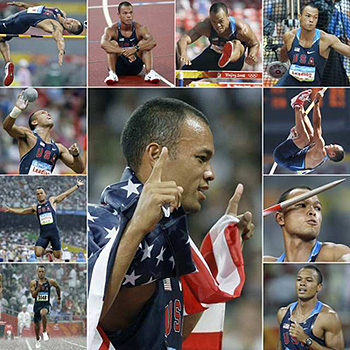
An honourable mention is due the Olympic decathletes, like Brian Clay (pictured), whose multi-sport discipline of running, jumping, throwing and vaulting (an amazing combination of movements) requires them to have a truly impressive combinbation of strength, speed, stamina and agility.

Okay, so I’ve succeeded in arguing that actually some Olympians do qualify as really fit – not my original intention. I still stand by the argument that, very often, the requirements of elite sporting performance are incompatible with a Darwinian interpretation of fitness. Given that, let’s return to what does qualify as fitness, or what does “greater tolerance to shifts in environmental parameters and biologically mediated challenges” really mean? Can you cope with unexpected challenges to necessary or normal activity? (I wrote about how Pilates relates to this here).

If you’re a slight framed woman driving an Audi Q7 around London’s streets (yes, I’m a cyclist), and an electronic malfunction means that your power steering is disabled, can you control your vehicle? If you live on the 6th floor, and the lift is out of order, can you get your 20 kilos of groceries upstairs to your home? If you’re a 70 year old out for a stroll and some lunatic on a bike appears from nowhere heading straight for you, do you have the speed and agility (and balance) to get out of harm’s way? I’m sure we could come up with infinite examples of such scenarios. An answer of “yes” would suggest that, having a greater tolerance to …, you are more fit than some. Let’s not say that a ”no” answer means that you are unfit, rather that you could be fitter. The truth is that many, many people will get by, and quite possibly even thrive, without the skills to make it within the prehistoric framework. I would suggest that this only serves to show that our species is weaker than it once was.

Pilates for….what, exactly?

February 10, 2012 — 1 Comment

(The first thing I feel I should point out is that I’m writing this as a Pilates teacher trained, and practicing, in the UK. Other Pilates teachers may not recognise some of the scenarios I’m describing.)

Pilates called his system Contrology and in Return to Life he wrote:

“Contrology is designed to give you suppleness, natural grace and skill that will be unmistakably reflected in the way you walk, in the way you play, and in the way you work. You will develop muscular power with corresponding endurance, ability to perform arduous duties to play strenuous games, to walk, to run or travel long distances without undue body fatigue or mental strain.”*

It is clear that he intended his method to be a preparation for other ‘stuff’ – for life, in fact. Herein lies my frustration with a lot of what I see in Pilates studios and mat classes. Not to mention the kind of comments I hear, and see in social media from my peers.

I have heard American teachers insisting that, although injured people went to Pilates’ studio, and clearly got help with their injuries form the man himself, Pilates as an exercise method is intended for fit people. In the UK it seems that we have been somewhat hamstrung by the general impression that Pilates is for people who are injured, or in pain. This has been propagated by the media, and doubtless encouraged by teachers who want to boost their business by appealing to those people who may not feel that they can manage ‘normal’ exercise. Not to mention that many of us, myself included, took up Pilates to try to deal with chronic pain of some sort, and became evangelists for the method because it is has the capacity to change lives.

What’s the problem with that? On the face of it, it’s a brilliant thing, and I have been nearly moved to tears on a number of occasions when I’ve seen people discover that they’re able to do more than they believed possible. Unfortunately, what I seem to see all to often, is people doing Pilates weekly (or even more frequently) who have plateaued at a reduction in their pain, and failed to move forward from there. The promises contained in the quote above have little or no relevance to them, and this is a tragedy. Instead of feeling empowered to do more, it seems as though they and/or their teacher/s have created an invisible ceiling for them, that they are terrified to try to break through. What seems to be left then is an emotional attachment to Pilates, a belief that they cannot function without it, yet no desire for, or belief in the possibility of achieving more (playing strenuous games, for example).

As teachers we often have a difficult job encouraging clients to expect more, and I fear that sometimes we, knowingly or not, succeed in holding them back, or at least allow them to ‘aim low’. I would suggest that the first lesson of Pilates ought to be “You are responsible for your own health” – a notion that seems to be systematically undermined in our society. I have seen advertisements for Pilates workshops that describe “using Pilates on our clients”, and I have heard clients saying “[insert teacher’s name] has been working a lot on my shoulders”. As soon as we allow ourselves to take the client’s personal responsibility from them, we have disempowered them, and greatly reduced their chances of enjoying the kind of results that Pilates wrote about.

It seems blindingly obvious that the underlying message of the passage quoted above is that Pilates is not an end in itself. I absolutely endorse the idea of Pilates as a lifelong practice, but not for its own sake. We often teach people to move slowly, in order to help them move with control. This is just a part of the journey, and not a rounded preparation for life outside the studio/class. We may well give people exercises with relatively low loads, in order for them to sense how they can transfer load from their limbs to their centre – fantastic! But not enough if we really want to make people fit and strong – and if Pilates isn’t about trying to help people to be fit and strong then we’ve seriously lost the plot.

If I try to answer my own question (Pilates for what?) I have to say (however corny it sounds) “Pilates for life” – not for ‘relaxation’, ‘feeling good’, ‘Pippa’s bum’, ‘weight-loss’, ‘core stability’ etc.  I want to stand for Pilates as a means to deal with all the stuff that life puts in our path, good and bad, as well as we possibly can.

*I have the impression that a lot of teachers these days have a rather dismissive attitude to Pilates theories, preferring to believe that we have a much better understanding of things with the advances of science since he was writing. Every time I look through Pilates’ writing, I am delighted to discover how often he was spot on. I think this may relate to my previous post – a lot of his ideas still make perfect sense because they fit within the framework of evolutionary biology.