Archives For November 30, 1999

Prove it!

December 1, 2013 — 1 Comment

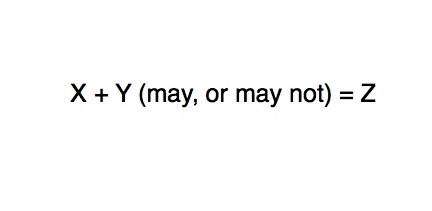
X YI recently came across “Back Pain Myths” via pilatestree.com, from a website called ‘Better Movement’, and a review of Kelly Starrett’s book ‘Becoming a Supple Leopard’ from a website called ‘Exercise Biology’, that both use science, or the absence of it, to question, or indeed attack, the beliefs and practices of many practitioners working within the sphere of exercise and rehabilitation. Somehow it feels as though this is a popular subject at the moment.

To paraphrase outrageously, the thrust of these is that if scientific studies cannot be found to support an idea, the idea must be wrong. “Back Pain Myths: Posture, Core Strength, Bulging Discs” (to give it its full title) sets out to show that anyone who has suggested that poor posture, lack of core strength, or bulging discs are a likely cause of someone’s back pain has not kept up with the science, and is barking up the wrong tree. (More about ‘Back Pain Myths’ in a post to follow). Our man at Exercise Biology levels the same accusation at Starrett: “He is literally taking your hand and walking you back to the dark ages of physical therapy of the 1950’s, when we used to believe pain comes from joint, tissues, bad posture and movement.” (Good thing that the OED had revised the definition of ‘literally’ to include ‘metaphorically’ as one of its meanings). To be fair, the book’s subtitle: ‘The Ultimate Guide to Resolving Pain, Preventing Injury, and Optimizing Athletic Performance’, leaves Starrett open to this kind of critique (if you are deliberately obtuse and overlook the fact that the book is manifestly about all three things combined, and not just resolving pain).

I don’t suppose that it will be news to many of us in the Pilates world that the causes and manifestation of pain are complex areas, and that there is strong evidence that people can have, for example, multiple disc bulges and no pain. Many of us may be familiar with the work of Butler and Moseley, who wrote the excellent ‘Explain Pain‘, and will know that (oversimplified) pain is a sensation produced by our brain, based on information it has received from somewhere in the body, that it has filtered through near enough every sensory input (physical experience, anecdotes heard, films watched etc) it’s ever received. Small wonder that experience of pain seems so highly individualised.

The International Association for the Study of Pain defines pain as: “An unpleasant sensory and emotional experience associated with actual or potential tissue damage, or described in terms of such damage.” So, the role of pain is to alert us to the likely need to change our behaviour, which seems pretty straightforward, and supports the idea that a poor position could indeed trigger a pain response. Of course, it is complicated, especially in the realm of chronic pain, and when someone experiences pain with no identifiable symptoms. Whilst I am familiar with, at least some (Butler/Moseley), current pain theory, I’m not ready to dismiss the possibility that how someone moves and holds themselves may have a bearing on the inputs that their brain receives. According to Anoop Balachandran (Mr Exercsie Biology), who is a fan of the ‘biopsychosocial’ model of pain, the biomechanics (usually termed PSB: postural-structural-biomechanical) model of pain “is now outdated, unscientific and incomplete..” Incomplete it may be, but if someone has pain that is clearly mechanically derived, and resolves the pain by changing their mechanics, that can’t be dismissed. (Nor would it somehow serve to disprove the idea that there is a valid biopsychosocial model of pain).

I don’t want to give into what may be flawed logic, but I’m sure that many of us will have seen the positive outcomes achieved by helping people to understand and change poor posture or movement patterns. I have no studies to fall back on to prove it, and accept the fact that we cannot prove that Pilates, for example, works. A solution that appears simple can still be a solution. Balachandran writes: “I wrote an article back in 2005 about the myth of posture and pain and ended the article saying Now close your eyes, take a deep breath, slowly slump – and savor the freedom of movement”.” He ‘knows’ that this is a sound thing to be saying, because no-one has yet conducted a study that can show conclusively that there is a relationship between posture and pain. I ‘know’ that it’s a ridiculous statement, because I’ve never seen anyone moving well, or freely, from a slumped position. I know that I went from being a chronic pain sufferer, to being pain-free because I learned better movement patterns, and better positioning strategies. I know that my joints fitting together as well as possible, and the surrounding soft tissues being supple and elastic will help me to avoid dysfunction – and I’m positive that, pain or no pain, that’s a good thing. To quote him again: “The more you talk about biomechanics, joints and movements, the more you are raising the threat level in the brain and making the pain chronic. This is exact reason why current pain science involves educational sessions to change people’s belief about the role of their muscles and joint in pain. Just changing the beliefs about pain has been now shown to lower pain, disability score and improve ROM and movement.” It may be that my beliefs about pain were changed during the first year or so that I took Pilates classes, I’ve no way of knowing that. It may be that counselling would have had a similar result, but we cannot prove it either way. A movement practice, and the changes in habit that followed, in my experience, resolved my back problem. I don’t need to prove whether it was a mental or physical change – it’s not provable – and it doesn’t matter. The practice was empowering to me in some way, maybe many ways, and that’s all that matters.

Ironically, Balachandran refers his readers to this interview, which is fascinating, and also includes the affirmation that Balachandran’s beloved BPS (bio-psycho-social) model of pain actually incorporates the PSB model of pain that he derides, as we saw above, as “unscientific” and “outdated”. His scathing review of ‘Becoming a Supple Leopard’ hinges on it being unscientific – given that Starrett doesn’t mention BPS, and that there is “no single scientific reference...” included. Ah, SCIENCE, the trump card. Balachandran makes it clear on his blog that he favours an ‘evidence-based’ approach to fitness. I believe that the only evidence that can be considered to prove anything comes from a randomised, double-blind study. I’m given to wonder what exercise we can undertake whose efficacy has been proven by studying groups of people, chosen at random, some of whom are undertaking the exercise without being aware of it, and supervised by people who don’t know who’s exercising and who isn’t. Thus, if he’s not basing his exercise on anecdote or observation, he is probably not exercising very much.

I’m not seeking to defend Starrett particularly (though I do think that BASL is a very useful resource), but a superficial reading makes it clear that the primary subject is pain that can be related to movement dysfunction, and that the evidence that he bases his work on is the success that it appears to have over his years of practice as a coach and physio. Isn’t it the case, in the realm of fitness (movement), that anecdote and observation are as reliable evidence of the value of a practice as any other kind?

Efforts to increase our understanding of how the human body works must be helpful, and science doubtless has much still to teach us. Particularly if we are working with people who have long-term chronic pain (especially that which doesn’t appear to have any biomechanics cause), it is helpful to have some understanding of the complexities of the biology of pain. That should not equal throwing the baby out with the bath water.

Starrett’s tagline for his work, attached to all the free material that he published to the internet long before the book, is “All human beings should be able to perform basic maintenance on themselves”. Listening to him it’s easy to believe, financial rewards aside, that he is motivated to try to make a positive difference to people’s lives – to make the world a better place. Perhaps those of us in the Pilates teaching profession all share that same desire.

Is the motivation to write a review of this book (which carries an implicit critique of any of us who’s work is often centred on the PSB model of pain) the desire to educate, to advance debate, or the desire to build a reputation?


Who’s Health?

October 10, 2013 — Leave a comment
image courtesy of healthcare.com

image courtesy of healthcare.com

When Joseph Pilates wrote “Your Health” in 1934 the world was a different place from the one we know now (or, at least, the Western world was). The majority of people would have lived less sedentary lives. Whilst work for many was physically hard, it appears that lines between work and leisure were much less blurred than they are now (e-mail, anyone?) Industrial food giants were largely a twinkle in the eye of their founders and real food, as opposed to food products, would have been the standard. Wheat looked very little like the Frankenstein’s monster of a grain that it is now, and CAFOs (‘concentrated animal feeding operations’) were a couple of decades away. Ancel Keys wouldn’t succeed in demonising saturated fat for another 25-30 years (and, in the absence of CAFOs, animal fat would have been less potentially sinister anyway).

The list of health related differences could probably go on for a while. In short, I suspect that it was a little easier for people to be responsible for their health then than it is now.

What of it? Well, a couple of years ago I was at the house of a client who had a business associate visiting (both American). There was an American news channel on the television, with a discussion of Obama’s universal healthcare policy underway. My two companions were clearly of a Republican persuasion, and vigorously opposed to this socialist notion. As a European I found it utterly bizarre that anyone could be opposed to something that I have taken for granted for my whole life.

I’ve lived and worked in the US, and experienced the surprise of being asked for my credit card details, in the ER, whilst trying to staunch the bleeding from a sizeable wound. I’ve also seen people of apparently limited means handing over large sums of cash in the pharmacy for their monthly prescriptions. How could this be reasonable?

More recently I’ve started to question my knee-jerk position on universal healthcare. I suspect that the Republicans mentioned above are opposed to the idea for financial reasons – I don’t know the details (apparently the ‘Obamacare’ bill runs to more than a thousand pages, so perhaps no one does) but I can imagine that there are potentially lost profits somewhere in the system. There’s little prospect of me profiting from privatised health care, beyond teaching Pilates, so I’m not concerned by that. What I am uncertain about is the degree to which our system allows us to imagine that, collectively, GPs; surgeons; nurses; physiotherapists; pharmacists etc. are responsible for <strong>our</strong> health. We can afford to fail to take care of ourselves, and make poor choices, because there’s a broad safety net of health professionals that are obliged to try to fix us. Clearly not a good recipe for personal responsibility. If we all knew that there would be financial consequences for the poor lifestyle choices that we make wouldn’t we be much more likely to make better choices?

The problem is that the ship of personal responsibility, in this regard, sailed a long time ago. Even if this isn’t you, I bet you know plenty of people who will seek a pill for any ailment, take antibiotics for a cough/cold, or go to their osteopath/chiropractor/physio to get ‘fixed’ if something hurts. If you’re a Pilates teacher I’d be amazed if you have not been asked for a remedy to some physical ill.

And here’s the real problem – we’ve been encouraged to think like this, by both governments and the corporations that ‘help’ them to form policy. Who knows why the food pyramid looks the way it does? Was it the work of a well-meaning but scientifically illiterate committee of politicians, or was it hatched in the subterranean lair of an evil food corporation executive? Probably somewhere in between, but it doesn’t matter anymore. Their work is done and the great majority of us ‘know’, beyond doubt, what healthy eating looks like. We also know that several episodes per week of 30 minutes of moderate intensity exercise are what we need to manage our weight and keep our cardiovascular system in top condition. (This probably requires a post of its own, but don’t we also know that it’s natural for a baby to vomit much of its food…?)

Governments try to protect us from the evils of tobacco, and, to a lesser degree, alcohol, and we justify huge rates of duty because these lifestyle choices place an extra burden on public healthcare. If you manufacture cigarettes you may not advertise your products, because we know all about the health risks associated with your product. However, we enjoy no such protection from the promotional efforts of the corporations, some of whose products purport to be healthy. Nestlé are free to advertise breakfast cereal made with ‘healthy whole grains’, Tropicana are equally free to advertise orange juice, which has the same sugar load as Coca Cola (who, of course, enjoy the same freedom to promote their wares). The list could go on and on – margarine proven to lower cholesterol, sweetened drinks to improve your gut health etc etc.

In these circumstances the odds seem so heavily stacked against us that personal responsibility is hardly an option. Informed choices are only as useful as the information they’re founded on. If governments and corporate giants collude to mislead us, a two-headed monster of misinformation, doing our best can easily become a recipe for ill-health. In these circumstances it seems more than ever that providing universal healthcare is an obligation. If your body were a high performance car, you’d be careful about the fuel you put in, you’d put air in tyres if they looked a little squishy. Perhaps you’d clean it often, and you probably wouldn’t park it where the risk of damage or vandalism was high. In short, you’d probably follow the manufacturers recommendations to keep it in good, if not great condition. This analogy stumbles a little in that our bodies don’t come with a manufacturers warranty, and companion handbook. However, the two-headed monster above has purported to provide one for us. ‘You break it, you pay for it’ seems like a generally appropriate maxim, and could be well applied to healthcare – you abuse and damage your body, you pay to sort it out. However, if you’ve followed the manufacturer’s instructions faithfully, surely it’s their problem?

What does fit weigh?

September 28, 2013 — Leave a comment

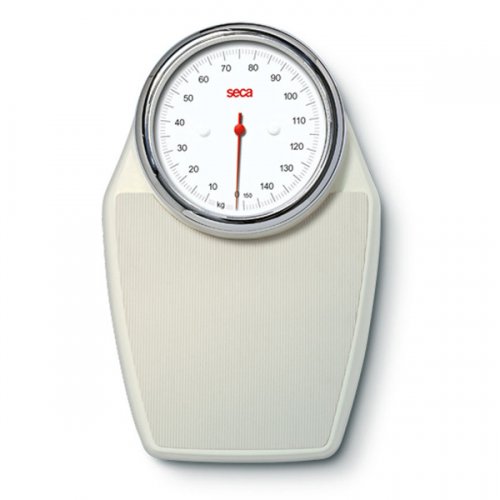
3_seca-760_ecru_white_detailMy urge to write often seems related to the me coming across two colliding ideas, or if not colliding, at least divergent ideas. In this case, I’ve recently started reading the excellent “The Paleo Coach” by Jason Seib, and also seen snippets/chunks of the series “The Men Who Made Us Thin” on the BBC, written and presented by Jacques Peretti.

Peretti’s TV series offers up some extraordinary insight, my favourite moment being when the former CFO of Weight Watchers in the United States almost gleefully pronounces that the company he spent 20 years working for was a good business model because their product didn’t work, but kept people coming back and paying for more. It was if, instead of being interviewed by a journalist, he was making a secret presentation to potential investors.

Overall, the series seems to be a sincere attempt to uncover why so many people are becoming obese, and what solutions, if any, are effective. Peretti points out a number of misleading generalisations, but makes plenty of his own in the process. The most striking thing for me in all that I saw was this comment: “Personally I think people should stop worrying about their weight and focus on being healthy and happy, at any size.” This seems to me to highlight the degree to which our thinking about health has been torn away from any grounding in evolutionary biology, and outright bizarre. If your brain and body are under the impression that your situation is so stressful, or that a time of famine is imminent, and that you need ample stores of fat, is there any possibility that you are healthy?

It’s widely accepted that being fat is unhealthy, yet it seems that the opposite extreme has become the definition of healthy. There is no middle ground – Fat is bad, ergo skinny is good. When skinny is patently unattainable (not to mention ‘unhealthy’) the response is to celebrate being too fat, as in “I’m happy the way I am.” There may be a case to say that, in some sections of the UK media, the pressure to be happy the way you are is nearly as great as the pressure to look like someone else a good deal smaller than you. The idea of being fat and fit is bound up somewhere in all of this. For Peretti, the fact that two obese women, who had some previous experience, could keep going in an aerobics class longer than he could was a sign that fat and fit are not mutually exclusive. Overall, the message seemed to be that nothing is truly effective in combating obesity long term – dieting doesn’t work, exercising doesn’t work, surgical intervention doesn’t work etc. Not great news for the concerned viewer who really wants to change themselves.

Then I picked up Jason Seib’s book, and was delighted. Having ‘Paleo’ in the title means I know he’s going to be talking about an ‘ancestral’ model for living now. In other words, taking the physical activity and nutrition of our ancestors as a template for how to live now. This is another way of saying that he uses evolutionary biology as the basis for his assertions about health and fitness (more of ‘health and fitness’ anon).

It fits that our concerns about our size and weight are related to how other people perceive us, or how attractive we are. Using that evolutionary model, we are wired to propagate our own genes, and mix them with other genes that are going to be resilient, robust etc. From that perspective, what attracts us to others is their appearance of health – “Does this person have what it takes to survive and flourish, and produce children that will do the same, in this adversarial world?” Just as excessive body fat won’t signal a promising mate, nor will being very skinny. In other words, as life has become easier and easier, we have developed some twisted ideas about what the roots of attraction are.

Seib argues that people who begin a diet, or programme of exercise, with aesthetic goals are largely bound to fail. That said, it’s not unreasonable to have a goal of fitting into clothes that you wore a couple of years back, or to want a smaller waist circumference, BUT weight per se is a red herring. You might change your body composition significantly, effectively exchanging stored fat for muscle mass, and not lose much weight. The whole notion of ‘losing weight’ is misguided in fact. Bathroom scales tell us next to nothing about how healthy we are. I know someone who has recently succeeded in losing weight, and I’m certain that, as well as shedding some body fat, she has also lost muscle mass. Did anyone’s health ever improve as they got weaker?

As an aside, Seib refers to research that indicates that yo-yo dieters become more efficient at storing body fat. In other words, if you get into a cycle of dieting to lose weight, and then regaining that weight, then you are likely to become progressively fatter. I can’t articulate how or why, but this is surely a natural response of the human body to the stress of deprivation and signalling the need for storing greater energy reserves.

The solution of “The Paleo Coach” is to have a goal of health, rather than a number that you read on the scale. If you take the necessary steps to be as healthy as possible then aesthetic goals will be achieved as a by-product – again, we’ve evolved to find the appearance of robust health desirable. This brings me back to the ‘health and fitness’ point. Under the heading of “What is fitness?” the CrossFit Training Guide (yes, CrossFit, again) contains this line: “We have observed that nearly every measurable value of health can be placed on a continuum that ranges from sickness to wellness to fitness.” This is to say, health and fitness are not separate – fitness is the optimum state of health. If we accept this idea then the notion of “happy and healthy at any size” is exposed as a nonsense.

Bathroom scales can tell you how heavy you are, they cannot tell you how healthy you are (I know there are some that purport to measure body fat but since one such scale told me that I was borderline morbidly obese I doubt their accuracy). Unless you’re wanting to go on, say, a theme park ride with a weight limitation, or wondering if the lift can cope with one more body in it, what you weigh is of minimal significance – your fitness will take care of your weight.

Oh, and don’t settle for wellness (“How are you?” “Oh, fair to middling.”) – is that really going to be good enough for you?

Dear Pilates Teaching Colleagues

UnknownHaving browsed through Peter Fiasca’s book “Discovering Pure Classical Pilates” a couple of years back, I was slightly embarrassed for him. The excessive use of bold type to underline key points concerning heretical misinterpretations of Pilates, and the somewhat polemical subheadings (“The Great Decline: Derivative Styles of the Traditional Method”), smacked of someone losing their marbles.

I’m beginning to have sympathy with his position (perhaps I am losing my marbles), though our viewpoints differ a little. I’m not fanatical about teaching only ‘classical’ Pilates repertoire but I’m with him when he says “Pilates is not physical therapy”. If not losing my marbles then at least I’m becoming less temperate with regard to the realm of Pilates teaching. Sure, we all have different backgrounds, different influences, loves, hates etc. but I’m writing this to ask if we can agree on a few basics.

Such as:

Pilates is not magic, it’s a system that facilitates teaching good movement.

Pilates is therapy only in as much as movement is therapy.

We teach, clients do – in other words, we don’t do Pilates to our clients.

If our clients believe that they can only do Pilates in our presence we have failed.

We don’t work on our clients problems, they do that.

What clients do in their classes is based on what they need, and what they want. If they ask “What do you want me to do next?”, we’ve given them the wrong impression.

Unless we have medical qualifications, we do not diagnose, or treat.

It’s not our job to determine which specific muscles are culpable in, say, an asymmetry (so it’s not appropriate to be saying, for example “Your left obliques are weaker then your right”).

We have the chance to ‘set the bar’ of what’s possible for our clients, and we should set it high.

We have the tools to help people to be better – if there’s no sign of that happening over time then we should be directing them elsewhere.

We should be practicing what we teach – all the time.

We should be taught by another teacher, regularly.

Oh, and perhaps most importantly, strong is not a dirty word.

My Primal moment

August 21, 2013 — Leave a comment

The story that follows is nothing compared to the stories of hundreds of thousands of people who have experienced danger, disaster, war etc. That said, it felt like I learned something useful about myself, and it also felt as though it justified the changes I’ve made to my lifestyle in the last couple of years.

Here goes:

IMG_1388

The view, on a good day…

I was recently on holiday in Southern France with my wife’s family. We were staying in a house that is about 350m above sea level, on the side of a hill (mountain?) that is 1050m above sea level. There’s a rough but easy to follow path from the house to the peak, and 3 of us set off to the top one afternoon.

Clouds had been building up, and after only 5 minutes or so we could hear a sound like a strong wind through the trees, that turned out to be a wall of monsoon-like rain coming toward us. Prudently we turned back, but set off once again after the rain had passed, only 10 minutes or so later.

Around the point that we had previously turned back, all 3 of us wearing shoes, shorts and nothing else, passed a family coming down the path, wrapped up in waterproof jackets and looking miserable. I’d be lying if I said we didn’t feel amused by the contrast between our party and theirs, though that was tempered by discovering some of the hailstones that had fallen earlier, probably on that poor family.

IMG_1399

My brother-in-law has spent many summers exploring the area so, when he suggested deviating from the main path to make a more circular than out-and-back journey, we had no doubts about the idea. This is a beautiful part of the world, there are stunning views to admire, and on this morning there was the chance to see the impact of heavy rain on the landscape, some paths still being mini rivers.

Around the time that the sky was turning particularly blue-grey, it was acknowledged that we had missed our uphill path, though on the hillside what appears to be a path can quickly disappear into the undergrowth. The solution was to simply head upwards, negotiating the vegetation in the way. So far, so undramatic. When the rain started we experimented with sheltering under trees and scrutinising the pallor and movement of the clouds, confident of a break in the rain. It didn’t come, so we decided that being on the move was better, and carried on uphill. It had already crossed my mind that I wasn’t feeling the need to hold F (my brother-in-law) responsible for our predicament -weird.

It seems counterintuitive but the vegetation became denser the higher we got, and the way (not path – definitely no path) got steeper. Did I mention the rain was unrelenting? So the purchase on mud/stones/roots was increasingly tricky. I’d had my favourite eggs, bacon and avocado breakfast, and was feeling energetic and strong. P, the youngest of our party, is what I might (in a judgemental moment) call a ‘sugar-burner’ – bread and jam for breakfast. He’s young, and was raised that way, so the choices he makes are more habit than real choice. Anyway, P was beginning to shiver, and the novelty of our situation had evidently worn off. (I later discovered that, in the conditions, his shoes were disintegrating from the inside out, so his crappy breakfast may not have been entirely to blame for his mood).

F was regularly assuring us that we were nearing the top so, of course, it felt as though we weren’t. Amazingly, the rain became more intense and we decided to try to shelter again. This was when I had my ‘epiphany’. Squatting under a tree, with hail cutting through the leaves of our ‘shelter’, and with rain water running into parts of my body that even a shower won’t always get to, I was amazed at how I felt. Again, I wasn’t blaming anyone else, and in years gone by I know I would have been angry with F for leading us to this point. I was reminded of scenes from ‘Platoon’ when the grunts are sitting in the jungle drenched under the incessant rain (yes, I do know that we were in no danger of being shot at). I wasn’t cold (daily cold showers paying off?), instead feeling incredibly resilient. I was a bit concerned about P, whose shivering was intensifying, but at the same time I knew that I was strong enough to carry him to safety if I had to. Our situation was ludicrous and, again to my surprise, I wasn’t at all dispirited.

Deciding once more that we were better off on the move we set off for the ridge, where the vegetation disappears. There is a track running the length of the ridge which was a river a few inches deep at this point. Our way back meant following the track a little more up hill before meeting the path back down to the house. We jogged our way to the top of that path, and then sped up on the descent. Now the rain eased. The path is rough, alternating from stones to gravel, clay to chalk, and with roots here and there to add spice. Once running it was hard to stop, and I have rarely felt as invigorated as I did then – concentrating hard on each footing and feeling agile and powerful. Some 4 hours after we set off we arrived back at the house with, for me at least, a feeling of triumph.

Again, I’m well aware that this isn’t a tale that involves much peril, or endurance, and we all came out of the experience unscathed. Nonetheless, it felt to me that 2 years of ‘primal lifestyle’ had made me better able to cope with adversity. I’m better nourished; stronger; more resilient; my immune system is stronger; and, perhaps most importantly, I’m aware of how empowering it is to, instead of blaming someone else, own responsibility for my actions and any resulting predicament.

Thanks for reading.

“No Days Off”

February 15, 2013 — Leave a comment

A couple of weeks back PilatesTree.com asked via Facebook “how much self practice do you really put in?”. It’s a really interesting question to ask professional Pilates teachers, not least because we so often seem to prioritise teaching over working on ourselves. When I first started teaching I used to “do” the class that I was teaching, and it took me a while to realise that this was a really good way to develop some bad habits (never mind that my mat was not the optimum place to be teaching from all the time..).

I’ve struggled for some time with conflicting ideas around Pilates teachers’ responsibility to be aspirational figures (see ‘What should a Pilates teacher look like?‘) and, of course, what we do should be more important than how we look. If we finish teaching a class and then adopt a collapsed posture we’re doing a lousy job of reinforcing what we teach. “Do as I say, not as I do” is rarely a powerful teaching message.

One of the consistent messages of primal/paleo lifestyle authors, and indeed Kelly Starrett, my movement sensei, is that it is our responsibility as human beings to optimally express our genes – to be the best version of Homo sapiens that we possibly can be. This seems eminently reasonable to me, and also a great basis for a slightly different question from the one above: “How often should we be trying to be better?” or better yet – “How often should we be practicing being amazing?”

The answer, naturally, is ‘every day’. Hence, there are NO DAYS OFF. Practice making permanent = we become good at what we do often, which brings us back to the post-class slouching Pilates teacher. A state of fitness is not the result of a couple of hours per week of exercise. That may well form a part of fitness, but if we practice being great for 2 hours a week, and then the remaining 110 hours (assuming a generous 8 hours sleep per night) practicing being mediocre, or worse, we don’t need NASA to tell us what the outcome will be.

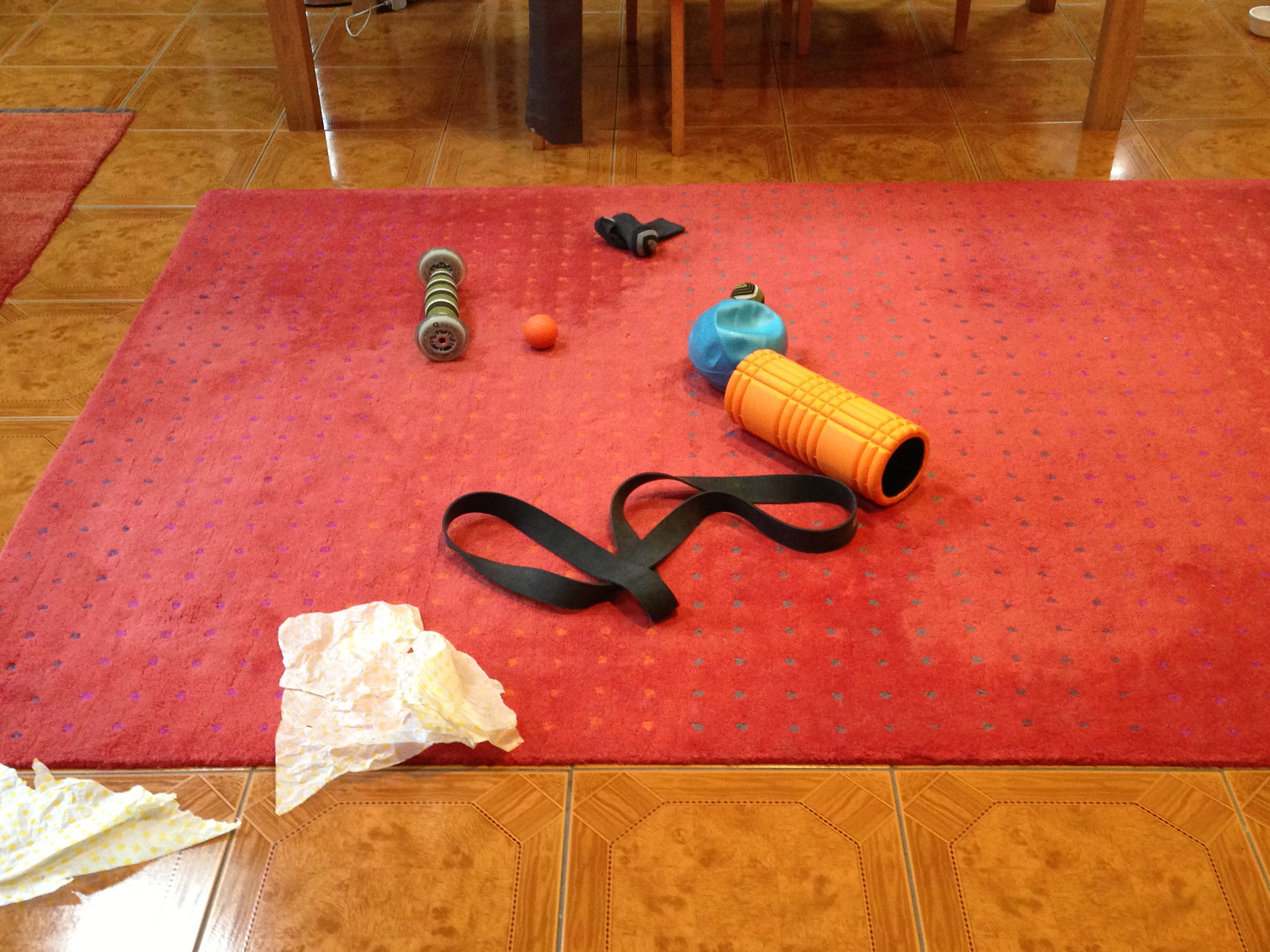
Typical view of living room floor (tissue paper is for the cats to play with).

Typical view of living room floor (tissue paper is for the cats to play with).

I was unusually reticent about answering the original question on PilatesTree….in part because I know that I can’t pretend to do anything resembling a Pilates class more than once a week. Preferring to answer my own question (“How often should we be practicing being amazing?”). As of this year, I do something in pursuit of being better as often as it crosses my mind, and this means at least every day. I don’t work out every day, but I try to practice something that I need to improve daily, whether that be a skill/movement, or mobility. I’m very lucky to be married to a woman who shares my passions/obsessions, and evenings in front of the TV usually involve one, or both of us rolling various body parts on sundry firm objects, or indulging in mutual ‘quad smashing’ (For a visual on how to do this to a massive weightlifter, or your loved one, click here, and remember: “Foam rolls are for children”).

Talk of my idiosyncratic home life may have me straying off the point. Here’s the thing: Yes, practice Pilates, yoga, boot camp, karate…whatever’s your poison (passion?), at least once per week AND practice being a better Homo sapiens every day. In the middle of a TV show I was watching the other night (I put my hand up here and acknowledge that I was making no effort to be better at the time), I heard the line “Clean water is a human right.” It sounded weird at the time – I think we’re often too quick to award ourselves rights (argh! Rabbit hole! Yes, ideally every living human should have access to clean water). Ethical quagmires aside, could we say that “an optimally functioning body is a basic human right”? I hope so, and if we’re agreed upon that, we have to remember that “with rights come responsibilities”.

We have the basic human responsibility to maintain our bodies in such a way that we are able to best express our genetic heritage.

In acknowledgement of the inspiration for this post, here’s Kelly Starrett. Not my favourite MobilityWOD video (and he no longer advocates icing) but maybe it can serve as a way in to the goldmine for you – he’s ALL about being better at EVERYTHING.

It’s a GPP system

My understanding (and I can’t remember whether this was gleaned from reading Pilates’ books, or hearing it said by one or other of the first generation teachers) is that Pilates’ intention was to create a form of physical training that, unlike the kinds of training he had done himself (boxing, for example), would ready one for any conceivable physical challenge. In a nutshell, General Physical Preparedness.

Along with the CrossFit Training Manual, I’ve been reading a fair amount of Gray Cook‘s writing lately, and both have some interesting things to say about specialisation.

“CrossFit considers the sumo wrestler, triathlete, marathoner and power lifter to be ‘fringe’ athletes, in that their fitness demands are so specialised as to be inconsistent with the adaptations that give maximum competency at all physical challenges.” To extrapolate that a little, none of those athletes can be considered truly fit. Heresy alert: Mo Farah is not fit!

In his lecture ‘Developing a Movement Philosophy‘ Gray Cook observes “Every time we specialise we give up our adaptability”, and later “any time we specialize, the human body at some point will start to break down.”

When writing here I invariably seem to get to the point of feeling the need to insert the “What has this got to do with Pilates?” sentence. Well, Pilates is meant to be promoting health – and I do like CrossFit founder Greg Glassman’s concept of ‘health’ being measured on a scale that runs from sickness, through wellness, to fitness – so hopefully Pilates is not simply promoting health, but specifically promoting fitness. (Why settle for being ‘well’, instead of ‘fit’, when ‘well’ puts us already half way to ‘sick’). Fitness requires adaptability, and as Gray Cook implied, specialisation is the enemy of adaptability – and here’s where Pilates steps up, because, again, it’s a GPP system.

At Pilates in Motion Studio we try to instil the idea in our clients that Pilates is a means to an end, not an end in itself. In a very broad sense, we could call that ‘end’ “living better“, and that’s precisely because Pilates is not a method to help us to get better a specific skill, or improve endurance in a particular activity (though of course those benefits may come), but because it should be preparing us for a wide array of challenges, from the mundane to the extraordinary.

By incorporating a mixture of movement patterns, in multiple planes, and by practising the principle of trunk stabilistaion while moving extremities (How many Pilates exercises revolve around this central concept?), we make ourselves more ‘robust to perturbation’ (as the biomechanists might say). Given a definition of fitness that incorporates a notion of adaptability, Pilates (perhaps with the addition of more load) practised with some periods of high intensity, provides a great foundation for general, not specialised, fitness.

The “Fast Diet”, also referred to as the “5:2” diet seems to be all over the UK media at the moment, accompanied by both very positive reviews, and expressions of concern about the dangers of encouraging anyone to fast.

I had this diet described to me as “fast for 2 days (actually, limit calories to 500/600 per day), and eat what you like for 5 days”. The man behind this is Dr Michael Mosley – and he made a television programme all about it, so it must be infallible. Apparently he found evidence that, aside from weight-loss, the Fast Diet is also associated with a range of other health benefits.

I have grave misgivings about any suggestion of ‘eat what you like’, because it seems to suggest that nutrition is unimportant. In other words, there’s an awful lot of ‘food’ around these days of very limited nutritional value. The idea (not Dr Mosley’s, I’m sure, but possibly widely-held nonetheless) that it’s okay to eat crap for 5 days, and then severely restrict your calories for the other 2, sounds like a recipe for very poor nutrition. And food, after all, is meant to nourish us, not simply supply us with calories.

I can’t help but listen to news items about diets without my Paleo-biased brain shouting “It’s what you eat, not how much or how often, that matters”. I’m also trying not to be a 197693_3967280097068_451202589_nfundamentalist about food. I do get a little stressed over vegan parents raising their babies as vegans. Equally, it would take very strong evidence (that I’ve seen no trace of) to persuade me that being vegetarian is as healthy (never mind sustainable) as being omnivorous . At the same time, occasional rants about soy products aside, if someone feels that the way they eat is the best for them, what business is it of mine? None, of course.
Back to ‘diets’. The biggest problem that I can see is that they always appear to be temporary. I may well be wrong, but I doubt that Dr Mosley is proposing that anyone follows the 5:2 ratio for life. This is why I really like the way that I’m eating these days (and why I’m always a little baffled by people asking me if I’m “still doing that diet”) – it’s great because it feels totally sustainable. I choose, generally, not to eat certain things, that were amazingly easy to give up. That’s it. Again, I’m trying not to evangelise.

I was exposed to another idea today (courtesy of Paleo Solution podcast episode 167), attributed to Greg Glassman, founder of CrossFit. It seems like a brilliant approach to body composition, health, and (probably) any other outcome one might desire from a diet. Essentially, set yourself some athletic goals that will really stretch you. The podcast mentions double-bodyweight back squats and a couple of other outlandish strength/gymnastic goals, but we can all figure out athletic achievements that will stretch our individual capabilities. Perhaps it’s mastering the entire Super-Advanced Reformer repertoire, or doing “Romana’s Mat Challenge” 4 times in a row, if Pilates is your thing (though I think a more profound strength challenge would be best). Maybe it’s preparing to climb Kilimanjaro for charity. The point is that, if your goal is sufficiently challenging for you, doing what it takes to reach it will inevitably involve eating appropriately, and making positive changes to your body composition. No 5:2, no GI, no Caveman, no South Beach, no Atkins, no Blood Type (and on and on and on and on)

Perfect! Nourish yourself to achieve amazingness, and enjoy the combined side-effects of better health, and the body composition you’ve dreamed of.

Adaptive Athletes

January 22, 2013 — Leave a comment

If I’m uninhibitedly honest, before last years Games, I used to view the Paralympics as a distinctly fringe event. Rather in the vein of “Ahh, that’s nice”, but of minimal personal interest.

Like many people, I suspect, last year was different, in that my family was making a point of watching many of the events on television (and trying to get tickets), learning the names of more athletes (no longer ‘Oscar Pistorious, and all the rest’), and becoming emotionally involved in many of the events.

A big part of what changed my perception of the Paralympics, was seeing GB track cyclist Jody Cundy’s reaction to his disqualification. You can see the full unedited version of what happened here, or the short version (all swearing, no back story) here. Suddenly I understood that, for the athletes involved, this was absolutely as serious as the Olympic Games is for anyone competing there, and that the level of training and commitment is at least equal. (I can only apologise for failing to grasp that previously).

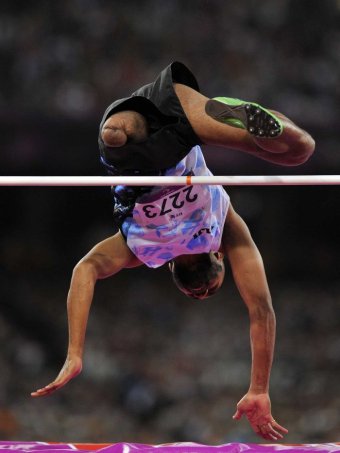
Iliesa Delana clearing 1.74 metres (Courtesy of Australian Broadcasting Corporation)

Fiji’s Iliesa Delana clearing 1.74 metres
(Courtesy of Australian Broadcasting Corporation)

Over the ensuing days I was consistently awed, humbled, and moved by what I saw of the Paralympics. Some of the highlights for me were the men’s F42 high jump (for single, above-the-knee amputees), and the blind long jump (I can’t imagine many things more terrifying than sprinting and jumping into space blind). The fact that the relay runners with cerebral palsy are required to exchange the baton within the same distance as the ‘able-bodied’ athletes should have made some of the latter, who failed to get the baton round the track, feel distinctly inadequate.

In the following months, aside from the BBC’s ‘Sports Personality of the Year’ awards, paralympic sport seems to have drifted back out of the public consciousness, perhaps to be largely forgotten until 2016. Happily for me, the lustre of last year’s Paralympics, and my associated perception of ‘disability’ sport, has recently been restored by the video below.

The story of CrossFit Rubicon, in Virginia, both rekindled my esteem for ‘disabled’ athletes, and helped to reset my perspective, such that ‘disabled’ (finally) feels like un entirely inappropriate word. The owner of the gym makes it clear that the words ‘handicapped’ and ‘disabled’ are not acceptable within the gym, and he describes those athletes working out there, who may be without one, or more, limbs as ‘adaptive’. This seems like a wonderful way of acknowledging the obstacles that people may have had to overcome to be turning up at the gym to exercise, without bringing any negative connotations. I’ve always had an uneasy feeling about the name paralympics – the ‘para’ sounds to me like it refers to paraplegic, defined in Wikipedia as: “an impairment in motor or sensory function of the lower extremities”. The idea of impairment seems completely misplaced in relation to both the athletes from last year’s Games, and the men and women at CF Rubicon.

So how’s this for an idea? The Adaptive Olympic Games, instead of Paralympic Games. I think that labels are often useful for clear communication, and find that many of the attempts in the last few decades to ‘reclassify’ things with less pejorative, or stigmatising language  serve mostly to make communication less clear. ‘Adaptive’ seems to admirably walk the line between clarity, and a description that doesn’t suggest ‘less than normal’.

The video’s not short (27 minutes) but deserves the “heart-warming”, “life-affirming”, “uplifting” cliches of many a Hollywood film poster. If you watch, I defy you to be unmoved by the spirit of these adaptive athletes.

Videos from Channel 4, and http://www.journal.crossfit.com

One doesn’t have to search very long on the web to find critiques of CrossFit, there are many, and many of them valid. This seems to be largely down to the fact that it allows (fosters, perhaps) an obsession with the number of ‘reps’, or the time taken to do the workout, over practicing good technique. In essence, the idea of learning skills and then challenging one’s ability to remain skilful under duress is a really interesting idea. If you read any of the CrossFit training literature the same message is frequently repeated – form is everything. There is not an official edict that says “Finish the workout at all costs, never mind your technique”. Unfortunately, this point seems to have been missed by a number of certified coaches who fail to scale workouts appropriately for different people, and fail to teach the imperative of proper technique. CrossFit then earns a reputation for being dangerous, and causing injuries.

I will agree with anyone who suggests that becoming a certified CrossFit coach should be a little harder, but the arguments against Crossfit based on poor coaching are the same as the Daily Mail “How pilates can make your bad back worse..” type articles. Once you get passed the eyebrow-raising headline, the article essentially says ‘if you have a poor teacher, things may not work out too well’. As another blogger (whom I’m afraid I cannot credit, sorry) put it: “Crossfit is not dangerous. Bad coaching is dangerous. Poor movement is dangerous. Ego is dangerous.”

Enough about the problems with/for CrossFit (‘CF’ hereafter). This is about why I love it.

Maybe teaching Pilates for as long as I have (coming up to 10 years) had made me slightly jaded. The pressures of running a business during one of the longest recessions of my lifetime might have played a part too. Before I discovered CF I was still a firm believer in the possibilities of Pilates to work, something like magic, in transforming the lives of people with chronic pain, and other physical challenges, but I had fallen out of love with Pilates, a little. (That may also have something to do with my perception of the dominant trend away from building strength and fostering empowerment in UK Pilates teaching). In stumbling upon CF, and recognising their common threads, I’ve rediscovered my original zest for Pilates.

Aside from the philosophical similarities with Pilates that I referred to here, CF consistently teaches me about myself, in a way that no other discipline or type of exercise has. I’ve run marathons in the past, and done long training runs as part of the preparation, and I certainly found myself looking inward then. It’s probably true that I’ve suppressed some of the memories of what I may have seen. What I remember was the struggle to find a way to overcome physical fatigue, and some pain (and, to be fair, the stakes were high – nobody wants to train for 6 months to run a marathon, and then fail to finish). It also took a long time – both the activity, and the recovery. The soul-searching that I might do during a CF workout is different, and it’s a more humbling experience. On a number of occasions I’ve wanted to give up on finishing a workout, not because I was too physically tired to continue, but because my mind was telling me that I’d had enough. It was quite a surprise for me to discover that (with the motivation of, for instance, seeing my wife carry on when I wanted to stop) I’m capable of pushing myself beyond my previously perceived limits, which opens up a variety of new horizons.

There’s a camaraderie in doing CF workouts with others that I’ve never found in Pilates – perhaps because you’re more likely to be exploring the limits of your capacity. I’ve seen plenty of official marathon t-shirts with slogans that imply that being a marathon-finisher puts you in an elite group. Whilst the sentiment resonates with me, I also find it somewhat obnoxious. At the same time, there’s something about sharing the experience of a workout like Diane (Deadlift 225 lbs, Handstand push- ups, 21-15-9 reps, 3 rounds for time), especially doing it together, that forges connections. (CF is widely recognised for its community-building aspects).

Kristan Clever’s Diane at the 2012 CrossFit Games regionals

If you watched the video, there’s a clue to the humbling element of CF – not only is my ‘Diane-time’ about 10 times slower than the woman featured, it’s also slower than my wife’s (who of course has minimal interest in how long it took). It’s a curious feeling to set about something, believing myself to be bigger and, therefore, stronger, but to find that my wife is actually stronger than me. She’s a very accomplished Pilates teacher, and I admire her teaching a lot, but it doesn’t compare to the feeling of witnessing her steel herself, and push back the limits of her physical capability. For her too, more often than not, it seems that it is pushing past mental boundaries, that extends the physical ones. I’m finding it hard to adequately describe – there are moments at the end of a workout when, gasping for breath, I see deeper into myself than I have done during other physical pursuits. I wonder if it’s too much of a leap to suggest that it helps me make a connection to my primal self – the one that was born to run and hunt and struggle for survival…