


It’s been a very long time since I felt I had anything to write about teaching Pilates and, to my surprise, training in Tao-Tantric Bodywork for Emotional Detox was the catalyst for an evolution in my teaching (and the impulse to share here).
For a long time I’ve been practicing ‘client-centred’ teaching, and for the last few years I’ve been aware of the work of the HeartMath Institute and welcomed the importance of heart into my teaching, at times. If I described my purpose in teaching Pilates/movement two years ago it would have been “Helping people to recognise the miracle that they are, and signposting their discovery of the capacity that lies within them.” So it’s foundational to my teaching that I don’t seek to impose anything on my clients or to ‘do Pilates’ to them. So far, so virtuous.
The foundational philosophy of the bodywork that I practice is that it is an act of unconditional love. The purpose of the work (for me) is to give my clients an embodied experience that makes their value, even their divinity, undeniable. I have heard more than one palliative care doctor say that invariably, upon resuscitating a patient, after saying “Why did you bring me back?” they all describe a feeling of total acceptance. This is unconditional love and we need not wait until death to experience this.
Tantra has many definitions and descriptions – it is a weaving together, it is expanding consciousness, it is a philosophy for living. One that sticks with me particularly is that Tantra recognises everything as divine, even excrement. Thus, Tantra welcomes everything. In the sacred space of a massage session unconditional love means that there is no judgement and that the receiver is totally free to be themselves. An interesting element for me is my presence in the room when someone is able to fully be themselves – in some ways it seems that I’m superfluous in those moments, yet there is something about that embodied ‘self-ness’ being witnessed by another that seems to be especially powerful. That’s to say, not only has the person had the experience of their deepest and most authentic self, they have also been witnessed as that authentic self, making it harder to doubt or deny later.
As a receiver of this kind of massage it was an extraordinarily healing experience – at a critical point in my life I had the undeniable affirmation that I am worthy of love. This is where the unconditional element is so valuable – I was receiving from the practitioner with no expectation of reciprocating. This seems to be a remarkably rare thing and it was extremely challenging to override my conditioning to give back. And even in the most loving relationships we might always know that there could be an accounting at some point – ‘what I’m receiving now will need to be returned later’.
As a practitioner I’ve been privileged to witness my clients having an experience that they may not have had since they were babies. Being able to let go of shame, lower their defence reflexes and to feel embodied pleasure without guilt. This always comes from within. What I’m giving is my presence, awareness and attention – of course, these outcomes are not in my gift to give. My role is as a guide to discovering the self that may be suppressed or hiding.
Which brings me back to teaching Pilates, and the realisation that these two practices are not very different. For a massage session the client’s feeling of safety is paramount, the environment is very important, listening is essential, and there is a high level of intimacy. Could we not say exactly the same for teaching Pilates, especially one to one? “It’s not that intimate!” you may say – and it’s true that if I were to touch someone as a teacher in the way I would in massage it would be considered unprofessional at the very least. That said, in teaching we are working with physical beings and, apart from perhaps the most superficial or uncommitted teacher/client relationships (which are unlikely in a one to one scenario) our clients are entrusting their being to us. Especially if we have reverence for human bodies (and I hope we do) this trust together with our care makes for an intimate relationship, never mind that intimacy is not merely physical.
As well as the necessary conditions for a successful class being very similar to massage, my intention for the outcome is also nearly identical for both. Paraphrasing myself, couldn’t “Letting go of shame, surrendering to the moment and having a guiltless embodied experience” serve as a description for a Pilates class? If you view the job as facilitating change and growth through movement, and give any credence to “Es ist der Geist das sich den Korper baut”* perhaps you might agree.
Being relatively new to the notion of unconditional love I still feel that it may need justifying in the context of teaching Pilates. For me it relates to the moment (the hour) that I’m with that person, accepting them exactly as they are and acknowledging that they are a manifestation of the divine. If we can help our clients know that they are worthy of love how might that help their capacity to grow? To put it another way, how much dysfunctional or destructive behaviour stems from people either trying to prove that they deserve love, or ‘knowing’ that they don’t deserve it?
If you are a Pilates teacher reading this, can your classes be offerings of unconditional love? Perhaps I’m behind my peers and yours already are – either way, I’d love to hear more…..
*This is the quote from Schiller that was hung on the wall in Pilates’ New York studio, which could be translated as “It is the spirit that builds the body”.
Some books that have been significant to this approach:
“The Body Keeps the Score”, Bessel van der Kalk
“The Four Agreements”, Don Miguel Ruiz
“The Mastery of Self”, Don Miguel Ruiz Jr

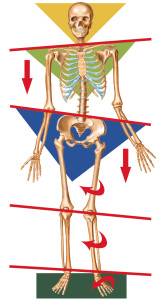 I imagine that there’s near universal agreement amongst Pilates teachers across the globe that alignment is important. Perhaps it is even the central tenet of the Pilates Method.
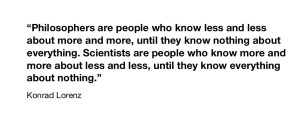 I believe that, as a profession, Pilates teachers are generally eager to learn and driven to keep doing courses and workshops long after their initial training. I recently discovered the term “course whore”, applied (by herself) to a Pilates teacher and, while it may not be a phrase I’d use, it appears to be a ‘thing’. It’s all the more interesting because it was clearly used as a pseudo-derogatory term, feeding an idea that the more courses you’ve done the better you will be. Or the more knowledge you have the better you will be.
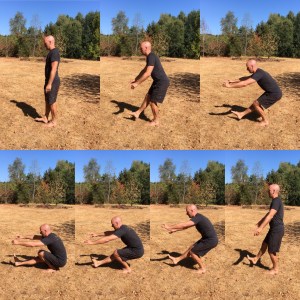
 When you’re teaching, do you see muscles, or bones?
 paleolates