Archives For November 30, 1999

The “Fast Diet”, also referred to as the “5:2” diet seems to be all over the UK media at the moment, accompanied by both very positive reviews, and expressions of concern about the dangers of encouraging anyone to fast.

I had this diet described to me as “fast for 2 days (actually, limit calories to 500/600 per day), and eat what you like for 5 days”. The man behind this is Dr Michael Mosley – and he made a television programme all about it, so it must be infallible. Apparently he found evidence that, aside from weight-loss, the Fast Diet is also associated with a range of other health benefits.

I have grave misgivings about any suggestion of ‘eat what you like’, because it seems to suggest that nutrition is unimportant. In other words, there’s an awful lot of ‘food’ around these days of very limited nutritional value. The idea (not Dr Mosley’s, I’m sure, but possibly widely-held nonetheless) that it’s okay to eat crap for 5 days, and then severely restrict your calories for the other 2, sounds like a recipe for very poor nutrition. And food, after all, is meant to nourish us, not simply supply us with calories.

I can’t help but listen to news items about diets without my Paleo-biased brain shouting “It’s what you eat, not how much or how often, that matters”. I’m also trying not to be a 197693_3967280097068_451202589_nfundamentalist about food. I do get a little stressed over vegan parents raising their babies as vegans. Equally, it would take very strong evidence (that I’ve seen no trace of) to persuade me that being vegetarian is as healthy (never mind sustainable) as being omnivorous . At the same time, occasional rants about soy products aside, if someone feels that the way they eat is the best for them, what business is it of mine? None, of course.
Back to ‘diets’. The biggest problem that I can see is that they always appear to be temporary. I may well be wrong, but I doubt that Dr Mosley is proposing that anyone follows the 5:2 ratio for life. This is why I really like the way that I’m eating these days (and why I’m always a little baffled by people asking me if I’m “still doing that diet”) – it’s great because it feels totally sustainable. I choose, generally, not to eat certain things, that were amazingly easy to give up. That’s it. Again, I’m trying not to evangelise.

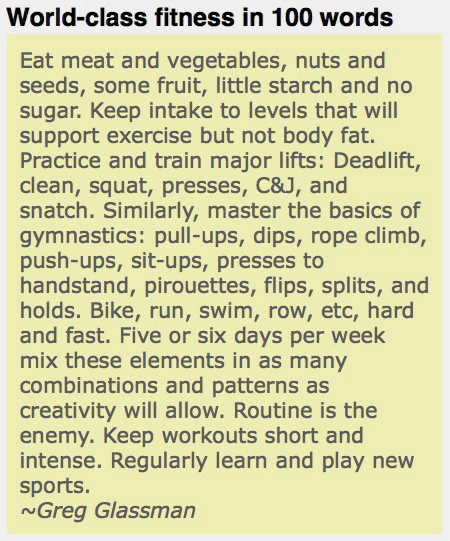
I was exposed to another idea today (courtesy of Paleo Solution podcast episode 167), attributed to Greg Glassman, founder of CrossFit. It seems like a brilliant approach to body composition, health, and (probably) any other outcome one might desire from a diet. Essentially, set yourself some athletic goals that will really stretch you. The podcast mentions double-bodyweight back squats and a couple of other outlandish strength/gymnastic goals, but we can all figure out athletic achievements that will stretch our individual capabilities. Perhaps it’s mastering the entire Super-Advanced Reformer repertoire, or doing “Romana’s Mat Challenge” 4 times in a row, if Pilates is your thing (though I think a more profound strength challenge would be best). Maybe it’s preparing to climb Kilimanjaro for charity. The point is that, if your goal is sufficiently challenging for you, doing what it takes to reach it will inevitably involve eating appropriately, and making positive changes to your body composition. No 5:2, no GI, no Caveman, no South Beach, no Atkins, no Blood Type (and on and on and on and on)

Perfect! Nourish yourself to achieve amazingness, and enjoy the combined side-effects of better health, and the body composition you’ve dreamed of.

There’s not enough THRUSTING

In a recent conversation with a personal trainer, he made the observation that the components of functional training are: “pushing, pulling, lunging, squatting and twisting”. Similarly, Mark Sisson refers to PEMs (Primal Essential Movements): Squats, Pull-ups, Push-ups & Planks.

A search of the web for components of functional exercise offers up the following “4 Pillars of Human Movement” (coined by ‘fitness maverick’, JC Santana): Standing and locomotion; Level changes in the body’s centre of mass (e.g.. squats, lunges etc.); Pushing & Pulling; Rotation.

Dr. Richard A. Schmidt (author of various books on motor control and learning) defined the six basic human movements as: squat, bend (deadlift), lunge, push, pull and twist.

CrossFit’s Training Guide describes Functional movements as those: “…that mimic motor recruitment patterns that are found in everyday life….Squatting is standing from a seated position; deadlifting is picking any object off the ground.”

You’re probably getting the gyst, and may be wondering what this has to do with Pilates. Well, Pilates is about teaching movement, and hopefully we can all agree that it’s a much better idea to be teaching functional movement over non-functional (isolation) movements.

One of the common themes to these lists is the presence of hip extension, which the CrossFit Training Guide (yes, I’m preparing for my Level 1 certification…) describes as”..the foundation of all good human movement” adding: “..without powerful, controlled hip extension you are not functioning anywhere near your potential.” Perhaps as a result of what I’ve learned from regular sessions of CrossFit, I’ve become somewhat obsessed with hip extension, and aware that the great majority of people that I see, both in classes and in the street, seem to be lacking ‘normal’ hip function.

Surely this is where Pilates should be coming in, and spanking everyone into good function? There’s lots of hip extension in Pilates, certainly when it comes to the equipment repertoire, (not so much in the mat work), so what am I on about? Here’s the thing – we typically approach hip extension, in Pilates, from a static trunk position. Take leg springs lying supine, or feet in straps on the reformer – both great exercises for teaching people how to move at their hip joint without compensating with their spine – but not allowing full hip extension. This doesn’t teach us that much about being upright. In addition, legs move in relation to the trunk, and there is very little Pilates repertoire that requires us to extend our hip joints by doing the opposite (trunk moving in relation to legs, or both moving simultaneously).

It’s been amazing to me to discover, both in myself and other Pilates teachers, how common the inability to dynamically extend the hips seems to be. When I was first asked, from a standing position, to flex at my hips and my knees, keeping my trunk stiff (something like the appropriate position from which to pick an object up from the ground), and then extend at my knees and hips to return to vertical, I couldn’t seem to do it without adding in some kind of spinal articulation. The short version of that rather wordy sentence is: ‘ I couldn’t thrust my hips’. Wanting to consider myself moderately virile, that’s a pretty humiliating discovery.

One of the things that I consider it my job, as a Pilates teacher, to convey to the people I’m teaching, is how to avoid substituting moving with their spines for moving in their hips – yet there I was, incapable of avoiding that substitution, when asked to do an unfamiliar hip movement. This is the crux – do we, or does Pilates, do a good job of teaching people to effectively use their hip extensors when they’re not lying down?

It’s not as if there’s an absence of standing work in the studio (again, mat work is a different story), and maybe I just don’t teach enough of that repertoire – though there’s a lot more squatting and lunging involved in my classes than there used to be. Working from the basic premise that spinal articulation exercises are only to promote flexibility (thus facilitating stability), I wonder if we don’t tend to overemphasise articulating the spine, at the expense of efficient, powerful hip extension. You may argue that powerful hip extension (‘PHE’, from now on) isn’t a part of optimal posture, but I’m willing to bet that someone that has the facility for PHE has a reasonable alignment of their pelvis on the top of their legs. I was tempted to insert pictures at this stage, but it feels too objectifying. Suffice it to say that I was watching a promotional video (from a very well-known manufacturer of Pilates equipment) for a new piece of equipment. The model, who in fairness may not be a Pilates practitioner (though I know of a number of Pilates teachers whose shape is similar), had a pronounced angle at the front of her hips in standing, that speaks to me of lack of hip extensor activity – again, this feels like a common sight to me – generally more noticeable amongst women, but that may simply be down to clothing. In contrast, the elite female CrossFitters seem not to exhibit the same posture, but are ‘flatter’ through the front of their hips. Typical CrossFit movements: dead-lifting, squatting, kettle-bell swings, even gymnastic movements at speed like pull-ups and rope climbs, are dominated by PHE.

Could it be that we could help more people improve their hip function overall, and their posture specifically, by incorporating more standing (& lying) PHE?

For suggestions on how to achieve this (without doing CrossFit) please look out for a forthcoming project, that aims to help make Pilates easier, simpler, and possibly, dare I say it, more effective. Readers of this blog will be the first to know about it.

One doesn’t have to search very long on the web to find critiques of CrossFit, there are many, and many of them valid. This seems to be largely down to the fact that it allows (fosters, perhaps) an obsession with the number of ‘reps’, or the time taken to do the workout, over practicing good technique. In essence, the idea of learning skills and then challenging one’s ability to remain skilful under duress is a really interesting idea. If you read any of the CrossFit training literature the same message is frequently repeated – form is everything. There is not an official edict that says “Finish the workout at all costs, never mind your technique”. Unfortunately, this point seems to have been missed by a number of certified coaches who fail to scale workouts appropriately for different people, and fail to teach the imperative of proper technique. CrossFit then earns a reputation for being dangerous, and causing injuries.

I will agree with anyone who suggests that becoming a certified CrossFit coach should be a little harder, but the arguments against Crossfit based on poor coaching are the same as the Daily Mail “How pilates can make your bad back worse..” type articles. Once you get passed the eyebrow-raising headline, the article essentially says ‘if you have a poor teacher, things may not work out too well’. As another blogger (whom I’m afraid I cannot credit, sorry) put it: “Crossfit is not dangerous. Bad coaching is dangerous. Poor movement is dangerous. Ego is dangerous.”

Enough about the problems with/for CrossFit (‘CF’ hereafter). This is about why I love it.

Maybe teaching Pilates for as long as I have (coming up to 10 years) had made me slightly jaded. The pressures of running a business during one of the longest recessions of my lifetime might have played a part too. Before I discovered CF I was still a firm believer in the possibilities of Pilates to work, something like magic, in transforming the lives of people with chronic pain, and other physical challenges, but I had fallen out of love with Pilates, a little. (That may also have something to do with my perception of the dominant trend away from building strength and fostering empowerment in UK Pilates teaching). In stumbling upon CF, and recognising their common threads, I’ve rediscovered my original zest for Pilates.

Aside from the philosophical similarities with Pilates that I referred to here, CF consistently teaches me about myself, in a way that no other discipline or type of exercise has. I’ve run marathons in the past, and done long training runs as part of the preparation, and I certainly found myself looking inward then. It’s probably true that I’ve suppressed some of the memories of what I may have seen. What I remember was the struggle to find a way to overcome physical fatigue, and some pain (and, to be fair, the stakes were high – nobody wants to train for 6 months to run a marathon, and then fail to finish). It also took a long time – both the activity, and the recovery. The soul-searching that I might do during a CF workout is different, and it’s a more humbling experience. On a number of occasions I’ve wanted to give up on finishing a workout, not because I was too physically tired to continue, but because my mind was telling me that I’d had enough. It was quite a surprise for me to discover that (with the motivation of, for instance, seeing my wife carry on when I wanted to stop) I’m capable of pushing myself beyond my previously perceived limits, which opens up a variety of new horizons.

There’s a camaraderie in doing CF workouts with others that I’ve never found in Pilates – perhaps because you’re more likely to be exploring the limits of your capacity. I’ve seen plenty of official marathon t-shirts with slogans that imply that being a marathon-finisher puts you in an elite group. Whilst the sentiment resonates with me, I also find it somewhat obnoxious. At the same time, there’s something about sharing the experience of a workout like Diane (Deadlift 225 lbs, Handstand push- ups, 21-15-9 reps, 3 rounds for time), especially doing it together, that forges connections. (CF is widely recognised for its community-building aspects).

Kristan Clever’s Diane at the 2012 CrossFit Games regionals

If you watched the video, there’s a clue to the humbling element of CF – not only is my ‘Diane-time’ about 10 times slower than the woman featured, it’s also slower than my wife’s (who of course has minimal interest in how long it took). It’s a curious feeling to set about something, believing myself to be bigger and, therefore, stronger, but to find that my wife is actually stronger than me. She’s a very accomplished Pilates teacher, and I admire her teaching a lot, but it doesn’t compare to the feeling of witnessing her steel herself, and push back the limits of her physical capability. For her too, more often than not, it seems that it is pushing past mental boundaries, that extends the physical ones. I’m finding it hard to adequately describe – there are moments at the end of a workout when, gasping for breath, I see deeper into myself than I have done during other physical pursuits. I wonder if it’s too much of a leap to suggest that it helps me make a connection to my primal self – the one that was born to run and hunt and struggle for survival…

The answer is “Yes”.
The question is one of my unfavourites, in a Pilates context – “What’s the breathing for (insert exercise name here)?” The answer is most definitely, “yes (you do need to breathe)”.
Of course, Breathing was one of Joseph Pilates’ fundamentals for his method. Attention to one’s breath can foster greater mind-body connection, and sense of ‘centre’ (presentness, if you will). And it’s also true that there may be a specific breathing pattern that will facilitate some movements, especially during the warm-up phase of a class. Equally, teaching someone ‘posterolateral costal breathing’ may encourage more mobility in their thoracic spine, and allow for greater control of lumbar spine stability. Undoubtedly valuable assets in Pilates, and life generally.
Not to mention that breath focus can be a powerful tool for relaxation. I like it if I’m having trouble sleeping – hopefully it’s a given that sleeping and a Pilates class are not complementary activities.
So, to clarify, I’m not trying to suggest that breathing should never be mentioned in a Pilates class. There are plenty of arguments for referring to it, especially in the early stages of a class.

My frustration arises when focus on breathing starts to hinder movement – because Pilates is fundamentally a movement discipline. I’ve seen many instances (back when I used to cue breathing patterns a lot) of people that were new to Pilates paralysed by confusion over when they’re ‘supposed’ to breathe. I’ve also seen teachers in training practicing what should be flowing movements, on the equipment, but stuck in space whilst they take the time to breathe in, so that they could then do the next part of the movement on an exhalation (because that’s how you’re ‘supposed’ to breathe…)

Again, I can think of good reasons for mentioning breathing during a Pilates class. When I first started teaching, cueing breathing was like a mantra that helped me remember the choreography of some exercises (Now I imagine that I can suggest a harmonious rhythm of movement and breath by the tone of my voice). Some people may need reminders to breathe in order not to grip and brace; other reasons I’ve mentioned above. All well and good in their place.

I’ve heard from teachers, who’ve trained with first generation teachers, that Pilates himself was only specific about breathing patterns with a couple of exercises, and otherwise simply wanted people to inhale and exhale fully. He surely wouldn’t have wanted anyone to focus on breathing to a particular prescription at the expense of enjoying the movement. If I try to rank the things that I believe are fundamental to Pilates, shortly after movement comes personal responsibility – and here’s my other beef with constant cueing of breathing: the more control the teacher assumes, the less their clients are likely to feel responsible for their own well-being. If the impression is created that particular movements have to be accompanied by particular breathing, will people be able to remain robust in situations that don’t allow time to consider when to breathe?

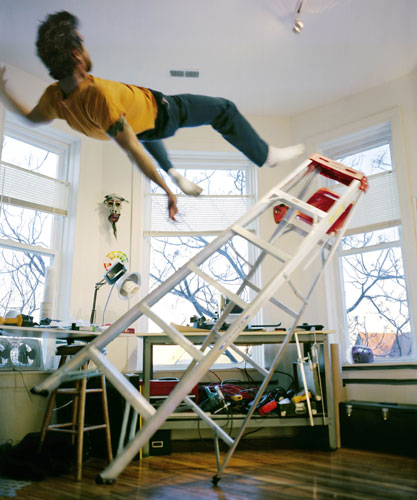
Photograph: Kerry Skarbakka/Barcroft Media

“Damn, should I land on an in-breath, or an out-breath?”

Many different people have tried to find their own niche in the world of Pilates, fusing with, or adding elements of other disciplines; or perhaps trying to make their classes specific preparation for another sport, or activity. (Yes, I have seen ‘bikinilates’ advertised). I think this may be missing the point, but more of that later.
There are also signs that some teachers feel that Pilates is not enough in itself – that it needs to lead to something more – and I’d number myself amongst them. One of my teachers and trainers early in my Pilates career, James d’Silva, has created the Garuda Method, which was advertised at one stage along the lines of “where Pilates ends Garuda begins”. (One might debate the idea of Pilates ‘ending’ somewhere, I can imagine some sticklers for tradition and the original work rejecting the idea wholesale.) For me, CrossFit begins, not where Pilates ends, but overlapping, and happily coexisting. Perhaps this is the time to answer the ‘What is Crossfit?’ question.

The answer is: “Constantly varied, high intensity, functional movement.” (…”Functional movements are universal motor recruitment patterns; they are performed in a wave of contraction from core to extremity; and they are compound movements -i.e. they are multi-joint.”), from ‘Understanding CrossFit’ by Greg Glassman.

Greg Glassman is the creator of CrossFit and, like Joseph Pilates, a maverick figure with a solid conviction that what he is doing is valuable and should be disseminated as widely as possible. The strongest link that appears to me between the two disciplines is in the intended outcome. My understanding has always been (though I can’t find it in either of Pilates’ books, I’ve heard it from first generation teachers) that Pilates’ intention, after years of practicing a variety of different disciplines, was to create an exercise program that was non-specific. In other words, his exercises were for overall fitness, in readiness for whatever challenges life may bring. More recently the concept of GPP – general physical preparedness – has emerged, and this is central to CrossFit methodology. One trains a wide variety of activities in order to be prepared for as wide a variety of potential challenges as possible. Glassman seems to be fond of the idea of preparation, in as much as one can, for the “unknown and unknowable”.

I cannot think of a single Pilates exercise that works a joint or muscle in isolation, and the idea of a “wave of contraction from core to extremity” sounds exactly like Pilates. Joseph’s own principles for his method were: breathing; whole body movement; and whole body commitment. I haven’t come across anything in writings about CrossFit specifically related to breathing, but it is very much to do with whole body movement, and total commitment. In a divergence of the two methods, Pilates prescribed his exercises lying or sitting to “relieve your heart from undue strain” (from ‘Return to Life‘). This is one of the areas that leaves some of us feeling that Pilates alone is not enough, and CrossFit workouts certainly put significant strain on the cardiovascular system. (Whilst I think the tired “no pain, no gain” slogan is a crass one, I believe it’s true to say that you can’t have adaptation without stress.) In this context CrossFit also profoundly effects breathing, and full use of lung capacity. Anyone who has tried high intensity exercise will most likely be aware that breathing to full capacity doesn’t require cueing…

The video is self-explanatory, if you jump straight to 3:20 you’ll see how well her lungs are functioning. (In case anyone is concerned, the video above is of an elite athlete performing at an advanced level. This does not represent the kind of work that beginners would be asked to do.)

Many Pilates exercises involve maintaining a stable trunk (spine) whilst moving arms and/or legs. Typically the weight of the limbs and their movement act as a challenge to that stable trunk position. Similarly, one of the fundamentals of many CrossFit movements is ‘midline stabilisation’ – the idea that, particularly under load, you keep your trunk stiff, and move from your hip and shoulder joints. The only difference between the two is that Pilates doesn’t add load to the same degree. Had he been faced with current levels of osteoporosis, for instance, who’s to say that Joseph wouldn’t have favoured picking some weight up?

Another element that CrossFit and Pilates share is an emphasis on precision. Sadly, if you make only a cursory search of the internet, you will find plenty of alarm expressed over the dangerous nature of some CrossFit workouts – and, indeed, plenty of YouTube video clips of people doing very demanding movements with eye-wateringly poor form. Just like so many articles about Pilates being bad for you, I don’t believe that this is a reflection of CrossFit, but one of either poor coaching, or simply poor performance. Just as Pilates insisted on his exercises being done with precision, both videos of training seminars, and conversations with Crossfit luminaries make it clear that ‘Form is everything’. In fact, one of the particularly interesting challenges for me is that CrossFit workouts ask questions along the lines of: ‘We know that you can lift that heavy barbell off the floor with good form, now can you do that multiple times, quickly, with good form? And how about keeping your form and doing that when you’re gasping for breath because you’ve just been doing another challenging movement at speed?’

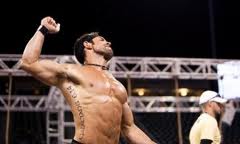
Rich Froning – ‘Fittest Man on Earth’

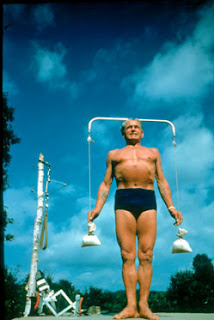
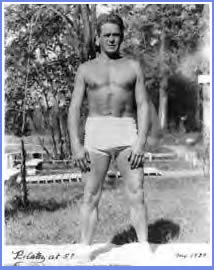
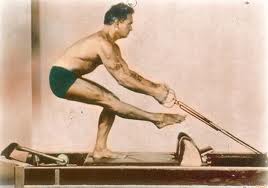
Joseph Pilates – tattooed health visionary

What else is there to lead me to the conclusion that Joseph Pilates would have embraced CrossFit? Followers of both methods will attest to the remarkable transformations in body composition, energy levels and overall well-being that are there for the taking. He didn’t seem to be interested in  great analysis of his method: one of my favourite Pilates quotes (as recounted by Ron Fletcher) is, in response to a question about the purpose of an exercise, “It’s for the body!”. CrossFit celebrates becoming faster, stronger, more agile – and does not dwell on the exact mix of muscles required. Perhaps most significantly Joseph, tattooed as he was, would have fit right in with a great number of CrossFitters, for whom ‘ink’ seems de rigeur.

I’m convinced that Joseph would have been involved in a movement like CrossFit, had he the chance. The truth is, while I couldn’t bring myself to give the post this heading, I believe (with apologies) that ‘CrossFit is the new Pilates’.

IT WORKS.

If you can maintain a ‘whole body’ approach, and avoid getting bogged down in complexities, but just get on and do it, Pilates really works!
An osteopath that used to work closely with a studio that I teach in would frequently refer his patients to the studio. Rather than giving them instructions for specific things to work on, he would advise them to “just do Pilates”. Presumably he knew that nothing extra was required.
I know, as a teacher, it’s easy to get caught up in the minutiae, or to become engrossed in trying to ‘fix’ a particular issue in a client. Of course, Pilates is a holistic practice. And the ‘edge’ that we may have over some medically trained practitioners is exactly that.

We could probably debate for ever how much Joseph really understood, on an anatomical or bio-mechanical level, about what he was doing. As I’ve asserted previously on this blog, whatever progress we think we’ve made since the 1940s, Pilates understood movement. This allowed him to devise a whole array of effective exercises, along with some foundation principles, that helped people to pattern good movement in their bodies. I think I tend to take this for granted, since my ‘Pilates miracle’ happened a good few years ago now. This miracle was going to a studio, at first once, and then twice a week, and working through a routine – not strictly the same exercises every time, but a consistent warm-up, and then trying to address my whole body whilst applying the fundamental principles (even before I knew that this was what I was doing).

Since then I’ve had plenty of opportunities to witness clients experiencing revelations about their own bodies, discovering that they can manage pain much more easily, increasing their range of movement and all the other things that we might expect from Pilates. More recently I’ve had a stronger reminder of Pilates’ elegant simplicity, in the transformation of one of my wife’s students. Perhaps one of the reasons that I noticed something particular in her case is that, while she has a history of various injuries, they were never the ‘object’ of her classes. When she started taking studio classes there was definitely room for improvement in how she stood, and the front of her body showed more muscle development than the back (We have shared a few laughs since at my early attempt to express, delicately, “your buttock should be more distinct from your thigh”).

Six months or so on, her transformation has been remarkable – the change in her posture is easy to see. Has she been following a particular program to address this; or having ‘new’ exercises invented for her? Not at all. What she has done is attend classes two or three times a week, been diligent about working on doing some mobility work on the joints that needed it, learning the exercises/movements that are especially appropriate or valuable for her, and getting on with doing Pilates.

And it’s been successful.  

If you can maintain a ‘whole body’ approach, and avoid getting bogged down in complexities, but just get on and do it, Pilates really works!

How did cheap and dirty become delicious?

(This post owes a huge debt to “It Starts With Food” by Dallas and Melissa Hartwig – buy it for yourself, and for everyone else that you care about…)

Millions of years before food scientists existed, our ancestors developed ways of helping them distinguish, and then remember, between good sources of nutrition, and bad. Sources of quick energy tasted sweet; sources of dense calories tasted fatty; and salty tastes were a sign of foods to help hydration, or maintaining hydration.

The net result: we are ‘hard-wired’ to seek out sweet, fatty and salty foods. It’s worth mentioning that the fruit our early ancestors ate was probably a fraction as sweet as the fruit we enjoy – we’ve had hundreds of thousands of years to select the sweeter mutations and make them dominant in their species. Fat sources would have been unprocessed, and salt simply found in more sodium-rich foods.

Everything our ancestors needed to nourish themselves was available in nature.
We all know that food can elicit an emotional response, and if our brain is receiving the signals that we’re being nourished it will release dopamine and endorphins. Thus, our ancestors would not only be nourished, but would feel good too.

Fast-forward to around ten thousand years ago, and our less-distant ancestors developed agriculture – allowing for production of food by a few for many to consume, and the potential to store food for long periods (never mind, for now, that this food was less nutritionally dense than more traditional hunted/gathered food).

I only mention agriculture because it allowed for all sorts of development, not least the study of sciences. Not needing to hunt or gather, some of those ancestors of ours had the time to indulge in more lofty pursuits. So, in more than one sense, agriculture gave us food scientists.

Fast-forward again, this time to the middle of the twentieth century, and manufacturers of food products had the knowledge and facility to exploit our hard-wiring to generate masses of profit. All that was necessary was to make food products that were sweet, fatty, or salty, or (ideally) a combination – doughnuts, potato crisps…..

These food products tasted amazing, and ticked the boxes that our DNA was programmed to recognise as nutritious input.

Here’s the best part, and the answer to the opening question. Real food (animals, fish, vegetables, fruit) can be costly to come by, might require a lot of looking after, careful handling and so forth. Those crops that lend themselves to an industrial scale of production (grains, corn, rape, soy, sugar beet etc) do so because they’re much less complicated they can be mechanically harvested and require minimal care in their handling en route to processing. Therefore they’re relatively cheap, and never mind that they’re a poor source of nutrition, the food scientists have an array of additives, or means of manipulating them so that they can be turned into ‘super-normal’ (super = beyond) tasting sweet, salty or fatty foods – way beyond what nature could conceive.
What effect does that have on our emotional response to food, mentioned above? Natural/real food, with its modest level of sweetness, fattiness, or saltiness, rapidly loses the ability to get our brains excited enough to release those feel good chemicals. How could it compete with ‘super’ ‘Frankenfoods’?

Have a look at the ingredients of, say, a packet (tube?) of Kellog’s sour cream and onion Pringles:

Dehydrated potatoes, vegetable oil, vegetable fat, rice flour, wheat starch, sour cream & onion flavour(hardened vegetable fat, onion powder, sour cream powder, dextrose, flavourings, sugar, sweet whey powder, lactose, milk protein, potato starch, food acids:citric acid, lactic acid and malic acid), emulsifier:E471, maltodextrin, salt, modified rice starch

Might any of those ingredients look like food? Sugar and salt, probably; dehydrated potatoes, maybe; modified rice starch….?

Where does this stuff come from…..

“Disc centrifuge for vegetable oil refining are widely used in continuous degumming, neutralizing, dewaxing, and washing of vegetable oils, such as peanut oils, colza oil,palm oil,oliver oil,sunflower oil,cottonseed oil,corn oil etc.”

Makes for an interesting contrast with ‘first cold pressing’, no?

                                                                                                               Modified starch making machine                            For more on rice starch click here

Mmmmm, ‘spray process’.

(It was an eye-opener having a brief search for suitable pictures, especially if one is viewing them from the ‘food’ & ‘industrial’ are two words that don’t go together perspective)

Perhaps this was my subconscious at work – I thought of Pringles as an example before I remembered their advertising strap line: “once you pop, you can’t stop”. They make a virtue of the fact that their food product is addictive…. Plus, it’s cheap to produce, dirty (in that, if shown them all individually, you probably couldn’t identify any of the ingredients, apart from sugar and salt), and (doubtless, to many) delicious.

Why would you want to eat real food ever again?

All that lying down.

The claims made for Pilates’ benefits are myriad – it is astonishing that it can, apparently, offer the wide array of outcomes that one can read about on the web. Before I give the wrong impression, let  me be very clear (again) that I’m an enthusiastic advocate of Pilates, and have both personal and professional experience of the remarkable changes it can help to make in many people’s lives.

One website I visited contends both that Pilates can help prevent osteoporosis, and that it will not stress joints. (Perhaps I’m wilfully misinterpreting, but surely stress is what promotes bone growth…?) This seems to relate directly to what, I would contend, is a flaw in Pilates (as it is often offered to the public). How much time do people spend lying down, both in mat and equipment classes ?

Revisiting some of those frequently listed benefits: How do we improve posture? We make muscles work more effectively (dare I say stronger?). How do we improve ‘core strength’? The same answer. How do we relieve back pain? Isn’t it the same answer? And helping prevent incontinence? Surely the same again. Of course there is a component of lengthening and releasing overworked muscles, and we can’t overlook working on breathing patterns, and developing physical awareness. All of these things are adaptations, and one of the most potent ways of triggering adaptation is stress, as expressed in the concept of hormesis. Explained as follows on www.innovitaresearch.org, a website offering information related to ageing:

In response to stress, an organism is expected to go through three distinct phases: alarm reaction, resistance phase, and exhaustion phase. According this schema, the adaptability can be developed during the resistance period. This notion is in line with the evolutionary view on the survival for the fittest theory, for which the only possible way to attain the survivability is through the organism’s metabolic and defensive adaptation to deleterious stress.”

 There are excellent reasons to spend some time in a Pilates class with the participants lying on their backs – using the floor as feedback for developing postural awareness, safely introducing loading of the trunk stabilisers, and introducing loaded hip extension, for example. Occasionally I set out to teach a mat class without any lying down, but generally speaking any mat class I teach will involve a bit, for those reasons above, and a few others. At the same time, many mat classes seem to incorporate a lot of lying down, and I’ve come across many people who are regulars at a Pilates studio and in the habit of spending 45 minutes of a 75 minute class lying on their backs (maybe a foam roll too, for variety..), before then moving to the reformer to do more…lying on their backs.
The trouble with lying down is that it’s not a very useful position from the point of view of affecting adaptation, since we can’t do much in the way of stressing bones, muscles etc. If, for example, someone is quite kyphotic, or has protracted shoulders, they may be able to find a better position, with the help of gravity, whilst lying down. What happens when they stand up? If we are to help people understand and maintain good/ideal/optimal (or insert your own referred adjective) upright posture then we need to teach them in upright positions. Just as you’re unlikely to improve your running technique by practicing swimming, you’re unlikely to get better at sitting or standing upright by practicing lying down.
Similarly, whilst we can lay the foundation for trunk stability in a supine position, we can’t help people learn how to be robust to changing loads/forces on their trunk when they’re standing unless we teach exercises that involve them standing. We cannot help people to move efficiently (safely, with confidence etc.) against gravity in the outside world if we don’t incorporate standing or sitting work in Pilates classes.
If we accept that one of the primary goals of Pilates is to help our clients to become stronger (In the man’s own words: “To achieve the highest accomplishments within the scope of our capabilities in all walks of life we must constantly strive to acquire strong, healthy bodies and develop our minds to the limits of our ability.”) then we have to be helping those same clients to affect adaptation. And if we accept that adaptation is triggered by practice, or rather, that we become good at doing the things we practice a lot (see ‘The Talent Code‘ by Daniel Coyle) then we should be asking ‘How much do our clients need to practice lying down?‘ I hope that we can agree that the answer is ‘Not much.’

Primal 101

May 11, 2012 — Leave a comment

It turns out that at least one reader wants me to explain the Primal lifestyle more than I’ve succeeded in doing previously (and doesn’t want to read ‘The Primal Blueprint‘). So, aiming for brevity, here goes:

Eat meat, fish, eggs, lots of vegetables, and some fruit, nuts and seeds.

(Red wine and 85% chocolate if you wish).

Fuel your system with fat, instead of sugar.

Avoid grains – they’re pro-inflammatory, calorically dense and nutritionally poor and, in the case of wheat particularly, associated with a broad array of ailments (from skin rashes to schizophrenia…)

Avoid legumes (beans, pulses etc.) – also potentailly pro-inflammatory, and the gas that they have a repuatation for causing is a product of your body trying to cope with things we’re not made to digest.

Move about frequently, at a slow pace.

Avoid ‘cardio’ exercise of the hamster-in-its-wheel variety (treadmill, crosstrainer etc. for half an hour plus). It doesn’t serve any useful purpose.

Lift heavy things regularly – squatting, deadlifting, pressing etc. (ideally have someone competent teach you how to do this)

Sprint occasionally. (High intensity interval training).

Get plenty of sun exposure (without getting fried) – it’s great for your vitamin D levels, and vitamin D has a role in a variety of crucial functions.

Get plenty of sleep, ideally in a totally darkened room. If possible, wake up naturally.

Stay alert – be as attuned as possible to your environment (maybe avoid walking around texting, shutting out sound with MP3 player etc.) This is about avoiding silly mishaps/accidents.

Don’t hold other people responsible for your own well-being.

Learn new skills.

Play (have fun) – there’s plenty of research to show that playing is both a fundamental part of learning, and a means to keep stimulating brain activity as we age.

That’s about it….Easy.

PrimalCon 2012

April 28, 2012 — 2 Comments

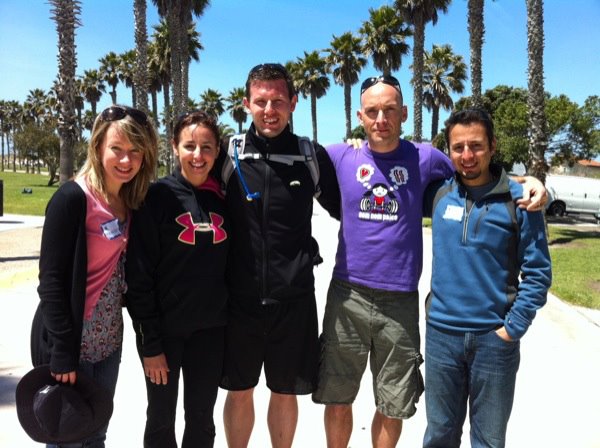
With some REALLY nice people I met at PrimalCon

This post feels a bit like “What I did on my Summer holidays”, and PrimalCon may be of limited interest to anyone who isn’t a primal or paleo lifestyler. Nevertheless, my trip to California has had the effect of shifting my view of Pilates, and teaching, along with a variety of other plusses (and minor minuses) that may be worth a mention, and a couple of readers have encouraged me to write about it.

I decided to book a place for the event late last year, based on the expected presence of two particular presenters, Frank Forencich and Erwan Le Corre, both of whom I really wanted to work with, even if only for the brief period PrimalCon would allow. Talk about nutrition, exercise and rubbing shoulders with like-minded people would be an added bonus. At the same time, California is a long way to go for 3 days of convention, so I started looking for courses or workshops around that time that would help to justify the journey. I was aware of MobilityWOD from mentions on various blogs, and had filed the site in my head as ‘must look at later’. A one day ‘Crossfit Mobility Cert’ presented by the creator of MobilityWOD, Kelly Starrett, was the only opportunity for professional development in the LA area that my searches threw up, so I signed up. I had my misgivings about the Crossfit methodology so, while the course sounded interesting, I didn’t have very high expectations.

A few weeks before going to California I came to realise that I was hoping that PrimalCon would help me to figure out what it was that I had been seeking to augment my Pilates teaching. When I discovered that Frank Forencich would not be presenting after all I was heartily disappointed, but hopeful that Erwan Le Corre’s MovNat might prove to be the way forward for me (exercising in nature, in a functional way – terrific).

The day after I landed at LAX I was heading for Crossfit Balboa feeling slightly uneasy. For those of you unfamiliar with Crossfit there are plenty of videos on YouTube that will give you an idea of what it’s about. Suffice it to say that many practitioners are big, strong and gymnastically fit (some emphatically not, but there’s a separate story), and I was definitely feeling like the puny Pilates teacher. First revelation of the trip (no, I was relatively puny) was that Kelly Starrett is a brilliant presenter – engaging, funny, endlessly enthusiastic, dynamic, and apparently able to deliver a whole day of material without notes. The really exciting part for me was that, although he was speaking the language of strength and conditioning (squatting, deadlifting, pressing, pulling, handstand push-ups etc), he was often sounding a lot like Pilates. I’ve referred in the blog previously to revelations about the synergy between Pilates and S & C, but this was really underlining it for me, and making me understand some of Pilates writings/exercises better than I had done previously. Why didn’t Joseph Pilates teach reformer footwork with internal hip rotation? Was it because he hadn’t thought of it? No, I bet it’s because he understood that it’s a crap position in which to do footwork. Naturally I was delighted to discover that Kelly was also going to be presenting at PrimalCon on the following weekend.

So, the main event. I got to Oxnard, home of PrimalCon, on the Thursday evening, and duly made my way to the beach park for the informal gathering of participants, meeting, amongst others, a woman who competes in “fig-yur”. Turns out it’s a kind of non-bodybuilding physical exhibition sort of thing that doesn’t seem to have made it’s way across the Atlantic (small mercies etc.). As mentioned, the event was being held in a beach park, so it was a bit of a blow when, shortly after the 7.30am registration,  a rainstorm of biblical proportion settled over the town for the bulk of the day. No problem, we’re Primal, we love evolutionary theory because it explains everything we do, so we adapt to circumstances, and move into a ballroom in the neighbouring resort hotel.

First on the schedule for my group was Kelly Starrett, presenting, essentially, a small segment of the one day course I’d done previously. The jokes were still funny, and it was a welcome reminder of some of his key ideas – I hadn’t been able to write fast enough to get everything down on the previous weekend. I was also left with questions practically spilling out of my head – always a sign for me that I’m in a stimulating environment. Next up was the MovNat presentation – yes, that which I was pinning my future hopes on. Clearly, learning about a movement program that is based on the outdoors is somewhat diminished by being inside a hotel ballroom, and Erwan Le Corre appeared to be duly flustered and frustrated by the circumstances.  We got underway with him explaining some theory that was certainly interesting – ‘Becoming fit through the practice of efficient movement skills enables a physical and mental conditioning that is the most effective and applicable to all areas of life.’ – and then practicing a few drills: how to jump and land, for example. Around this point in the presentation someone asked if there were resources, such as videos on the MovNat website, that would help us to priorly practice these skills later. The answer: No. The follow-up question was naturally ‘How then can we practice this more?’ The answer: Do a one day or two day MovNat course. It’s worth mentioning at this point that Kelly Starrett’s motto is:

“All human beings should be able to perform
basic maintenance on themselves”

and his MobilityWOD website has in excess of 400 video clips, freely available, to show you a huge array of techniques/exercises to increase mobility/range of movement/movement efficiency etc. To be honest, having spent a lot of time trawling around the websites and blogs of the primal/paleo community, I’ve come to expect that people are sharing valuable information for free, because it appears to be the norm. Never mind what’s the norm, the brusque manner with which Le Corre dealt with people who were expressing an interest in learning more was disappointing. There was enough interesting material in the short time that we had for me to still be interested in the certification courses that he mentioned before the finish, so I took the opportunity to ask him for more information. His response was along the lines of: ‘It’ll be on the website”, before turning his back to me. Now, call me old fashioned if you wish, but if someone approaches me to tell me that they’re interested in Pilates, and would like to know about my studio/where I teach etc. my first reaction is going to be appreciation for the fact that they’re interested , and some enthusiasm for telling them more. Consequently I was starting to wonder if Erwan was someone I wanted to be giving thousands of dollars to….

The afternoon’s agenda started with Mark Sisson’s (author of ‘The Primal Blueprint’, and PrimalCon creator) keynote address. One to one, or in small groups, Sisson didn’t seem terribly comfortable, but standing in front of a large audience he was very impressive. He spoke mostly about nutrition (apparently without notes) in considerable detail, emphasising the benefits of being a ‘fat burner’ rather than a ‘sugar burner’ – decreased oxidative damage, greater cell longevity, decreased inflammation, improved insulin sensitivity etc. Perhaps most impressively, he fielded a number of questions, some of them quite complex (even multifaceted – bravo Ozgur) and managed to give detailed answers, sometimes slightly tangential, without losing track of what he was talking about. He has 15 years on me and his memory appears to be decidedly better than mine – maybe if I follow his lifestyle tenets for another 10 years or so it’ll improve…

There were plenty of other presentations – running technique, kitchen skills, weight-lifting and gymnastic skills, nutritional advice, etc. with a lot of time given over to ‘free choice’ – meaning that the various presenters were around and available for questions and discussion. This meant that mini-workshops spontaneously occurred around the beach park which probably constituted the most valuable part of the weekend. Inevitably, still full of questions, I gravitated toward Kelly Starrett most of that time, and he didn’t disappoint – seemingly always available and eager to talk about movement (and happily, a keen advocate of Pilates). In contrast, Mr MovNat was much less available, and I became certain that his work does not present my way forward. In that respect PrimalCon was a failure for me, because I’d been hopeful of leaving knowing that I would enrol on a training course that would help to develop my own work. On the other hand, I learned so much from the time I spent listening to Kelly (and having my calf/thigh/shoulder mashed) that it was huge success. Not to mention that, though my Pilates teaching has already changed a little, what I learned feels like a doorway to much much more that I can be excited about discovering. I’ve realised that learning what you don’t want can be as valuable as learning what you do want.

Making new friends, and developing what I’m doing professionally, along with reminders of some things that perhaps I knew but had let slip, and lots of sunshine made the whole trip worthwhile. If you have the will to keep reading there’ll be more to follow shortly on specifics in relation to Pilates.

Here’s a bonus for making it to the end of this post….