

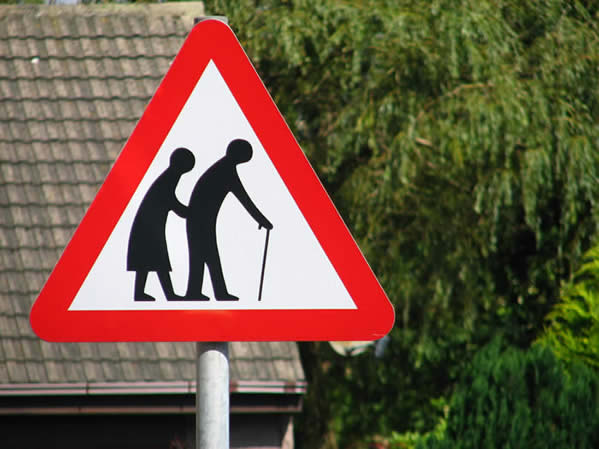
 In many ways, as a society, we seem to be fixated on age. There is the menace of the ‘ageing population‘, and the pressures on the economy, pension funds, and social services that this implies. Then there is the spectre, for many people, of how their age manifests itself in their bodies. It appears that the greatest anxiety for many, or perhaps the one which can be best exploited for profit, is facial ‘signs of ageing’ (The Anti-Ageing Skin Care Conference offers some intriguing sounding lectures…).
A Google search for ‘anti ageing products’ nets around 18 million results. Women (the advertising tells us) aren’t supposed to wrinkle with age – or at least they should spare the rest of us the horror by taking steps to reduce the wrinkles. Similarly, men and women alike should quite possibly mask any grey hairs that may grow. So far, so superficial. What seems to be less of a taboo are the signs of ageing visible in the way people move (or don’t move, perhaps), and the way that people hold themselves. It strikes me as ironic that the effects of ageing that are likely to put a significant burden on society are not the ones that we focus on the most. Perhaps that’s in part because there isn’t a lot of money to be made from encouraging older people to maintain their strength and mobility, and perhaps it’s because we have come to accept that getting older necessarily means that our bodies increasingly fail us. I’ve never thought to count the number of times that I’ve heard clients blaming aches and pains on age – I’m sure that if I tried to keep a tally it would number in the hundreds, at least.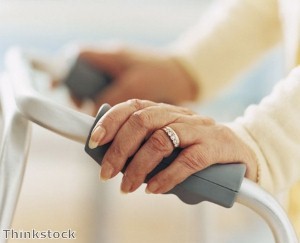
Why is it that we’re so ready to accept that becoming older means physical disintegration? (WOW, in typing that I’ve just realised that ‘disintegration’ is dis-integration. That’s a compelling argument for centering as a fundamental of Pilates, and many other movement/exercise disciplines). I’m not seeking to deny biological truths, whatever they may be, but rather to ask whether or not we are inclined to give in too easily? Another way of asking this might be: Are we living longer than our bodies are meant to last, or are we failing to maintain our bodies adequately for our natural lifespan?
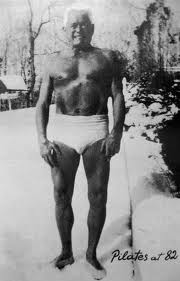
Joseph Pilates is an interesting example – legendary for his enthusiasm for posing, shirt off, showing an admirable physique aged 82. At this point I find myself wrestling with the notion of “…looks great for their age…”, which in a subtle way seems almost as tyrannical as the advertising I referred to earlier. I think Pilates looks amazing in this picture because he looks so robust – he looks younger than I expect a man to look at that age but it’s not to do with his face, or his hair, but rather the impression of vitality (whether or not that would be so apparent if he was fully dressed is another question). So, I like the idea that the notion of how age ‘should’ look in someone is not to do with skin texture, but with signs of life. I’ve certainly seen people with obvious signs of plastic surgery, or botox injections, that robs them of the appearance of life…
Pilates himself had an interesting take on age, and physical ageing. I have seen “We retire too early and we die too young, our prime of life should be in the 70’s and old age should not come until we are almost 100” attributed to him, though I cannot find the source. What we know he said, taken directly from ‘Return to Life’ is: “If your spine is inflexibly stiff at 30, you are old. If it is completely flexible at 60, you are young.” Romana Kryzanowska is one of his proteges who certainly embodied this philosophy, performing gymnastic repertoire on the Pilates apparatus into her 80s. At the same time, there is a wealth of information on the internet related to what a “gentle”, and “safe” form of exercise Pilates is, and that it won’t leave you “puffed-out”. The DVD ‘Pilates for Over 50s’ is available from amazon.co.uk, and whilst many of the reviews are positive, the one titled ‘Over 50s?! Over 70s more like!!’ speaks for itself. What should older people be expecting when undertaking Pilates? Many websites declare, for example, the benefits for bone density, yet I wonder if (in the UK at least) we are typically encouraging older clients to load their bones and joints sufficiently to make any meaningful difference.
I am forced to reflect on how I’ve approached teaching older people over the years, and my assumptions about what they will be capable of. I’ve taught many people over 70 in my 9 years of being a Pilates teacher, with a variety of orthopaedic problems. As a general rule I think it’s honest to say that my goals with most of those people were to maintain what strength and mobility they had, rather than to expect that there might be more. I’m sure that some of them enjoyed an improvement in flexibility, and balance in particular, but I cannot honestly claim that any of them got significantly stronger. Then I started teaching Li, a 73 year old women with a wonderful outlook on life (despite various daunting challenges to her health), who approaches her Pilates classes with vigour and gusto. I’ve rarely had so much fun teaching someone, and she has become both an enthusiastic advocate for Pilates, and promoter of our studio. I’ve found myself teaching repertoire to Li that I never imagined I would be teaching to a septuagenarian (Hanging Down on the Cadillac? – absolutely), and revelling in her appreciation of her own achievement.
Overall I hope that, when I’ve taken a softer approach to teaching some older clients (with perhaps less flexibility, or more orthopaedic challenges), it’s been a responsible choice, and appropriate too the individual. At the same time, have I let myself carry on in the same vein for too long, without offering the client the possibility of greater challenges? To return to the question: Are we living longer than our bodies are meant to last, or are we failing to maintain our bodies adequately for our natural lifespan? I think the answer might be a bit of both, and relates to Pilates’ own statement about age in relation to spinal flexibility – if we’re going to live for many decades shouldn’t we hope for optimal health throughout, and feel a responsibility to maintain our physical function to the best of our ability? (And as Pilates teachers, do we not have the responsibility to encourage our clients in this endeavour?)
Regular readers (might there be any?) won’t be surprised that I believe there is a nutrition component to this – avoiding pro-inflammatory grains and legumes will make us less prone to degenerative conditions. Dense (animal) protein will help us to maintain muscle mass – essential in recovering from illness, when the body demands protein for repair. Not to mention sun exposure, or Vitamin D supplementation to facilitate mineral absorption….
I am going to take Li, and the 86 year old woman in the clip below as my inspiration, and err on the side of adventure with my older clients. If I can be more relaxed about what is ‘safe’, and make Pilates more fun, perhaps it can help to have more wide reaching benefits – much like Pilates himself mat have imagined. One of the wonderful things about Pilates is that, I would argue, you have to really try quite hard to hurt someone with the great majority of the repertoire (I’m thinking of studio repertoire here), and this gives us huge scope to challenge and empower clients of all ages. Watch Johanna (especially around 0:44), and ‘believe in better’.

 paleolates