Archives For November 30, 1999

Older is not better

May 31, 2013 — 2 Comments

There was a report in the news last week relating to research into the safest place for a baby to sleep. According to the researcher I heard interviewed, the conclusion of the study was that the safest place for a baby to sleep is ‘in it’s own environment’. This struck me as rather curious, since I’d also read recently about the almost constant contact that babies in indigenous cultures enjoy with one or other of their parents.

A couple of days later I was talking to a pregnant woman, and mentioned this, at which point she said “Older is not necessarily better”, and went on to point out that in the past many more babies died than currently do. (This is a favourite theme for anyone rejecting an ancestral model for lifestyle choices. That or, ‘no-one lived past 40’…) It wasn’t the time to be pursuing that debate, but I cycled home musing on it that night.

It’s certainly true that because humans have done something for a long time it does not follow that it’s true. There are many examples of horrific practices that, happily, we have left behind us. I’m also aware that it’s rather easy to romanticise a, perhaps, simpler time, or a simpler life. (Years ago I was on holiday with friends, one of whom was from a farming background, and with far more working class sensibilities than I can pretend to have. We were on the island of Tobago, and I was very taken with the lifestyle of the fishermen in the village that we were staying in. They positively glowed with health, and whilst they obviously had to work hard, they seemed to be quite well rewarded. I was attracted to what seemed to be a very ‘natural’ and healthy life, with a straightforward effort/reward equation, and incurred the disgust of my friend for my privileged ignorance of the realities of hard work/hand-to-mouth existence.)

So, acknowledging that I may be wearing my rose tinted specs, I’m still fascinated by the idea that populations with less of the trappings of western civilization might enjoy a closer connection to their environment than we generally do. And this connection imparts a kind of wisdom that we turned our backs on many decades ago. This is a subject that many writers seem to be delving into at the moment – Mark Sisson’s “Primal Connection” is directly related to this, and it’s a theme that Frank Forencich regularly writes about. Doubtless there are many more. Perhaps people that live in closer contact with their environment make choices for the health of their environment, rather than ease of living, as ‘civilisation’ and the industrial revolution have allowed us to do for the last century and a bit. If you know that your food and shelter is dependent on maintaining something of a symbiotic relationship between yourself and your surroundings then you are highly likely to behave in a way that preserves that relationship. The chances are that this way of living has been ingrained for centuries, so that it is interwoven with your learning, play and life in general as you grow. In other words, perhaps it’s unconscious – you know what’s important without knowing that you know. Again, this is my rose-tinted perception, reinforced by wonderful books like ‘Wild‘ by Jay Griffiths.

In contrast, industrialisation and technology have allowed us to disconnect from the natural world more and more. (Aside from the practical implications, there is a rich vein of research into how this impacts our mental/emotional state). I’m certainly not about to give up a home with central heating, but I can believe that some time amongst trees and plants nourishes me in ways that food cannot.

Perhaps as the basis of postmodern theory (which I understand, highly simplistically, to be something like; ‘reality has been replaced by symbols and simulations of reality’ – apologies to Baudrillard if I’m way off the mark) we seem to have become very good at identifying problems that we have created for ourselves through technological advances, and remedied them with more ‘technology’. MBT shoes seem to be the perfect illustration of this idea – We recognise that there’s a problem with shoes, and pavements, flat ground etc. So instead of removing our shoes, and trying to spend more time with our feet on a more natural surface, we develop shoes that move us further away from true connection to the ground, whilst trying to represent that connection. Duh.

How about ‘ergonomic’ chairs? We recognise that sitting at a desk in front of a computer screen, controlling a mouse, and typing isn’t working out to well for us. No surprises there – we’re not ‘built’ for sitting for long periods, the load on our spines increases two-fold when we go from standing to sitting. The solution is, of course, to design a chair that makes us ‘better’ at sitting. One that actually requires less muscular connection in order to remain in the same dysfuntional position.

We no longer have the innate sense that should tell us that sitting for hours at a time is a bad idea. It reminds me of a conversation I had years ago with a martial arts enthusiast (and osteopath). His theory was that Pilates is essentially the same practice as yoga, tai chi, karate, kung-fu, kendo etc., but modified for a Western sensibility. One of the crucial differences is that, in the countries from which those other movement practices originate, children would be practicing them form a young age – repeating movements over and over again. By the time that they were old enough to question why they were going through these movement patterns, they had no need to ask the question because their body had learned the answer through the action. His argument went on that people doing Pilates often need to ask, or understand intellectually why they are doing particular exercises because they have not had the opportunity to develop that innate ‘body intelligence’.

tumblr_inline_mj1kfdrjMD1qz4rgp

Could this be the perfect squat?
Sorry, can’t find who to credit for this image….

A brief search on YouTube will quickly elicit plenty of video clips of toddlers doing ‘perfect’ squats, deadlifts etc. – the evidence seems fairly clear that we ‘know’ how to move well at a very young age, or at least that moving well is woven into our early development. Things seem to go wrong around the time that we start to put children in shoes, and make them sit for prolonged periods of time. Shoes and chairs are simple examples of technological advances that are creating problems for us, far beyond what surely could have been imagined when they were first conceived. Just as ‘older isn’t better’, newer is not better either. More importantly, increasing the disconnect between ourselves and our environment is a recipe for newer, perhaps more complicated problems (I’m envisioning later scenes in the excellent Pixar animated film ‘Wall-E” – if you don’t know what I’m referring to, please put this blog post down immediately and remedy the situation – I guarantee it’s way more entertaining).

So older is not necessarily better, but wisdom might trump technology. Returning to the subject that I started with, of baby’s safest sleeping place, isn’t it strange to think that a baby should have its own environment, that is separate from that of its parents? Does that occur in any other species of mammal? Is this perhaps a sign of our fundamental loss of sensitivity to our surroundings, that an adult’s sleeping space is inherently dangerous to a baby? Or have we truly figured everything out better than any of our ancestors did?

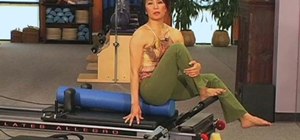
This workshop was first called “In Pursuit of Pilates Perfection”. It’s since been renamed “Pilates Made Simple”, but the content should encapsulate both ideas.

The aim of the workshop is to share the theories that a growing interest in strength & conditioning has exposed me to, and how they have influenced my Pilates teaching – and changed my life. (If you’ve seen any of my www.paleolates.com blog posts you may have already read references to this). I believe that it should be helpful to anyone teaching Pilates, either mat or studio, at any level, or to any particular population.

Meeting Kelly Starrett, taking his ‘Movement & Mobility’ seminar (and subsequently watching hours of his video blogs), helped me understand that I’d been over-complicating Pilates, and changed my teaching dramatically. Through him, and others in the strength & conditioning world, I learned that there are a set of simple principles and ‘rules’, fundamental to any human position or movement (that I now think Joseph Pilates understood), regardless of age or ability. Applying these ‘rules’ to Pilates allows me to see problems more clearly, and therefore to teach with more clarity, not to mention improving my own practice.

I’ve also gained a whole new set of tools to work on mobility, beyond what Pilates seemed to accomplish, and thereby changed my own body, also making Pilates repertoire feel easier. I hope to be able to pass on the sense of liberation, and satisfaction that it’s given me, with a mixture of theory and practical application that addresses both Pilates mat and equipment repertoire.

The workshop is 6 hours long, with approximately 4 hours spent on theory and relating theory to Pilates repertoire; and 2 hours for exploring the use of various mobility tools to facilitate the application of the theory to movement. There will be some notes provided – intended as a starting point/reminder for participants own thoughts and observations, and certificates of attendance will be issued.

Outcomes

After the workshop you will:

Be reminded of why good movement & positioning always matters 

Know a set of simple rules of movement and positioning, applicable to any activity

Be able to immediately apply those rules to teaching Pilates

Be able to impart those rules to your clients, to accelerate their progress

Have an additional paradigm for recognising movement faults and limitations

Have an array of mobilising tools to address movement limitations

Testimonials:

“A flexible and incredibly easy approach…”

“Fresh ideas – dynamic presentation. A retake on basics that is challenging in a positive way.”

“A brilliant way to improve your practice, and make it easier.”

“A very interesting workshop that has given me various ideas on teaching from cueing to exercise and equipment choice.”

“Rethink how you teach.”

The cost of the workshop is £90.

I seem to have frequent epiphanies these days – or rather the idea that things that I ‘knew’, perhaps in the darker recesses of my mind, suddenly crystallise into sharp and sometimes powerful ideas. Simple things, such as ‘Pilates doesn’t cure back pain, good movement cures back pain.’ Of course, Pilates is an excellent vehicle for teaching good movement, and it certainly ‘fixed’ my chronic low back pain years ago. Now I recognise that it wasn’t that my various Pilates teachers waved their wands and cured me with a dose of magic – they taught me better movement (and positioning) than I was accustomed to practice at that time (God love ’em).

There’s another conversation that can be had later/elsewhere about various methods some Pilates teachers seem to have for appearing to do magic, to be filed under ‘Disempowerment’.

Another closely related epiphany that I had recently (thanks to the wisdom of Kelly Starrett finally sinking in) is that whether we are teachers of Pilates, or yoga, or salsa, or karate, or tai chi, or…almost any other movement discipline, the work is the same – teaching good movement. (Pilates called it ‘right movement’). Some of those disciplines may involve a broader scope than Pilates but, in as much as they are movement disciplines, they should be teaching good movement.

I was leaving a health club today, after teaching, when one of the PTs approached me and asked if I just teach Pilates, or if I teach yoga as well. To my surprise, when I answered “No, I don’t teach yoga.” her immediate reply was “Why?”. My internalised response was something along the lines of: “Because I’ve found a really efficacious method for teaching movement (and spent years trying to do it well), why would I want to train to teach a different method with the same purpose?” I understand that people are drawn to yoga and Pilates in ways that I am not, so no disrespect to the multi-disciplinarians out there. To me, she may as well have said “Why aren’t you a personal trainer?”, given that I think that job should be essentially the same – teaching good movement.

This is what gets me excited at the moment, the idea of helping people in my classes to move, or position themselves well. And Pilates is such a brilliant means to this end. I had another revelation today – that the Hundred is a fantastic assessment tool. It can tell you so much about someone’s awareness and competence – Is their thoracic sufficiently mobile for their head to be well positioned? Can they stabilise their scapula? Are they able to disassociate their arms from their trunk? Can they stabilise their midline under the load of their legs? Can they keep breathing while doing all of the above? And so on. All questions that relate to activities outside the class.

If I can see that someone is struggling with any of those requirements of the Hundred, what are the most effective ways that I have for helping them do better? Obviously there are many ways to skin this particular cat, and I have a question for any teachers that are reading this: Is cueing muscles the best way to help people to move well?

The organisation under which I trained is holding their AGM around the time of writing, and an internationally renowned teacher has been invited to present workshops over the weekend. One of them is apparently titled “Pilates in Clay”*, and offers the chance to sculpt muscles, in clay, onto a pvc skeleton. The description continues: “Once you have made a group of muscles, we will use the Pilates apparatus to understand how they are engaged and in what functional capacity on the reformer.”

Now, it’s probably just me, but isn’t there a significant disconnect between teaching ‘right’ movement and understanding how (which) muscles are engaged and in what functional capacity on the reformer? Perhaps I would discover that my clients left tibialis anterior is over-recruiting during the tendon stretch. Then what? Do I then devise a program of tib ant recruitment timing exercises, along with a stretching program? What would Joseph Pilates have made of this? We might be able to look wise to our clients if we can suggest to them that their serratus anterior is failing to do its job of scapula stabilising correctly, but does that help them to move better? If you know the muscle that’s working/not working, are you a better teacher?

I would argue that this is an illusion. Yes, certainly knowing muscles and their function can aid in understanding movement. And I need to be able to have a conversation with a physiotherapist, osteopath, or surgeon using anatomical language. But when it comes down to the nitty gritty of moving, my brain is simply giving instructions for one body part (or more) to move relative to another, and the muscles are just accessories. Your brain doesn’t actually know that you’ve got muscles. Poor muscle balance is a product of poor movement, not the other way around. Aside from this, focus on muscles when teaching (in addition to appearing clever) can easily disempower the client, and help to reinforce the notion that Pilates is in fact magic, to be performed on you by your teacher. Can’t differentiate between your gastroc and your soleus? Oh dear, this is worse than I thought.

After years of being excited by analysing anatomy, and trying to ‘see’ muscles working/not working in my clients, I’ve been very fortunate to stumble upon the understanding (again, hat off to Kelly Starrett – and Gray Cook, Mike Boyle, Carl Paoli etc.) that Pilates is simple. Brilliant, and simple. The fundamentals of joint positioning for transmission of force, or resistance of load, are the same for Pilates as for any other movement discipline. ‘Force’ and ‘load’ are perhaps not words commonly associated with Pilates, but this is just different written/spoken language to describe the common language of movement.


*This may well be a brilliant and highly instructive workshop, it’s just that the description made me feel like chewing my fingers off.

Too much ‘creativity’.

As ever, the following is a reflection on the practice of Pilates that I am familiar with in the UK, and may not have any relevance/resonance for some, especially sticklers for classical Pilates.

I’ve attended workshops with Romana trained teachers (one in particular) and found that their vigorous adherence to ‘what Mr Pilates taught’ was rigid to the point of dogma, and not appropriate for the broad range of clients that I encounter. At the same time, it seems that we can sometimes forget/overlook the amazing range of repertoire that Pilates himself devised, and how effective so much of that repertoire is.

One of the consequences of living with (and being married to) another Pilates teacher is that many dinner time conversations revolve around shared experiences from our work. A frequent cause of frustration and, thus, topic for conversation, is a group teaching scenario whose dialogue goes something like: (client) “Can I do that exercise standing at the end of the Cadillac?” (teacher) “Sure, which one?” “It’s the one where you stand on the rotating disc and you hold the bar….and I think you bend forward, or something…” “Sorry, I don’t know that one.” “Yes you do. (Teacher X) showed it to me. It was really good.” “I’m pretty sure I don’t know which exercise you mean. What was it for?” “(Puzzled expression) For…? I don’t know – It felt really good.” “If you know why X gave it to you I might be able to figure out what it is – do you remember?”

This could go on for a while, but hopefully you get the gist. Let’s be clear – of course it’s great for clients to enjoy themselves and, in general, I’ve got nothing against people doing exercises that make them ‘feel good’. Then again, too many times I’ve seen people assuming horrible positions that apparently feel really good, teachers included (“Oh no, I would never let a client do this, it just feels really good.”).

There’s a couple of reasons, at least, for the above dialogue to be the cause of frustration. In the first place, while I wouldn’t advocate chapter & verse on whys and wherefores with every exercise, if we know the purpose or objective of an exercise, we have a much better chance of understanding and executing it well. On a couple of occasions when the client may have been able to recreate the feelgood exercise/movement, (typically involving a number of auxiliary props*) I’ve found myself wondering why a particular classical Pilates exercise wouldn’t have done just as well, if not better.

There may be many instances when it’s appropriate to adapt exercises, and also some occasions when it seems necessary to ‘invent’ something to meet the needs of a specific individual (just as Pilates himself did). Is that always the reasoning behind teachers ‘creating’ new exercises? I would guess that the answer is, quite often, no. Gray Cook addresses this in his article ‘Function?’:

We cannot prove this exercise will improve the way you move. It has not been shown to make you more functional. It has not been proven to create better performance or metabolism. It is simply the result of your trainer’s creativity and a surplus of time and equipment. It is an unscientific attempt to reduce your boredom with your current training program. This combination of equipment and movement is a way to entertain you and will distract from the objective tangible results you may not be getting.” (Gray Cook | Function? © 2011 Gray Cook, http://www.graycook.com)

Cook is writing about strength and conditioning coaches but his words seem to apply very well to Pilates (as do a lot of his writings, I can’t recommend him enough). To compound what he says, quite often it seems that there is no identification of, or desire for, specific and measurable results. In other words, aren’t we (no, our clients!) better off with a situation in which someone can say “I can see and feel that I’m able to move further and more easily in this range”, rather than “That stretch feels really nice for my back”?

The other side to this is that mystery exercises help to fuel people’s dependence on a teacher. Any time someone has no clear idea of the purpose, or desired outcome of an exercise the further along the road they are away from empowerment. Perhaps empowerment is not a goal that everyone has for their clients…. certainly it is at the heart of the philosophy at our studio. I’ve referred previously on this blog to conversations I’ve had with clients who’ve said something like “Teacher X has been working a lot on my neck”, when the client seems to think that Pilates is something that is done to them, and it feels like the same territory, to me, as teaching exercises that don’t have a clear intent. Never mind an identifiable name to make it readily repeatable.

One of the fringe benefits for me of having a teacher training program based in our studio is the presence of students working through manuals, practicing repertoire and reminding me of things that I’ve forgotten, because I don’t teach them regularly. The classical repertoire covers so much territory, and is so adaptable (especially in the studio) that I believe there are very few situations that truly require ‘new’ exercises. The classical repertoire, being recognisable and repeatable, also allows us to have some measures of our capability.

In other words, there’s nothing really wrong with Pilates, so we don’t need to be ‘fixing’ it with our creativity.

*There’s a side issue here of adding auxiliary equipment to exercises, to increase the ‘challenge’. Is there ever a good reason to put a foam roll on a reformer?

target-your-shoulders-with-pilates-reformer-routine.300x140

Image from pilates.wonderhowto.com

It’s a GPP system

My understanding (and I can’t remember whether this was gleaned from reading Pilates’ books, or hearing it said by one or other of the first generation teachers) is that Pilates’ intention was to create a form of physical training that, unlike the kinds of training he had done himself (boxing, for example), would ready one for any conceivable physical challenge. In a nutshell, General Physical Preparedness.

Along with the CrossFit Training Manual, I’ve been reading a fair amount of Gray Cook‘s writing lately, and both have some interesting things to say about specialisation.

“CrossFit considers the sumo wrestler, triathlete, marathoner and power lifter to be ‘fringe’ athletes, in that their fitness demands are so specialised as to be inconsistent with the adaptations that give maximum competency at all physical challenges.” To extrapolate that a little, none of those athletes can be considered truly fit. Heresy alert: Mo Farah is not fit!

In his lecture ‘Developing a Movement Philosophy‘ Gray Cook observes “Every time we specialise we give up our adaptability”, and later “any time we specialize, the human body at some point will start to break down.”

When writing here I invariably seem to get to the point of feeling the need to insert the “What has this got to do with Pilates?” sentence. Well, Pilates is meant to be promoting health – and I do like CrossFit founder Greg Glassman’s concept of ‘health’ being measured on a scale that runs from sickness, through wellness, to fitness – so hopefully Pilates is not simply promoting health, but specifically promoting fitness. (Why settle for being ‘well’, instead of ‘fit’, when ‘well’ puts us already half way to ‘sick’). Fitness requires adaptability, and as Gray Cook implied, specialisation is the enemy of adaptability – and here’s where Pilates steps up, because, again, it’s a GPP system.

At Pilates in Motion Studio we try to instil the idea in our clients that Pilates is a means to an end, not an end in itself. In a very broad sense, we could call that ‘end’ “living better“, and that’s precisely because Pilates is not a method to help us to get better a specific skill, or improve endurance in a particular activity (though of course those benefits may come), but because it should be preparing us for a wide array of challenges, from the mundane to the extraordinary.

By incorporating a mixture of movement patterns, in multiple planes, and by practising the principle of trunk stabilistaion while moving extremities (How many Pilates exercises revolve around this central concept?), we make ourselves more ‘robust to perturbation’ (as the biomechanists might say). Given a definition of fitness that incorporates a notion of adaptability, Pilates (perhaps with the addition of more load) practised with some periods of high intensity, provides a great foundation for general, not specialised, fitness.

The “Fast Diet”, also referred to as the “5:2” diet seems to be all over the UK media at the moment, accompanied by both very positive reviews, and expressions of concern about the dangers of encouraging anyone to fast.

I had this diet described to me as “fast for 2 days (actually, limit calories to 500/600 per day), and eat what you like for 5 days”. The man behind this is Dr Michael Mosley – and he made a television programme all about it, so it must be infallible. Apparently he found evidence that, aside from weight-loss, the Fast Diet is also associated with a range of other health benefits.

I have grave misgivings about any suggestion of ‘eat what you like’, because it seems to suggest that nutrition is unimportant. In other words, there’s an awful lot of ‘food’ around these days of very limited nutritional value. The idea (not Dr Mosley’s, I’m sure, but possibly widely-held nonetheless) that it’s okay to eat crap for 5 days, and then severely restrict your calories for the other 2, sounds like a recipe for very poor nutrition. And food, after all, is meant to nourish us, not simply supply us with calories.

I can’t help but listen to news items about diets without my Paleo-biased brain shouting “It’s what you eat, not how much or how often, that matters”. I’m also trying not to be a 197693_3967280097068_451202589_nfundamentalist about food. I do get a little stressed over vegan parents raising their babies as vegans. Equally, it would take very strong evidence (that I’ve seen no trace of) to persuade me that being vegetarian is as healthy (never mind sustainable) as being omnivorous . At the same time, occasional rants about soy products aside, if someone feels that the way they eat is the best for them, what business is it of mine? None, of course.
Back to ‘diets’. The biggest problem that I can see is that they always appear to be temporary. I may well be wrong, but I doubt that Dr Mosley is proposing that anyone follows the 5:2 ratio for life. This is why I really like the way that I’m eating these days (and why I’m always a little baffled by people asking me if I’m “still doing that diet”) – it’s great because it feels totally sustainable. I choose, generally, not to eat certain things, that were amazingly easy to give up. That’s it. Again, I’m trying not to evangelise.

I was exposed to another idea today (courtesy of Paleo Solution podcast episode 167), attributed to Greg Glassman, founder of CrossFit. It seems like a brilliant approach to body composition, health, and (probably) any other outcome one might desire from a diet. Essentially, set yourself some athletic goals that will really stretch you. The podcast mentions double-bodyweight back squats and a couple of other outlandish strength/gymnastic goals, but we can all figure out athletic achievements that will stretch our individual capabilities. Perhaps it’s mastering the entire Super-Advanced Reformer repertoire, or doing “Romana’s Mat Challenge” 4 times in a row, if Pilates is your thing (though I think a more profound strength challenge would be best). Maybe it’s preparing to climb Kilimanjaro for charity. The point is that, if your goal is sufficiently challenging for you, doing what it takes to reach it will inevitably involve eating appropriately, and making positive changes to your body composition. No 5:2, no GI, no Caveman, no South Beach, no Atkins, no Blood Type (and on and on and on and on)

Perfect! Nourish yourself to achieve amazingness, and enjoy the combined side-effects of better health, and the body composition you’ve dreamed of.

Adaptive Athletes

January 22, 2013 — Leave a comment

If I’m uninhibitedly honest, before last years Games, I used to view the Paralympics as a distinctly fringe event. Rather in the vein of “Ahh, that’s nice”, but of minimal personal interest.

Like many people, I suspect, last year was different, in that my family was making a point of watching many of the events on television (and trying to get tickets), learning the names of more athletes (no longer ‘Oscar Pistorious, and all the rest’), and becoming emotionally involved in many of the events.

A big part of what changed my perception of the Paralympics, was seeing GB track cyclist Jody Cundy’s reaction to his disqualification. You can see the full unedited version of what happened here, or the short version (all swearing, no back story) here. Suddenly I understood that, for the athletes involved, this was absolutely as serious as the Olympic Games is for anyone competing there, and that the level of training and commitment is at least equal. (I can only apologise for failing to grasp that previously).

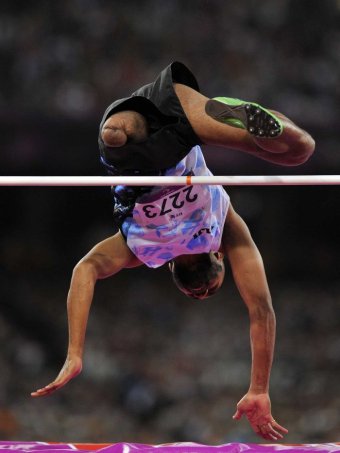
Iliesa Delana clearing 1.74 metres (Courtesy of Australian Broadcasting Corporation)

Fiji’s Iliesa Delana clearing 1.74 metres
(Courtesy of Australian Broadcasting Corporation)

Over the ensuing days I was consistently awed, humbled, and moved by what I saw of the Paralympics. Some of the highlights for me were the men’s F42 high jump (for single, above-the-knee amputees), and the blind long jump (I can’t imagine many things more terrifying than sprinting and jumping into space blind). The fact that the relay runners with cerebral palsy are required to exchange the baton within the same distance as the ‘able-bodied’ athletes should have made some of the latter, who failed to get the baton round the track, feel distinctly inadequate.

In the following months, aside from the BBC’s ‘Sports Personality of the Year’ awards, paralympic sport seems to have drifted back out of the public consciousness, perhaps to be largely forgotten until 2016. Happily for me, the lustre of last year’s Paralympics, and my associated perception of ‘disability’ sport, has recently been restored by the video below.

The story of CrossFit Rubicon, in Virginia, both rekindled my esteem for ‘disabled’ athletes, and helped to reset my perspective, such that ‘disabled’ (finally) feels like un entirely inappropriate word. The owner of the gym makes it clear that the words ‘handicapped’ and ‘disabled’ are not acceptable within the gym, and he describes those athletes working out there, who may be without one, or more, limbs as ‘adaptive’. This seems like a wonderful way of acknowledging the obstacles that people may have had to overcome to be turning up at the gym to exercise, without bringing any negative connotations. I’ve always had an uneasy feeling about the name paralympics – the ‘para’ sounds to me like it refers to paraplegic, defined in Wikipedia as: “an impairment in motor or sensory function of the lower extremities”. The idea of impairment seems completely misplaced in relation to both the athletes from last year’s Games, and the men and women at CF Rubicon.

So how’s this for an idea? The Adaptive Olympic Games, instead of Paralympic Games. I think that labels are often useful for clear communication, and find that many of the attempts in the last few decades to ‘reclassify’ things with less pejorative, or stigmatising language  serve mostly to make communication less clear. ‘Adaptive’ seems to admirably walk the line between clarity, and a description that doesn’t suggest ‘less than normal’.

The video’s not short (27 minutes) but deserves the “heart-warming”, “life-affirming”, “uplifting” cliches of many a Hollywood film poster. If you watch, I defy you to be unmoved by the spirit of these adaptive athletes.

Videos from Channel 4, and http://www.journal.crossfit.com

Rushing toward the end of the year (and having successfully negotiated the projected end of the world, unscathed) I’m probably not alone in contemplating resolutions for the next year. I’ve already made a commitment to be a ‘dryathlete’ for January –  no, NOT triathlete, my days of indulging in daft endurance challenges are behind me – the Dryathlon is a brilliant fundraising wheeze for Cancer Research UK, and will fit in nicely with my Whole30 plan.

I feel confident that I can go without alcohol for a month – I’ve done it before, just as I’ve done a Whole30 before (No: dairy, sugar, grains, legumes, alcohol. Yes: meat, fish, eggs, vegetables, fruit, nuts, seeds – hell yeah!), these are not radical changes, and don’t represent a significant challenge.

There are plenty of other instances when I’ve found myself not doing something that might represent positive change, and I’m trying now to evaluate my reasons. I notice immediately, casting my eye back over the previous sentence, that I ‘found’ myself not doing something – how’s that for disowning behaviour? On the whole, I’m not referring to very significant life changes, or behavioural changes, but rather the small things that might make a difference to a single day, and accumulate over time into more substantial benefit. For example, if I practiced skipping every day (I’m really crap at skipping – do not ask me to do a double under yet) I’m sure that I would get better at it relatively quickly. I do practice from time to time but, if it crosses my mind to do so, my usual gut reaction to that ‘practice-skipping’ thought is, at best “tomorrow”, and at worst “f**k it, I’m not in the mood”. There you are: compelling reasons not to be better… Why is it that those negatives seem so powerful? Perhaps it’s just me, and I’m inherently lazy. Yet, even as I write that, my mind is compiling a long list of evidence to support the case for my not being lazy, and I can’t accept that notion.

Along with the evidence from my own teaching practice, I hear plenty of tales from the coach that I see regularly of clients that are resistant to making small changes to their lives – small changes that might have a large effect. It appears, too, that the great majority of people who seek treatment of a specific problem from a physiotherapist or other health practitioner do not do the exercises they’re given as homework. I’ve come across this phenomenon so many times that the people that do their home exercises take me by surprise. Often, on suggesting dietary changes to someone with a chronic condition, or body composition goals, I’ve seen the mental shutters come firmly down. I’ve tried to give up on making such suggestions, as nutrition seems to be as contentious a subject as politics or religion, (but I still wonder… does anyone truly believe that they may become malnourished if they don’t eat bread for a few weeks?)

I’ve strayed a little bit from the point – who am I to say that dietary changes would necessarily be positive? I don’t limit myself to failing to engage in physical challenges that would be good for me. How often have I travelled on public transport, with the option of either reading something, or playing some stupid game on my ‘smart’ phone, and chosen option B? I’ve not read any books of the “7 habits of highly successful…” ilk, but if I did perhaps I’d learn that one of them is that, faced with that internal “shall I make the small effort required to do X, or not bother?” dialogue, really successful people will typically make that little extra effort. It may well not be my destiny to be really successful, so I’m not going to worry about that, but I am resolving to make the negligible effort to do something useful with my available time, rather than taking the pointless option. It seems like such a simple thing, yet I know it will be a hard resolution to keep. I just need to hold fast to the truth that there are no compelling reasons not to make positive changes, or to take positive actions: “later”, “f**k it”, “tomorrow”, “I can’t be bothered” certainly will not qualify. As Frank Forencich writes in ‘Change Your Body, Change The World‘: “When it comes to making substantive changes to minds, bodies or lives, easy doesn’t work. Easy doesn’t transform….Easy doesn’t save time; easy is a waste of time.”

The thing with new year’s resolutions is that they always seem to be finite, like my dryathlon will be. The real challenge, then, is to make avoiding the easy path into a life strategy, rather than a new year’s resolution.

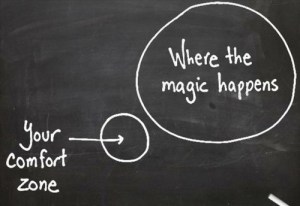
where-the-magic-happensImage courtesy of blog.unstash.com

Your Health

December 4, 2012 — Leave a comment

I heard recently that the NHS in the UK spent £8.6 billion on prescription drugs last year. Four of the top five most prescribed drugs are used to treat ‘lifestyle diseases’ – cardiovascular disease, diabetes etc. More recently I heard a news item about a suggestion that patients needing treatment for those kinds of illnesses should have to pay toward their treatment, on the basis that their condition is self inflicted.

All arguments about the practicalities of implementing such a system aside, why does it seem that many of us are willing to accept that ill health is inevitable, and beyond our control? There are plenty of scholarly books/articles written on the subject of ‘civilisation’ being our downfall as a species. The further we get from our origins as a species, the more prone we become to physical degeneration. The very things that make our lives easier are the things that make us more prone to sickness. As Frank Forencich writes (in ‘Change Your Body, Change The World‘): “by engineering our environment to take care of our every physical need and desire, we have simultaneously disempowered ourselves and bought disease upon our bodies.” (It’s perhaps worth noting part of his solution: “..we need to find creative and interesting ways to make our lives harder, in some cases much harder.”) Have our disconnection from our origins, our comforts, and medical interventions allowed us to believe that ill-health is somehow a natural state?

Since I began writing this, a few weeks ago, I’ve heard a few more snippets of information that have fed my thoughts on this subject. I heard a trailer for a radio programme concerning research conducted on animals, to investigate treatments for Alzheimers, diabetes, and obesity – estimated to cost the UK tax payer £35 billion/year. Separately, listening to episode 160 of The Paleo Solution podcast, I learned why ‘low GI’ foods are a hindrance to losing body fat. (It’s obvious really, and I should have figured it out before – our bodies need our blood sugar level to drop below certain levels in order to trigger the release of fat as an energy source. If you eat food that will specifically elevate your blood sugar level over a prolonged period you will be inhibiting your bodies ability to mobilise fat for energy).

The trailer for the above radio programme described scientists using their experiments on mice to find “treatments” for these diseases. Treatments that perhaps might be more effective than recommending diabetics eat low GI foods, one hopes…. But why ‘treatments’? It feels like an acceptance of the inevitability of these diseases to set about developing drugs (procedures, perhaps?) to treat them. If we don’t accept that our bodies have built in obsolescence, or that it’s ‘natural’ to become sick (please don’t!), then there has to be an alternative. How about honestly facing up to what behaviours lead to these problems, and giving people advice and support to change these behaviours – maybe then we’d find that it’s all the ‘treatment’ that is required.

Maybe everything comes back to money. There are so many vested interests in making us believe that we do not have control over our own bodies, and health – All those industries: the media; pharmaceuticals; food; ‘health food’ & supplements; fitness etc. This all adds up to a potent mix of misinformation, and contradictory information, that may well leave most of us with our heads spinning, or the impetus to bury them in the sand. In terms of diet alone – ‘fat is bad for you’; ‘carbohydrate makes you fat’; ‘saturated fat is very bad for you’; ‘red meat causes cancer’; ‘sugar is bad for you’; ‘reduce calories to lose weight’; ‘everything in moderation’; ‘calories don’t matter’ – not to mention all the miracle healing foods: cranberries, goji berries, acai etc. If you face serious struggles with body composition there is a minefield of advice in the media, of questionable value. And then in the supermarket: ‘fat free’; ‘no added sugar’; ‘low GI’; ‘high in fibre’; ‘heart-healthy’; ‘wholegrain’; ‘one of your 5 a day’ (funny that fruit and vegetables never get labeled with nutrition information… If you’re buying a packaged food item that makes this claim, I’d be deeply suspicious of its nutritional value).

This could become a tedious list very easily, so I’ll try to change tack. In short, the barrage of advice and consumer pressure all seems to add to a collective sense that we are somehow programmed to malfunction, and that the answer is either pharmaceuticals, surgery, or buying the right food product. This isn’t helped by government advice, both in the UK and the US, perhaps the rest of the developed world too, that is patently unsuccessful. How many people are following that advice and becoming fatter, or sicker? The lack of declining obesity rates should answer that.

In pursuit of an overall project of owning responsibility for our own health, along with remaining physically active (as I imagine you all are) – Pilates; lifting weights; walking; running; climbing; jumping, and all of that good stuff, here’s a challenge for you (I’ve just decided it’s called the “Don’t Play With My Food” challenge):

For the next 7 days only eat food that has not been packaged in plastic, tins, polystyrene or cardboard boxes (glass is allowed, as are cardboard trays for fruit, eggs etc.). The beauty of this is that you won’t need to look at ingredients lists, or nutrition information – you’ll be eating real food that doesn’t require labelling. Please let me know how you get on via the comments…

Many different people have tried to find their own niche in the world of Pilates, fusing with, or adding elements of other disciplines; or perhaps trying to make their classes specific preparation for another sport, or activity. (Yes, I have seen ‘bikinilates’ advertised). I think this may be missing the point, but more of that later.
There are also signs that some teachers feel that Pilates is not enough in itself – that it needs to lead to something more – and I’d number myself amongst them. One of my teachers and trainers early in my Pilates career, James d’Silva, has created the Garuda Method, which was advertised at one stage along the lines of “where Pilates ends Garuda begins”. (One might debate the idea of Pilates ‘ending’ somewhere, I can imagine some sticklers for tradition and the original work rejecting the idea wholesale.) For me, CrossFit begins, not where Pilates ends, but overlapping, and happily coexisting. Perhaps this is the time to answer the ‘What is Crossfit?’ question.

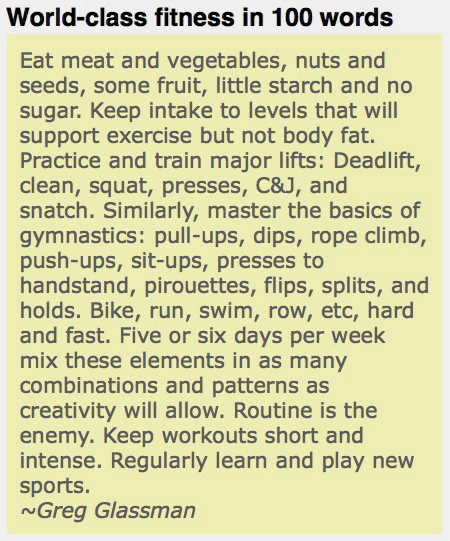
The answer is: “Constantly varied, high intensity, functional movement.” (…”Functional movements are universal motor recruitment patterns; they are performed in a wave of contraction from core to extremity; and they are compound movements -i.e. they are multi-joint.”), from ‘Understanding CrossFit’ by Greg Glassman.

Greg Glassman is the creator of CrossFit and, like Joseph Pilates, a maverick figure with a solid conviction that what he is doing is valuable and should be disseminated as widely as possible. The strongest link that appears to me between the two disciplines is in the intended outcome. My understanding has always been (though I can’t find it in either of Pilates’ books, I’ve heard it from first generation teachers) that Pilates’ intention, after years of practicing a variety of different disciplines, was to create an exercise program that was non-specific. In other words, his exercises were for overall fitness, in readiness for whatever challenges life may bring. More recently the concept of GPP – general physical preparedness – has emerged, and this is central to CrossFit methodology. One trains a wide variety of activities in order to be prepared for as wide a variety of potential challenges as possible. Glassman seems to be fond of the idea of preparation, in as much as one can, for the “unknown and unknowable”.

I cannot think of a single Pilates exercise that works a joint or muscle in isolation, and the idea of a “wave of contraction from core to extremity” sounds exactly like Pilates. Joseph’s own principles for his method were: breathing; whole body movement; and whole body commitment. I haven’t come across anything in writings about CrossFit specifically related to breathing, but it is very much to do with whole body movement, and total commitment. In a divergence of the two methods, Pilates prescribed his exercises lying or sitting to “relieve your heart from undue strain” (from ‘Return to Life‘). This is one of the areas that leaves some of us feeling that Pilates alone is not enough, and CrossFit workouts certainly put significant strain on the cardiovascular system. (Whilst I think the tired “no pain, no gain” slogan is a crass one, I believe it’s true to say that you can’t have adaptation without stress.) In this context CrossFit also profoundly effects breathing, and full use of lung capacity. Anyone who has tried high intensity exercise will most likely be aware that breathing to full capacity doesn’t require cueing…

The video is self-explanatory, if you jump straight to 3:20 you’ll see how well her lungs are functioning. (In case anyone is concerned, the video above is of an elite athlete performing at an advanced level. This does not represent the kind of work that beginners would be asked to do.)

Many Pilates exercises involve maintaining a stable trunk (spine) whilst moving arms and/or legs. Typically the weight of the limbs and their movement act as a challenge to that stable trunk position. Similarly, one of the fundamentals of many CrossFit movements is ‘midline stabilisation’ – the idea that, particularly under load, you keep your trunk stiff, and move from your hip and shoulder joints. The only difference between the two is that Pilates doesn’t add load to the same degree. Had he been faced with current levels of osteoporosis, for instance, who’s to say that Joseph wouldn’t have favoured picking some weight up?

Another element that CrossFit and Pilates share is an emphasis on precision. Sadly, if you make only a cursory search of the internet, you will find plenty of alarm expressed over the dangerous nature of some CrossFit workouts – and, indeed, plenty of YouTube video clips of people doing very demanding movements with eye-wateringly poor form. Just like so many articles about Pilates being bad for you, I don’t believe that this is a reflection of CrossFit, but one of either poor coaching, or simply poor performance. Just as Pilates insisted on his exercises being done with precision, both videos of training seminars, and conversations with Crossfit luminaries make it clear that ‘Form is everything’. In fact, one of the particularly interesting challenges for me is that CrossFit workouts ask questions along the lines of: ‘We know that you can lift that heavy barbell off the floor with good form, now can you do that multiple times, quickly, with good form? And how about keeping your form and doing that when you’re gasping for breath because you’ve just been doing another challenging movement at speed?’

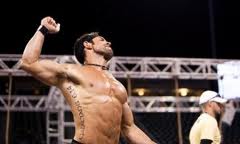
Rich Froning – ‘Fittest Man on Earth’

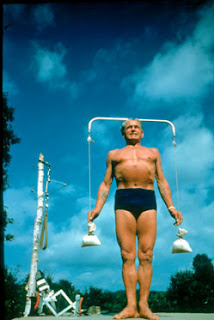
Joseph Pilates – tattooed health visionary

What else is there to lead me to the conclusion that Joseph Pilates would have embraced CrossFit? Followers of both methods will attest to the remarkable transformations in body composition, energy levels and overall well-being that are there for the taking. He didn’t seem to be interested in  great analysis of his method: one of my favourite Pilates quotes (as recounted by Ron Fletcher) is, in response to a question about the purpose of an exercise, “It’s for the body!”. CrossFit celebrates becoming faster, stronger, more agile – and does not dwell on the exact mix of muscles required. Perhaps most significantly Joseph, tattooed as he was, would have fit right in with a great number of CrossFitters, for whom ‘ink’ seems de rigeur.

I’m convinced that Joseph would have been involved in a movement like CrossFit, had he the chance. The truth is, while I couldn’t bring myself to give the post this heading, I believe (with apologies) that ‘CrossFit is the new Pilates’.