Archives For November 30, 1999

Your Health

December 4, 2012 — Leave a comment

I heard recently that the NHS in the UK spent £8.6 billion on prescription drugs last year. Four of the top five most prescribed drugs are used to treat ‘lifestyle diseases’ – cardiovascular disease, diabetes etc. More recently I heard a news item about a suggestion that patients needing treatment for those kinds of illnesses should have to pay toward their treatment, on the basis that their condition is self inflicted.

All arguments about the practicalities of implementing such a system aside, why does it seem that many of us are willing to accept that ill health is inevitable, and beyond our control? There are plenty of scholarly books/articles written on the subject of ‘civilisation’ being our downfall as a species. The further we get from our origins as a species, the more prone we become to physical degeneration. The very things that make our lives easier are the things that make us more prone to sickness. As Frank Forencich writes (in ‘Change Your Body, Change The World‘): “by engineering our environment to take care of our every physical need and desire, we have simultaneously disempowered ourselves and bought disease upon our bodies.” (It’s perhaps worth noting part of his solution: “..we need to find creative and interesting ways to make our lives harder, in some cases much harder.”) Have our disconnection from our origins, our comforts, and medical interventions allowed us to believe that ill-health is somehow a natural state?

Since I began writing this, a few weeks ago, I’ve heard a few more snippets of information that have fed my thoughts on this subject. I heard a trailer for a radio programme concerning research conducted on animals, to investigate treatments for Alzheimers, diabetes, and obesity – estimated to cost the UK tax payer £35 billion/year. Separately, listening to episode 160 of The Paleo Solution podcast, I learned why ‘low GI’ foods are a hindrance to losing body fat. (It’s obvious really, and I should have figured it out before – our bodies need our blood sugar level to drop below certain levels in order to trigger the release of fat as an energy source. If you eat food that will specifically elevate your blood sugar level over a prolonged period you will be inhibiting your bodies ability to mobilise fat for energy).

The trailer for the above radio programme described scientists using their experiments on mice to find “treatments” for these diseases. Treatments that perhaps might be more effective than recommending diabetics eat low GI foods, one hopes…. But why ‘treatments’? It feels like an acceptance of the inevitability of these diseases to set about developing drugs (procedures, perhaps?) to treat them. If we don’t accept that our bodies have built in obsolescence, or that it’s ‘natural’ to become sick (please don’t!), then there has to be an alternative. How about honestly facing up to what behaviours lead to these problems, and giving people advice and support to change these behaviours – maybe then we’d find that it’s all the ‘treatment’ that is required.

Maybe everything comes back to money. There are so many vested interests in making us believe that we do not have control over our own bodies, and health – All those industries: the media; pharmaceuticals; food; ‘health food’ & supplements; fitness etc. This all adds up to a potent mix of misinformation, and contradictory information, that may well leave most of us with our heads spinning, or the impetus to bury them in the sand. In terms of diet alone – ‘fat is bad for you’; ‘carbohydrate makes you fat’; ‘saturated fat is very bad for you’; ‘red meat causes cancer’; ‘sugar is bad for you’; ‘reduce calories to lose weight’; ‘everything in moderation’; ‘calories don’t matter’ – not to mention all the miracle healing foods: cranberries, goji berries, acai etc. If you face serious struggles with body composition there is a minefield of advice in the media, of questionable value. And then in the supermarket: ‘fat free’; ‘no added sugar’; ‘low GI’; ‘high in fibre’; ‘heart-healthy’; ‘wholegrain’; ‘one of your 5 a day’ (funny that fruit and vegetables never get labeled with nutrition information… If you’re buying a packaged food item that makes this claim, I’d be deeply suspicious of its nutritional value).

This could become a tedious list very easily, so I’ll try to change tack. In short, the barrage of advice and consumer pressure all seems to add to a collective sense that we are somehow programmed to malfunction, and that the answer is either pharmaceuticals, surgery, or buying the right food product. This isn’t helped by government advice, both in the UK and the US, perhaps the rest of the developed world too, that is patently unsuccessful. How many people are following that advice and becoming fatter, or sicker? The lack of declining obesity rates should answer that.

In pursuit of an overall project of owning responsibility for our own health, along with remaining physically active (as I imagine you all are) – Pilates; lifting weights; walking; running; climbing; jumping, and all of that good stuff, here’s a challenge for you (I’ve just decided it’s called the “Don’t Play With My Food” challenge):

For the next 7 days only eat food that has not been packaged in plastic, tins, polystyrene or cardboard boxes (glass is allowed, as are cardboard trays for fruit, eggs etc.). The beauty of this is that you won’t need to look at ingredients lists, or nutrition information – you’ll be eating real food that doesn’t require labelling. Please let me know how you get on via the comments…

Dallas and Melissa Hartwig, of  Whole9, have determined a set of ‘Good Food Standards’, set out below.

The foods we eat should:

  1. Promote a healthy psychological response.
  2. Promote a healthy hormonal response.
  3. Support a healthy gut.
  4. Support immune function and minimize inflammation.

Their basic message is that you should eat things that are nutritious (good for you), and avoid those ‘foods’ that are not – for instance, food with a high caloric but low nutrient value. I’m three and a half days into my fist attempt at a Whole30, a thirty day nutrition programme devised by Whole9. A Whole30 involves eliminating the following: all grains; all legumes (pulses, beans, peanuts etc.); all dairy (apart from clarified butter); all sugar (and substitutes); all alcohol. In addition, potatoes aren’t allowed, nor are any processed vegetable oils, which basically eliminates any restaurant fried food.

What’s the point? For me, it’s mostly to do with seeing if I notice any changes in all aspects of my life – exercise, sleep, energy levels, body shape and so on. It’s already been interesting to see how careful one has to be to follow this regime. I absent-mindedly reached for the chewing gum in the car yesterday and, thank goodness for my alert wife, was stopped in time.

I’m, typically, fairly mindful of what I’m eating, aiming to be generally living a primal lifestyle, but I’d noticed that I was managing to sneak more sugar back into my diet (85% cocoa chocolate still has sugar in, as apparently does alcohol, damn it). I’m curious to see how easy/hard it will be to go without those things that I’m used to having for a whole month, and my resolve is being bolstered by concurrently reading “Primal Body, Primal Mind” by Nora Gedgaudis, full of fascinating information about the consequences of our food choices.

It turns out that our digestive system is intimately linked with our immune system and overall health. We also, apparently, have more nerve cells in our gut than our brain, and 95% of all serotonin is produced in the gut, suggesting that there are links between digestion, and mood and sleep quality.

So, our fridge is stuffed with eggs and animal protein, and plenty of vegetables and fruit. I am feeling slightly more obsessive about food than usual, but obsessing about nutrient density doesn’t feel like such a bad thing. If it seems at all interesting I’ll report back at the end of June, when my 30 days will be up.

Primal 101

May 11, 2012 — Leave a comment

It turns out that at least one reader wants me to explain the Primal lifestyle more than I’ve succeeded in doing previously (and doesn’t want to read ‘The Primal Blueprint‘). So, aiming for brevity, here goes:

Eat meat, fish, eggs, lots of vegetables, and some fruit, nuts and seeds.

(Red wine and 85% chocolate if you wish).

Fuel your system with fat, instead of sugar.

Avoid grains – they’re pro-inflammatory, calorically dense and nutritionally poor and, in the case of wheat particularly, associated with a broad array of ailments (from skin rashes to schizophrenia…)

Avoid legumes (beans, pulses etc.) – also potentailly pro-inflammatory, and the gas that they have a repuatation for causing is a product of your body trying to cope with things we’re not made to digest.

Move about frequently, at a slow pace.

Avoid ‘cardio’ exercise of the hamster-in-its-wheel variety (treadmill, crosstrainer etc. for half an hour plus). It doesn’t serve any useful purpose.

Lift heavy things regularly – squatting, deadlifting, pressing etc. (ideally have someone competent teach you how to do this)

Sprint occasionally. (High intensity interval training).

Get plenty of sun exposure (without getting fried) – it’s great for your vitamin D levels, and vitamin D has a role in a variety of crucial functions.

Get plenty of sleep, ideally in a totally darkened room. If possible, wake up naturally.

Stay alert – be as attuned as possible to your environment (maybe avoid walking around texting, shutting out sound with MP3 player etc.) This is about avoiding silly mishaps/accidents.

Don’t hold other people responsible for your own well-being.

Learn new skills.

Play (have fun) – there’s plenty of research to show that playing is both a fundamental part of learning, and a means to keep stimulating brain activity as we age.

That’s about it….Easy.

In many ways, as a society, we seem to be fixated on age. There is the menace of the ‘ageing population‘, and the pressures on the economy, pension funds, and social services that this implies. Then there is the spectre, for many people, of how their age manifests itself in their bodies. It appears that the greatest anxiety for many, or perhaps the one which can be best exploited for profit, is facial ‘signs of ageing’ (The Anti-Ageing Skin Care Conference offers some intriguing sounding lectures…).

A Google search for ‘anti ageing products’ nets around 18 million results. Women (the advertising tells us) aren’t supposed to wrinkle with age – or at least they should  spare the rest of us the horror by taking steps to reduce the wrinkles. Similarly, men and women alike should quite possibly mask any grey hairs that may grow. So far, so superficial. What seems to be less of a taboo are the signs of ageing visible in the way people move (or don’t move, perhaps), and the way that people hold themselves. It strikes me as ironic that the effects of ageing that are likely to put a significant burden on society are not the ones that we focus on the most.  Perhaps that’s in part because there isn’t a lot of money to be made from encouraging older people to maintain their strength and mobility, and perhaps it’s because we have come to accept that getting older necessarily means that our bodies increasingly fail us. I’ve never thought to count the number of times that I’ve heard clients blaming aches and pains on age – I’m sure that if I tried to keep a tally it would number in the hundreds, at least.

Why is it that we’re so ready to accept that becoming older means physical disintegration? (WOW, in typing that I’ve just realised that ‘disintegration’ is dis-integration. That’s a compelling argument for centering as a fundamental of Pilates, and many other movement/exercise disciplines). I’m not seeking to deny biological truths, whatever they may be, but rather to ask whether or not we are inclined to give in too easily? Another way of asking this might be: Are we living longer than our bodies are meant to last, or are we failing to maintain our bodies adequately for our natural lifespan?

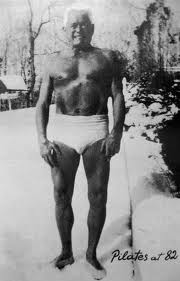
Joseph Pilates is an interesting example – legendary for his enthusiasm for posing, shirt off, showing an admirable physique aged 82. At this point I find myself wrestling with the notion of “…looks great for their age…”, which in a subtle way seems almost as tyrannical as the advertising I referred to earlier. I think Pilates looks amazing in this picture because he looks so robust – he looks younger than I expect a man to look at that age but it’s not to do with his face, or his hair, but rather the impression of vitality (whether or not that would be so apparent if he was fully dressed is another question). So, I like the idea that the notion of how age ‘should’ look in someone is not to do with skin texture, but with signs of life. I’ve certainly seen people with obvious signs of plastic surgery, or botox injections, that robs them of the appearance of life…

Pilates himself had an interesting take on age, and physical ageing. I have seen “We retire too early and we die too young, our prime of life should be in the 70’s and old age should not come until we are almost 100” attributed to him, though I cannot find the source. What we know he said, taken directly from ‘Return to Life’ is: “If your spine is inflexibly stiff at 30, you are old. If it is completely flexible at 60, you are young.” Romana Kryzanowska is one of his proteges who certainly embodied this philosophy, performing gymnastic repertoire on the Pilates apparatus into her 80s. At the same time, there is a wealth of information on the internet related to what a “gentle”, and “safe” form of exercise Pilates is, and that it won’t leave you “puffed-out”. The DVD ‘Pilates for Over 50s’ is available from amazon.co.uk, and whilst many of the reviews are positive, the one titled ‘Over 50s?! Over 70s more like!!’ speaks for itself. What should older people be expecting when undertaking Pilates? Many websites declare, for example, the benefits for bone density, yet I wonder if (in the UK at least) we are typically encouraging older clients to load their bones and joints sufficiently to make any meaningful difference.

I am forced to reflect on how I’ve approached teaching older people over the years, and my assumptions about what they will be capable of. I’ve taught many people over 70 in my 9 years of being a Pilates teacher, with a variety of orthopaedic problems. As a general rule I think it’s honest to say that my goals with most of those people were to maintain what strength and mobility they had, rather than to expect that there might be more. I’m sure that some of them enjoyed an improvement in flexibility, and balance in particular, but I cannot honestly claim that any of them got significantly stronger. Then I started teaching Li, a 73 year old women with a wonderful outlook on life (despite various daunting challenges to her health), who approaches her Pilates classes with vigour and gusto. I’ve rarely had so much fun teaching someone, and she has become both an enthusiastic advocate for Pilates, and promoter of our studio. I’ve found myself teaching repertoire to Li that I never imagined I would be teaching to a septuagenarian (Hanging Down on the Cadillac? – absolutely), and revelling in her appreciation of her own achievement.

Overall I hope that, when I’ve taken a softer approach to teaching some older clients (with perhaps less flexibility, or more orthopaedic challenges), it’s been a responsible choice, and appropriate too the individual. At the same time, have I let myself carry on in the same vein for too long, without offering the client the possibility of greater challenges? To return to the question: Are we living longer than our bodies are meant to last, or are we failing to maintain our bodies adequately for our natural lifespan? I think the answer might be a bit of both, and relates to Pilates’ own statement about age in relation to spinal flexibility – if we’re going to live for many decades shouldn’t we hope for optimal health throughout, and feel a responsibility to maintain our physical function to the best of our ability? (And as Pilates teachers, do we not have the responsibility to encourage our clients in this endeavour?)

Regular readers (might there be any?) won’t be surprised that I believe there is a nutrition component to this – avoiding pro-inflammatory grains and legumes will make us less prone to degenerative conditions. Dense (animal) protein will help us to maintain muscle mass – essential in recovering from illness, when the body demands protein for repair. Not to mention sun exposure, or Vitamin D supplementation to facilitate mineral absorption…. 

I am going to take Li, and the 86 year old woman in the clip below as my inspiration, and err on the side of adventure with my older clients. If I can be more relaxed about what is ‘safe’, and make Pilates more fun, perhaps it can help to have more wide reaching benefits – much like Pilates himself mat have imagined. One of the wonderful things about Pilates is that, I would argue, you have to really try quite hard to hurt someone with the great majority of the repertoire (I’m thinking of studio repertoire here), and this gives us huge scope to challenge and empower clients of all ages. Watch Johanna (especially around 0:44), and ‘believe in better’.

I have to hold my hand up at the outset and acknowledge that this post is going to be little more than a highly abridged version of Gary Taubes work in “The Diet Delusion“. That is to say, your time may be profitably spent reading his book instead of this post. I’m writing this really only to vent my frustration at the endless repetition of myths that Taubes so compelling takes apart in his book.

There have been a quite surprising volume of health/nutrition related programmes, and news features on UK television recently, ranging from: ‘Supersize vs. Superskinny’; to news coverage of the Harvard School of Public Health’s ‘Red meat increases cancer risk’ study; to Horizon documentaries like ‘The Truth About Fat’ and ‘The Truth About Exercise’.

What I find particularly remarkable about so much of the content is not what’s included, but what’s left out. That is to say that all of these programmes that I have seen assume that the viewers are already in possession of various ‘facts’ that require no explanation or back up. Things that we all ‘know’, such as: Dietary fat is bad for you, saturated fat is especially bad for you, cholesterol is bad for you, vegetable oils are more healthy than animal fats, wholegrains are healthy, high fibre is good, starches should form the basis of our meals, milk is healthy if it’s low fat…etc.etc.

Some time ago I saw another news story in which a member of the public was interviewed about lifestyle, and came out with the line: “We all know how to eat healthily…”. Obviously this is true, we’ve all heard it many times, and we can look at the Department of Health website if we’re not sure, that will show us the ‘Eatwell Plate’ to guide us to the right choices.

This is the conventional wisdom: low fat, high carbohydrate; 5 a day; and, increasingly, eat less meat. The question that Taubes set out to answer in “The Diet Delusion” was: ‘If we know so much about healthy eating, and sales of low fat and fat free foods have been so strong, why are obesity (and heart disease) rates still rocketing up?’ The answer, of course, is that we’ve been given bad advice on how to eat for the last fifty years or so.

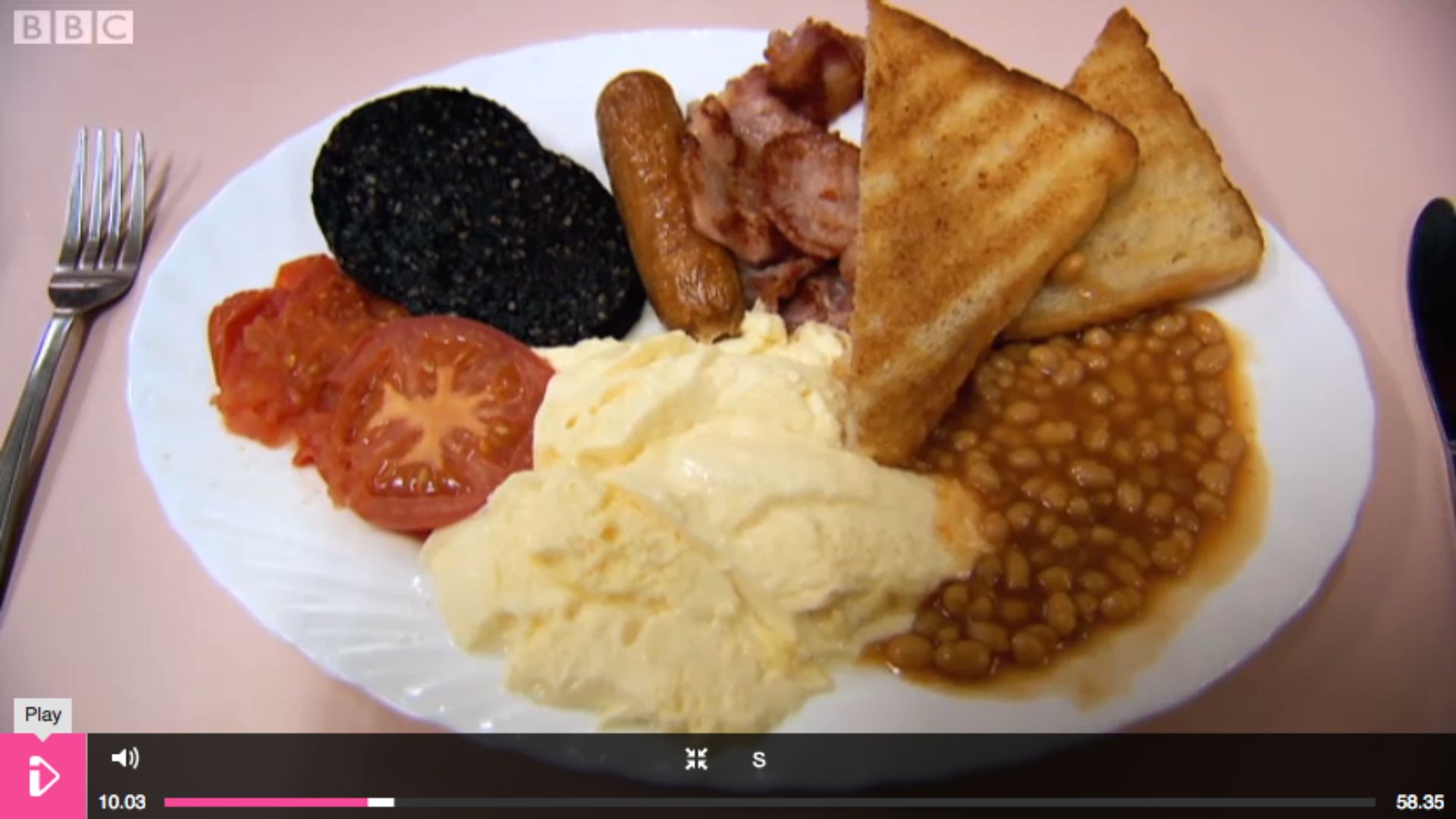
Horizon’s ‘The Truth About Exercise’ was the first programme to make me think about the regurgitation of  conventional wisdom. The point of the programme was apparently to look at how exercise might prevent the presenter form succumbing to diabetes. One of the segments looked at his blood lipids (how much fat was in his blood) after eating, and if exercising before eating had an impact on his blood lipid profile. The meal used for this was a ‘typical’ Scottish breakfast.

The expert, Dr John Gill  of the Institute of Cardiovascular and Medical Sciences at Glasgow University made a point of the fat in the breakfast (making no mention of the sugars present in the beans, bread, tomato etc.), and then took some of the presenter’s blood after eating, showing the viewer the level of fat in his blood. The message was very clear – eat fat, and the fat in your blood will increase. I’m no biochemist, but my understanding is that the mechanisms of digestion are a little more complicated than that. For example, if you’re eating fruit, and you’re muscle stores are full of glycogen then your liver will turn the fructose from the fruit into triglycerides (fat) that will then be transported by your blood to fat cells.

Horizon also presented ‘The Truth About Fat’ a couple of weeks later. It was refreshing to see that the gastric surgeon turned presenter for the programme changed her view of obese people (it turns out they don’t just lack her self-control). Disappointing to find that the ‘Truth’ that the programme offered lay in surgery, or hormone regulation medication that may be developed. Also disappointing to see the presenter selling the programme on breakfast television and casually mentioning the hormones that make fat people “want fatty foods”. A throwaway remark perhaps, and yet more reinforcement of the idea that fat makes you fat. The evidence is that it is carbohydrate that makes you fat, and addicted to it, to boot. (Read ‘Wheatbelly‘ for more on the addictive properties of wheat in particular).

The view of obese people often seems to be that they are greedy and lazy, and that if they only had more discipline, and exercised more, they would lose weight. I can accept that there are a lot of obese people who are continually consuming manifestly bad stuff – high sugar fizzy drinks, doughnuts etc., and I’m also sure that there are plenty of people who are trying hard to lose weight by “eating right”, but unsuccessful because what we’ve been told is the right way to eat is almost exactly the opposite of what will encourage weight loss. (According to Taubes the truth about healthy eating was being established by German scientists before the second world war but, tragically, there work was ignored – German science having been discredited by the horrors of the Nazi regieme).

Another BBC news story that I happened upon was about the popularity of ‘free-from’ foods (gluten-free, dairy-free etc.). The segment confidently asserted that only 1-2% of us are allergic to certain foods (subtext = it’s a fad). Whilst a small percentage of people may be allergic to gluten, testing is often unreliable, and many more of us may not tolerate gluten well. You don’t have to be celiac to suffer negative effects from gluten, possieffecting not on the gut, but the brain!   The dietician interviewed in the piece suggests that, if we exclude things like wheat and dairy, not only will we be eating a limited range of food, but we may be in danger of becoming malnourished (around 1:40 in the clip if you’re really interested). The story was followed by a discussion in the studio. The BBCs obligation to impartiality clearly doesn’t extend to nutrition, as the BBCs resident GP was the only person on hand to comment. Amongst her advice to viewers: “Do not consult a nutritionist, they are unregulated. Only consult a dietician” – like the one in the segment who thinks that eliminating wheat and dairy from your diet may result in malnutrition! If you visit the website of the British Dietetic Association seeking advice on healthy eating you will quickly find yourself looking at the ‘Eatwell Plate’, pictured above. Yes, meals based on starches, that we know make us fat. In fact, unless we are indulging in regular endurance type activity, we do not need any dietary carbohydrate because, by a process called gluconeogenesis, our body can make carbohydrate from other sources. (I’m not advocating a zero-carb diet, just trying to underline the crassness of suggesting that carbohydrate needs to form the basis of all our meals).

The Harvard School of Public Health’s study implicating red meat consumption represented another opportunity for the BBC news to cover itself in glory, presenting the story in an entirely uncritical light, and featuring a representative of Cancer Research declaring that “We now know that red meat causes cancer.” (To understand why this study is only fit for “lining a budgie’s cage” please see herehere, or here.)

There was no explanation of any possible mechanism, no-one to question how the data was gathered or interpreted. This was not a clinical trial that could legitimately be said to prove anything, yet the ‘findings’ were presented as incontravertible fact. Later that day in the gym I heard a trainer confidently asserting  that his client must get his protein needs from sources other than red meat. Fairy tale has become fact.

You might well argue that misrepresentations about eating red meat are less serious than those about how we become and remain fat – the consequences of people eating less red meat aren’t likely to be nearly as serious as the consequences ofoverweight people beingadvised to eat less fat and more starch (slow releasing sugar is still sugar). The pressing question is how we can be fit and well as a society if poor information, through repetition (often by authority figures), becomes popular belief? What’s the definition of insanity? How about repeating the low fat/high carbohydrate mantra and expecting obesity/cardio vascular disease rates to go down.

There’s a wealth of information available, not least of which is Taubes’ incredibly extensively referenced book. If you don’t fancy reading that, perhaps consider listening with a sceptic’s ear next time there’s a media story on nutrition/health.

Why go Primal?

March 15, 2012 — 2 Comments

Around June 2011 a friend of mine (let’s call him Glen, since that’s his name, and he may often make an appearance on this blog) told me about a book that he was reading, ‘The Diet Delusion‘. It sounded interesting, so I bought it, and was amazed by what I read in the first few chapters.  I won’t go into details here, suffice it say that the author dismantles, with the help of an astonishing array of references, many of the ‘sacred cows’ of healthy eating that I had believed in for years (the book is pretty dense, for a summary you can watch this video).

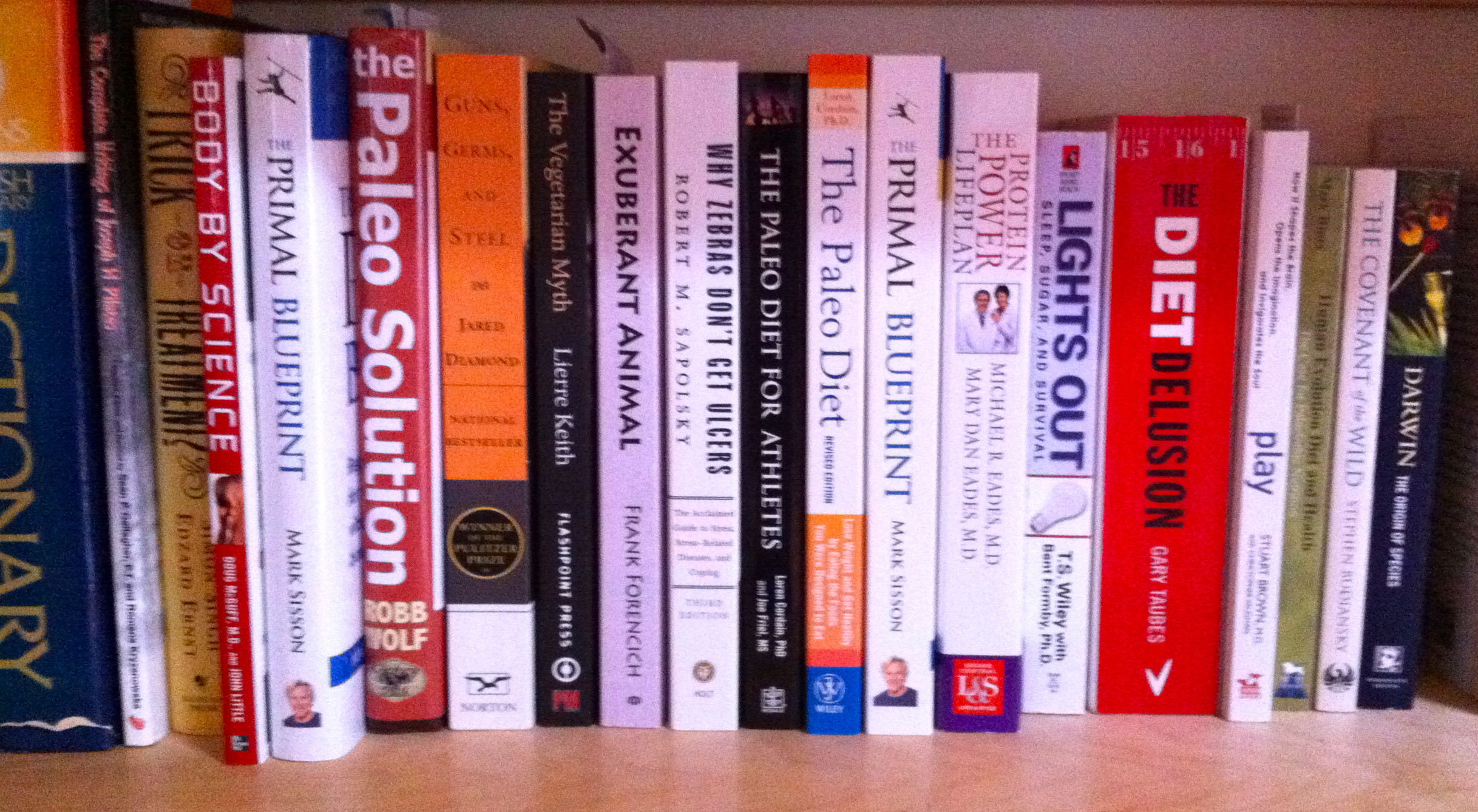
Talking to Glen about what I’d been reading, he suggested looking at the website Mark’s Daily Apple. Discovering this site was the watershed for me, and before long the shelf above my desk looked like this:

‘The Primal Blueprint’ is the manifesto of Mark (‘s Daily Apple) Sissons, and became my guide to applying the information of “The Diet Delusion’ to my life. The blurb on the cover offers “…effortless weight loss, vibrant health, and boundless energy”, and Sissons is very clear that the Primal Blueprint concept is not a diet, but a lifestyle. Nutrition is a significant slice of the Primal pie, but exercise, sleep and sun also play a part.

I didn’t start reading either of these books thinking that I needed to lose weight, but I certainly knew that I ate more sugar than was good for me, and had had a nutritionist point out to me that my diet was dominated by wheat. My daily food might look something like: toast and jam for breakfast; pain au chocolat and perhaps a croissant too during the morning; sandwich, with fruit, and probably chocolate for lunch; muffin/brownie/chocolate coated peanuts and maybe more fruit afternoon snack; and pasta or pizza for dinner. On the whole I considered myself to be reasonably fit and healthy (on reflection I may be very lucky with my genes…) and I knew that cutting back on sugar was very difficult for me. The transformation in my eating began, as I learned about the role of carbohydrate in fat storage, with trying to increase my protein intake – opting for sausage and egg croissant instead of the pain au chocolat, for example.

The more I read (and one of the things I enjoy about the Primal/paleo community is how much information people offer for free), the more I started to believe that eating grains was a bad idea, and with that I found it surprisingly easy to cut back on my wheat consumption. The shift in my eating probably took four or five months, and was amazingly easy. At first it was very difficult to find ‘primal’ snacks when I was out of the house but as my eating changed more I discovered that I don’t need snacks – four to five hours without food is perfectly manageable if you’re not carbohydrate dependent. A year ago I could easily eat an entire bar of Green & Black’s creamy milk chocolate (36% fat, 50% carbohydrate) – I might have felt a bit sick afterwards, but that wouldn’t have stopped me. Now I find one square of milk chocolate a) doesn’t taste of chocolate at all and b) is so sweet I can hardly bear it. At the same time Lindt 90% cocoa dark chocolate (55% fat, 14% carbohydrate) tastes truly wonderful.

As I mentioned earlier, ‘The Primal Blueprint’ isn’t just a diet book, so what else is there?

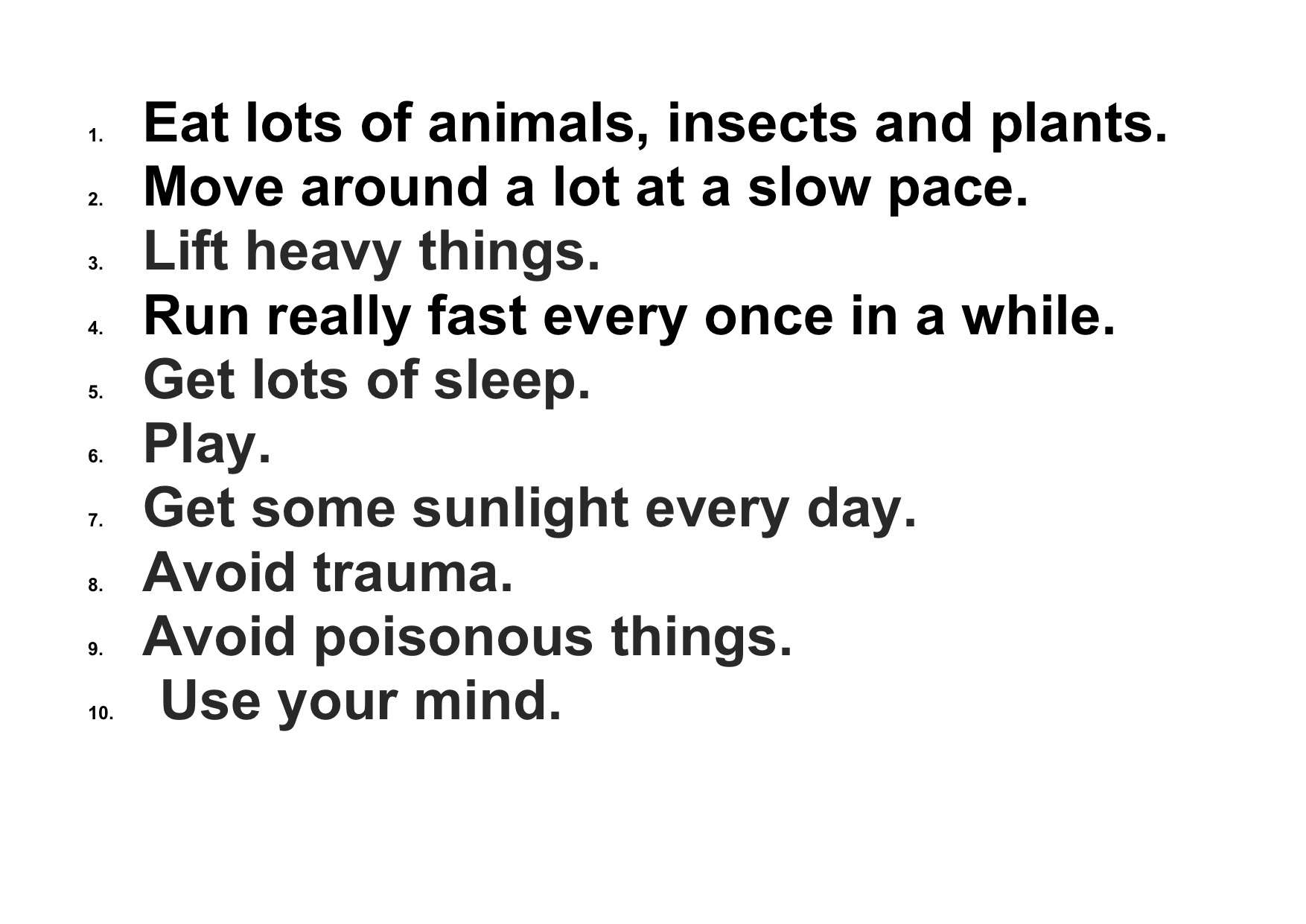
These are the 10 Primal Blueprint Laws. Some may need a bit of elucidation: ‘avoid trauma’ in an earlier edition of the book was ‘avoid stupid mistakes’, and is essentially to do with being more conscious of one’s environment, so as not to get hurt; ‘avoid poisonous things’ largely refers to eating foods that contain anti-predation chemicals/elements that we’re not made to digest – these would include almost all grains and legumes (I’m not the ideal person to explain why – please click on the links for Sisson’s own explanation).

I’ve not done so well with the insect eating, lots of sleep is sometimes tricky (especially when living with an excitable kitten…), and I don’t play as much as I might, but on the whole it’s been a very positive experience trying to stick to them. In fact, the changes to the way I eat, and approach exercise have led to one of the biggest transformations of my life.

Pilates definitely had a hugely transformative effect on me – it freed me from 18 months or so of chronic pain, and opened the door to the first real career that I’d ever wanted (and I met my wife through Pilates). It’s inspired me to learn, and allowed me the chance to be a part of running a thriving business. Probably because of my nature, Pilates also allowed me to have a somewhat entrenched view of ‘proper’, or worthwhile exercise, and a limited perspective on physical health. (Let’s be clear, these are my shortcomings. Please see my earlier post for more thoughts about Pilates and health).

And how has the Primal lifestyle transformed me? I’ve lost body fat (I had no idea I stored so much fat in my legs…); I feel like I have more energy; I’m stronger; my eczema is a thing of the past; I don’t feel bloated after eating; I’m less gassy, and my digestion from (ahem) start to finish is generally better. The weightlifting appears to have made me more flexible, and has also made me work some muscles much more than I’d managed previously – I’d never felt my back extensors work like they have to when I squat properly. I’ve also learned that activities like weight lifting have more in common with Pilates than I might have imagined – the language and the application is different but you still have to work from your centre, and the load is supported from your centre.

Physical things aside, there are plenty of other benefits. I’ve discovered that I really enjoy cooking, and, better still, the pleasure of cooking for friends and family who appreciate the food. I’ve developed a relationship with some of the people that I buy food from, and get a surprising kick from the whole process of eating, from the buying of fresh ingredients to the preparation and cooking (no more ready meals in our house…). As well as taking up weight-lifting and other high intensity exercise, I’ve also been introduced to other approaches to exercise/movement like MovNat and Exuberant Animal (see ‘Useful Links’), that I’m really excited to be learning more about. My inspiration to learn is greater than it has been in a long time, and I’m optimistic that I will be able to offer more to my clients over the coming years as a result. I’ve been led toward quite diverse reading material that has helped me to reframe thoughts about a variety of subjects, and to be more considerate of how my actions effect my immediate environment, and the larger world.

In the same way that we try to encourage clients at our Pilates studio to feel responsible for their health and well-being, the primal lifestyle really  fosters personal responsibility  that, in turn, encourages a positive outlook. If I believe that I’m in charge of my health, and I’m making sensible choices to support it, then I can feel optimistic about remaining healthy, fit and strong as I get older.

Pilates for…..health?

March 6, 2012 — 6 Comments

Many books about Pilates list the “6 principles of Pilates”, a number of them have extended 6 to 8 or 9, but many teachers will be able to tell you that the ‘original’ principles of pilates are: Breath; Centre; Control; Concentration; Precision; and Flow[ing movement].
These 6 principles do not appear in any of Pilates’ own writing and, in fact, appear to originate in ‘The Pilates Method of Physical and Mental Conditioning by Friedman & Eisen, and first published in 1980 (13 years after Pilates’ death).
The guiding principles of Pilates’ method, to be found in his 1945 book ‘Return to Life‘ are: Whole body health; Whole body commitment; and Breath; and have a very Pilates-esque no-nonsense simplicity to them. Why have 9 principles when 3 will get the message across?
Clearly things have changed in the years since Pilates’ death, we have a much better understanding of biomechanics, physiology and anatomy, along with entirely different ways of even considering human anatomy. (It should be said, too, that Pilates may not have been much concerned with those details – one of the highlights of the conversation between ‘Elders’ Ron Fletcher and Kathy Grant, available on DVD, is Fletcher’s reminiscence that, when asking Pilates what a particular exercise was for he received the gruff reply “It’s for the body”.) Despite these advances I can’t think of any compelling reasons to stray from his original 3 principles.

I’m all for asking for total commitment from our clients, especially if they have goals that they want to reach through Pilates, or expectations of what Pilates might do for them. This then begs the question (of me, at least): In teaching people Pilates, are we offering (the possibility of) whole body health?

Perhaps borrowing for the Pareto Principle, it seems to be widely accepted on fitness/exercise related internet resources that body composition is 80% determined by diet, meaning that exercise has a relatively limited effect on how fat we are. I’m not advocating a fixation on body fat, but all Pilates teachers must be aware that being overweight is highly likely to take an orthopaedic toll on an individual’s body. For example, the Johns Hopkins Arthritis Centre reports that ‘being only 10 pounds overweight increases the force on the knee by 30-60 pounds with each step.’ Joint problems are just one of many potential health issues related to being overweight or obese.

Having used it repeatedly in the paragraph above, I want to avoid repeating weight – I don’t think someone’s weight is as useful a measure of health as their body composition, how much fat they are storing. Hence how one’s clothes fit is a better indicator than a set of scales. It can be hugely challenging to address a client’s body composition, and requires that a relationship be established between teacher and client first of all (unless both are pretty thick-skinned). Nonetheless, if Pilates teachers (as fitness professionals, not alternative therapists), are to help clients towards whole body health I think we may have a responsibility to address such tricky topics. As you may have gathered if you’ve read earlier posts on this site, I lean quite strongly towards a particular way of eating – (in the interests of simplicity) low carbohydrate, moderate protein, high fat  – and, having read quite a lot on the subject, I’m happy to get into a conversation about nutrition with anyone these days (yes, maybe too happy, and more on that next time). The chances are that my nutrition views aren’t shared by all Pilates teachers, perhaps only a few, and I’m not arguing that we should all be preaching paleo eating to our clients. In the past I have had clients say to me “I know I need to lose some weight” and I’ve probably mumbled awkwardly and equivocated – now I think that, without getting into an epic conversation, I could have simply asked what they were doing, or planning to do, to accomplish the fat loss. I am not a nutritionist, but I can encourage clients to get help with shedding body fat, in the same way that I might encourage them to go to a physio or osteopath if that seems appropriate.

A lot of the clients that come to our studio list ‘weight loss’ as one of their goals. All other benefits aside, I don’t believe that Pilates is an effective means of achieving such a thing. Indeed, I think the evidence shows that eating is far more important to body composition than exercise. As fitness professionals I think we do have a responsibility to address nutrition (and maybe to mention that sleep quality and cortisol levels have a significant impact on our metabolism), even if that is no more than encouraging clients to seek professional help (or perhaps to read Gary Taubes’ “Why We Get Fat: And What To Do About It“). I’d love to hear what any fellow Pilates professional (in fact, anyone who may be reading) thinks….

Pilates for….what, exactly?

February 10, 2012 — 1 Comment

(The first thing I feel I should point out is that I’m writing this as a Pilates teacher trained, and practicing, in the UK. Other Pilates teachers may not recognise some of the scenarios I’m describing.)

Pilates called his system Contrology and in Return to Life he wrote:

“Contrology is designed to give you suppleness, natural grace and skill that will be unmistakably reflected in the way you walk, in the way you play, and in the way you work. You will develop muscular power with corresponding endurance, ability to perform arduous duties to play strenuous games, to walk, to run or travel long distances without undue body fatigue or mental strain.”*

It is clear that he intended his method to be a preparation for other ‘stuff’ – for life, in fact. Herein lies my frustration with a lot of what I see in Pilates studios and mat classes. Not to mention the kind of comments I hear, and see in social media from my peers.

I have heard American teachers insisting that, although injured people went to Pilates’ studio, and clearly got help with their injuries form the man himself, Pilates as an exercise method is intended for fit people. In the UK it seems that we have been somewhat hamstrung by the general impression that Pilates is for people who are injured, or in pain. This has been propagated by the media, and doubtless encouraged by teachers who want to boost their business by appealing to those people who may not feel that they can manage ‘normal’ exercise. Not to mention that many of us, myself included, took up Pilates to try to deal with chronic pain of some sort, and became evangelists for the method because it is has the capacity to change lives.

What’s the problem with that? On the face of it, it’s a brilliant thing, and I have been nearly moved to tears on a number of occasions when I’ve seen people discover that they’re able to do more than they believed possible. Unfortunately, what I seem to see all to often, is people doing Pilates weekly (or even more frequently) who have plateaued at a reduction in their pain, and failed to move forward from there. The promises contained in the quote above have little or no relevance to them, and this is a tragedy. Instead of feeling empowered to do more, it seems as though they and/or their teacher/s have created an invisible ceiling for them, that they are terrified to try to break through. What seems to be left then is an emotional attachment to Pilates, a belief that they cannot function without it, yet no desire for, or belief in the possibility of achieving more (playing strenuous games, for example).

As teachers we often have a difficult job encouraging clients to expect more, and I fear that sometimes we, knowingly or not, succeed in holding them back, or at least allow them to ‘aim low’. I would suggest that the first lesson of Pilates ought to be “You are responsible for your own health” – a notion that seems to be systematically undermined in our society. I have seen advertisements for Pilates workshops that describe “using Pilates on our clients”, and I have heard clients saying “[insert teacher’s name] has been working a lot on my shoulders”. As soon as we allow ourselves to take the client’s personal responsibility from them, we have disempowered them, and greatly reduced their chances of enjoying the kind of results that Pilates wrote about.

It seems blindingly obvious that the underlying message of the passage quoted above is that Pilates is not an end in itself. I absolutely endorse the idea of Pilates as a lifelong practice, but not for its own sake. We often teach people to move slowly, in order to help them move with control. This is just a part of the journey, and not a rounded preparation for life outside the studio/class. We may well give people exercises with relatively low loads, in order for them to sense how they can transfer load from their limbs to their centre – fantastic! But not enough if we really want to make people fit and strong – and if Pilates isn’t about trying to help people to be fit and strong then we’ve seriously lost the plot.

If I try to answer my own question (Pilates for what?) I have to say (however corny it sounds) “Pilates for life” – not for ‘relaxation’, ‘feeling good’, ‘Pippa’s bum’, ‘weight-loss’, ‘core stability’ etc.  I want to stand for Pilates as a means to deal with all the stuff that life puts in our path, good and bad, as well as we possibly can.

*I have the impression that a lot of teachers these days have a rather dismissive attitude to Pilates theories, preferring to believe that we have a much better understanding of things with the advances of science since he was writing. Every time I look through Pilates’ writing, I am delighted to discover how often he was spot on. I think this may relate to my previous post – a lot of his ideas still make perfect sense because they fit within the framework of evolutionary biology.