Archives For November 30, 1999

I just tried an internet search for “pilates low back pain” and Google returned 1, 380, 000 results. Google scholar also offers hundreds of ‘scholarly articles’ that touch on the subject. Amazon offers several DVDs of Pilates for low back pain, but their offerings are dwarfed by the hundreds of YouTube videos on the same subject. Another Google search for the same terms but in the News section suggests that in the last month English language newspapers and magazines have also had hundreds of articles on this subject. Coupled with my own experience of Pilates ‘fixing’ my low back pain, is it any wonder that I’ve spent years believing that Pilates offered the best solution for anyone suffering from this nearly ubiquitous affliction?

The Dummies.com website has a page, attributed to Ellie Herman on: ‘Easing Your Back Pain with Pilates‘ in which she explains that the causes of back pain are “faulty posture” and “sedentary lifestyle”. While we might like to suggest some other possible causes, I don’t suppose that many Pilates teachers would disagree with her – it seems like pretty basic stuff: you sit and/or stand badly, your postural muscles get lazy, you ability to stabilise your spine is compromised, and from there you’ll be very lucky if you don’t wind up in pain.

So, why is Pilates so good at helping relieve low back pain? Well, of course, it targets your ‘core’, deep postural muscles that give your lower back its stability. The less uncontrolled movement that you have in your lower back, the less likely it is that you will have pain. As your stability improves Pilates can help to develop efficient movement of the whole of your spine, encouraging good posture during a variety of activities. In addition, helping areas of relative stiffness to become more supple, and areas of relative ‘looseness’ to become more  stiff (stable) can help to bring more balance to our structure, and integrate our limbs into our trunk.

I was lucky enough to receive a pretty high level of training as a Pilates teacher (certainly by UK standards), and to work with some truly brilliant teachers from the UK and the US. I hope that I can reasonably consider myself to be well steeped in the principles of Pilates, and how to apply them when faced with clients with chronic pain and/or injury. I know about ‘working away from the pain’, and I’ve particularly enjoyed Ron Fletcher’s anecdote on that subject in his conversation with Kathy Grant (I referred to this DVD in a previous post) – Fletcher (a dancer at the time) explains that he went to see Pilates for help with a knee injury. Every time he went to Pilates’ studio he would be given exercises to do that had nothing to do, and Pilates would ignore Fletcher’s protestations that it was his knee that was the problem. After a few sessions Fletcher discovered that his knee was better.

So, I think my training has equipped me to help clients deal with back pain fairly well. I also believe that I understand a lot of the potential causes of back pain, as well as the importance of posture in maintaining a healthily functioning spine. I’ve been fixated (in my teaching) with hip mobility for years, and ‘get’ its importance relative to spinal stability and functional movement. I know, too, that most of us could do with working on upper back extension (and probably rotation and side-flexion too), and that the consequence of that will be less pressure on our necks. The list could go on, and that’s not really the point. In short, I felt that I had the basic understanding that I needed to do my job well, and that Pilates taught well was the ideal solution for all manner of problems. I certainly didn’t imagine that the world of strength and conditioning would have much more to offer in that regard.

More recently my perspective has been challenged. First of all by learning some of Mike Boyle‘s ideas (if you follow the link you’ll see just the kind of website that fit my prejudice completely – all it’s missing is advertising for protein powder) from his book ‘Advances in Functional Training’. (Actually this info is second-hand since it was my wife who bought the book and then explained it to me – I am nothing without her.) Boyle explains the body from the ground up as a series of joints that require, alternately, mobility then stability: ankle joint needs mobility, knee needs stability, hip needs mobility, lumbar/pelvic joints need stability, thoracic spine needs mobility, cervical spine (neck) needs mobility. Genius!

Being peripherally involved in a Pilates teacher training programme I understand how tricky anatomy and physiology can be to get to grips with, not least because it rarely seems to be straightforward, and how often students crave some dependable, simple answers. I’ve suffered the frustration, and seen it in many students too, of different books giving different answers for muscle functions. I know now that anatomy is an evolving subject, not a science in which all the answers have been found and set in stone. Thus, an explanation of what we need from our joints, expressed as simply as Boyle does, feels like a wonderful breath of fresh air. Mobility: stability: mobility: stability….It also seems to fit perfectly with ‘working away from the pain’ – you leave the problem area alone, and look for the adjacent compensations/weaknesses/stiffnesses. I think I had learned the same thing previously, but perhaps in a way that meant I didn’t see the wood for the trees – I knew it in pieces, and had never heard it said so succinctly. Lots of bits of information fell into place as I mused on this idea, and it’s become a constant reference point when I’m teaching.

Following that I was listening to a podcast recently in which the two hosts (one a strength and conditioning coach and the other an olympic weightlifting coach) were answering a question about exercising with a herniated lumbar disc. In discussing the question they came up with an equation something like: “If your hip joints are mobile, and your thoracic spine is mobile, you probably won’t have low back problems. If your hip joints aren’t mobile, and your thoracic spine isn’t mobile, you probably will have problems with your lower back at some point”. More genius! 

It’s just like Mike Boyle said! (Mobility, stability, mobility, stability….) Again, I knew already what they were saying, in fact I’ve probably been saying the same thing to clients for years, just not in such a clear and straightforward way. Perhaps I’ve just been lagging behind all these years, thinking I knew more than I did – certainly I need to view other disciplines with a little more humility than I have in the past. In any case, when trying to learn more about what I do for a living, casting my net wider has definitely been rewarded.

To return to the Ellie Herman piece on http://www.dummies.com, posture may well be a part of the picture, but there’s more to it, and you may be able to make a significant difference to your risk, or management of back pain, by going beyond her advice to:  “sit and stand up tall, keep your belly pulled in, and keep your shoulder blades pulling down your back”. Maybe even by listening to the advice of weightlifters.

Why go Primal?

March 15, 2012 — 2 Comments

Around June 2011 a friend of mine (let’s call him Glen, since that’s his name, and he may often make an appearance on this blog) told me about a book that he was reading, ‘The Diet Delusion‘. It sounded interesting, so I bought it, and was amazed by what I read in the first few chapters.  I won’t go into details here, suffice it say that the author dismantles, with the help of an astonishing array of references, many of the ‘sacred cows’ of healthy eating that I had believed in for years (the book is pretty dense, for a summary you can watch this video).

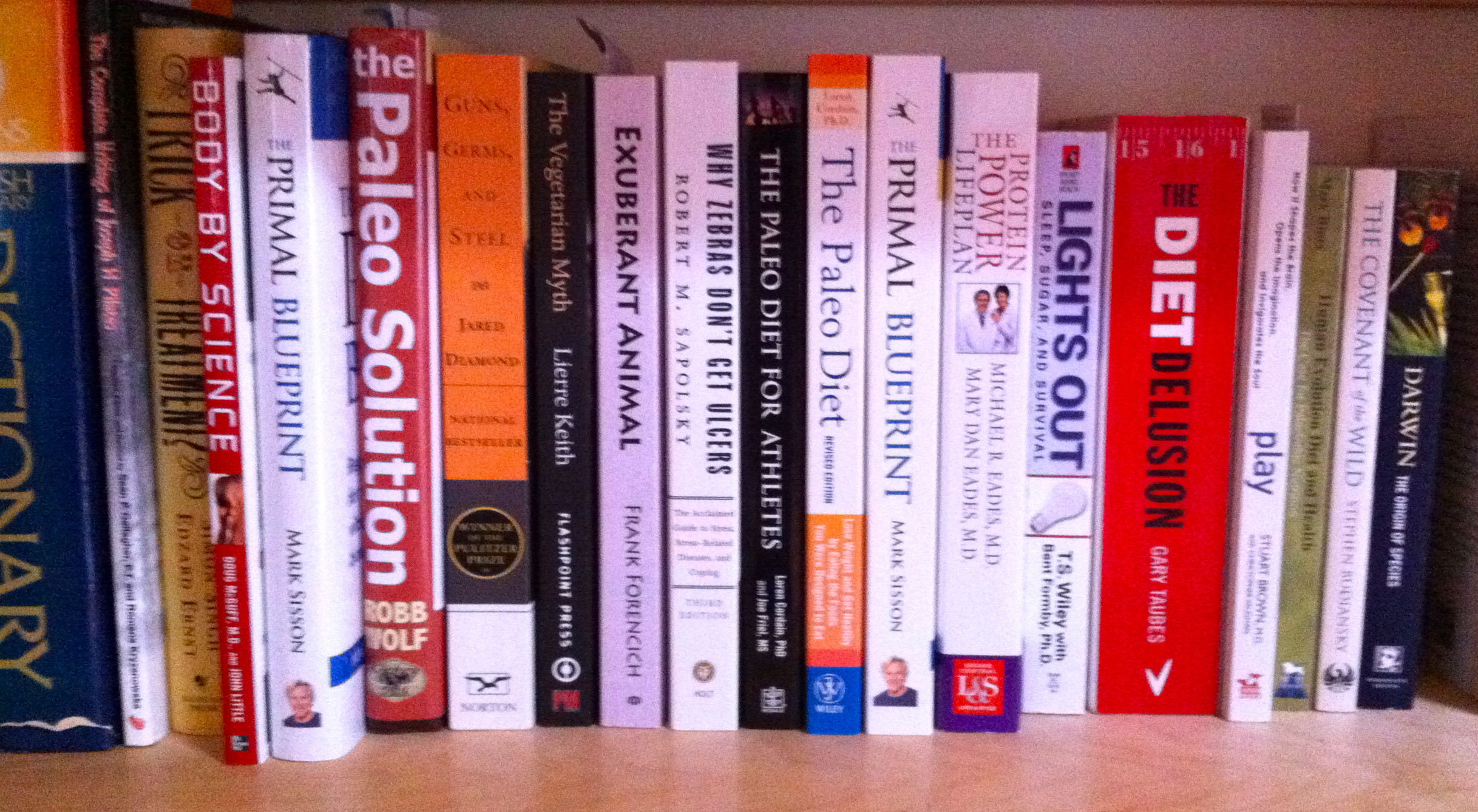
Talking to Glen about what I’d been reading, he suggested looking at the website Mark’s Daily Apple. Discovering this site was the watershed for me, and before long the shelf above my desk looked like this:

‘The Primal Blueprint’ is the manifesto of Mark (‘s Daily Apple) Sissons, and became my guide to applying the information of “The Diet Delusion’ to my life. The blurb on the cover offers “…effortless weight loss, vibrant health, and boundless energy”, and Sissons is very clear that the Primal Blueprint concept is not a diet, but a lifestyle. Nutrition is a significant slice of the Primal pie, but exercise, sleep and sun also play a part.

I didn’t start reading either of these books thinking that I needed to lose weight, but I certainly knew that I ate more sugar than was good for me, and had had a nutritionist point out to me that my diet was dominated by wheat. My daily food might look something like: toast and jam for breakfast; pain au chocolat and perhaps a croissant too during the morning; sandwich, with fruit, and probably chocolate for lunch; muffin/brownie/chocolate coated peanuts and maybe more fruit afternoon snack; and pasta or pizza for dinner. On the whole I considered myself to be reasonably fit and healthy (on reflection I may be very lucky with my genes…) and I knew that cutting back on sugar was very difficult for me. The transformation in my eating began, as I learned about the role of carbohydrate in fat storage, with trying to increase my protein intake – opting for sausage and egg croissant instead of the pain au chocolat, for example.

The more I read (and one of the things I enjoy about the Primal/paleo community is how much information people offer for free), the more I started to believe that eating grains was a bad idea, and with that I found it surprisingly easy to cut back on my wheat consumption. The shift in my eating probably took four or five months, and was amazingly easy. At first it was very difficult to find ‘primal’ snacks when I was out of the house but as my eating changed more I discovered that I don’t need snacks – four to five hours without food is perfectly manageable if you’re not carbohydrate dependent. A year ago I could easily eat an entire bar of Green & Black’s creamy milk chocolate (36% fat, 50% carbohydrate) – I might have felt a bit sick afterwards, but that wouldn’t have stopped me. Now I find one square of milk chocolate a) doesn’t taste of chocolate at all and b) is so sweet I can hardly bear it. At the same time Lindt 90% cocoa dark chocolate (55% fat, 14% carbohydrate) tastes truly wonderful.

As I mentioned earlier, ‘The Primal Blueprint’ isn’t just a diet book, so what else is there?

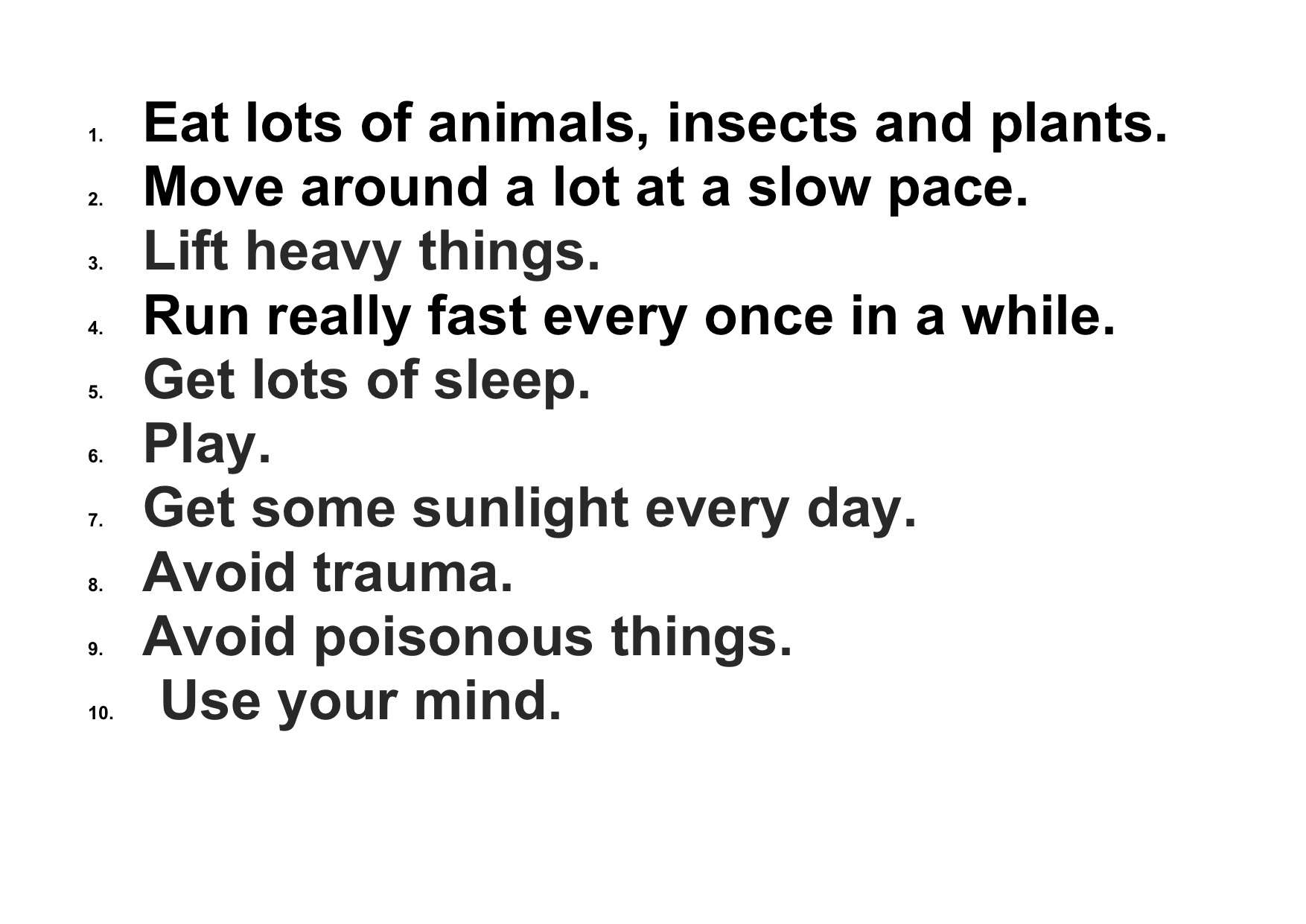
These are the 10 Primal Blueprint Laws. Some may need a bit of elucidation: ‘avoid trauma’ in an earlier edition of the book was ‘avoid stupid mistakes’, and is essentially to do with being more conscious of one’s environment, so as not to get hurt; ‘avoid poisonous things’ largely refers to eating foods that contain anti-predation chemicals/elements that we’re not made to digest – these would include almost all grains and legumes (I’m not the ideal person to explain why – please click on the links for Sisson’s own explanation).

I’ve not done so well with the insect eating, lots of sleep is sometimes tricky (especially when living with an excitable kitten…), and I don’t play as much as I might, but on the whole it’s been a very positive experience trying to stick to them. In fact, the changes to the way I eat, and approach exercise have led to one of the biggest transformations of my life.

Pilates definitely had a hugely transformative effect on me – it freed me from 18 months or so of chronic pain, and opened the door to the first real career that I’d ever wanted (and I met my wife through Pilates). It’s inspired me to learn, and allowed me the chance to be a part of running a thriving business. Probably because of my nature, Pilates also allowed me to have a somewhat entrenched view of ‘proper’, or worthwhile exercise, and a limited perspective on physical health. (Let’s be clear, these are my shortcomings. Please see my earlier post for more thoughts about Pilates and health).

And how has the Primal lifestyle transformed me? I’ve lost body fat (I had no idea I stored so much fat in my legs…); I feel like I have more energy; I’m stronger; my eczema is a thing of the past; I don’t feel bloated after eating; I’m less gassy, and my digestion from (ahem) start to finish is generally better. The weightlifting appears to have made me more flexible, and has also made me work some muscles much more than I’d managed previously – I’d never felt my back extensors work like they have to when I squat properly. I’ve also learned that activities like weight lifting have more in common with Pilates than I might have imagined – the language and the application is different but you still have to work from your centre, and the load is supported from your centre.

Physical things aside, there are plenty of other benefits. I’ve discovered that I really enjoy cooking, and, better still, the pleasure of cooking for friends and family who appreciate the food. I’ve developed a relationship with some of the people that I buy food from, and get a surprising kick from the whole process of eating, from the buying of fresh ingredients to the preparation and cooking (no more ready meals in our house…). As well as taking up weight-lifting and other high intensity exercise, I’ve also been introduced to other approaches to exercise/movement like MovNat and Exuberant Animal (see ‘Useful Links’), that I’m really excited to be learning more about. My inspiration to learn is greater than it has been in a long time, and I’m optimistic that I will be able to offer more to my clients over the coming years as a result. I’ve been led toward quite diverse reading material that has helped me to reframe thoughts about a variety of subjects, and to be more considerate of how my actions effect my immediate environment, and the larger world.

In the same way that we try to encourage clients at our Pilates studio to feel responsible for their health and well-being, the primal lifestyle really  fosters personal responsibility  that, in turn, encourages a positive outlook. If I believe that I’m in charge of my health, and I’m making sensible choices to support it, then I can feel optimistic about remaining healthy, fit and strong as I get older.

Zealotry

March 10, 2012 — 1 Comment

Listening to as many podcasts as I have, I’ve heard several questions addressed to the presenters along the lines of “How can I spread the word better?”, “What name could we use instead of ‘Paleo’ to get more people interested?”, “How can I convert my family/friends?” etc. etc. More often than not the response is something like “Why waste your breath? If people want the information they’ll come looking for it.” The trouble is that the answer is probably being given by someone who receives 100’s of emails every day seeking help, and that’s not the case for the amateurs out there like me, who are excited by what they’ve learned and want to pass it on.

It’s a cliche for good reason that people who have successfully given up smoking become the most vigorous advocates for going smoke-free. Perhaps it’s deep in our DNA to be this way. Since discovering and embracing the primal lifestyle I’ve seen in myself an apparent need, reflex, desire, urge… (one or more of those) to evangelise about food. Specifically the food that I believe it’s right to be eating. I was a vegetarian for many years (there’s that reformed smoker thing), and quite a stroppy one at that. I was younger, it was an emotional/sentimental thing, and there may have been a girl in the picture that helped my choice to give up meat. I don’t think that I was quite as enthusiastic about spreading the vegetarian word as I am at spreading the primal/paleo word, but I certainly wasn’t shy about letting people know what I felt about meat eating.

I know that I am not alone in wrestling with the problem of not being able to shut up about nutrition – the friend that showed me the path to the paleo way has had his own struggle with this. It appears that a lot of people in the paleo ‘community’ latch on to the idea very strongly because the framework of evolutionary biology seems so logical. Perhaps it’s inevitable that if something works for you, and resonates with you, the urge to spread the word is strong. I had back problems for about 18 months before someone pointed me toward Pilates, and in a very short time the practice of Pilates had ‘fixed’ me. I was pretty excited, and convinced that everyone with back problems should do Pilates. And hey, why just back problems? Anyone with any physical problem or injury will surely be fixed by Pilates. As a teacher I’ve seen this pattern repeated many times –  Pilates helps someone overcome chronic pain and consequently changes their life. As a result Pilates then becomes ‘bigger’ than a mode of exercise, and reaches the status of miracle, at which point evangelism may well follow.

What drives us to evangelise? I realise that in choosing this word I’ve gone into the realm of religion, and this highlights for me the whole problem of feeling the need to share. I’d rather base my ideology in science, and specifically evolution. I think I can reconcile this, and perhaps simply need to choose my words more appropriately. While Christian evangelism is dedicated to saving people from one unprovable idea (hell), and giving them hope of another unprovable idea (heaven), the lifestyle that I’m espousing offers the real possibility of health and longevity, and salvation from the equally real possibility of ill-health and disease. Surely that’s a reasonable thing to be trying to share?

I had a great lesson recently in the value of sharing information with people that aren’t very interested. We had family staying with us, part of the Belgian arm of my family, for whom bread is the principle component of, typically, two of their daily meals. Perhaps I was conspicuous in my non-eating of bread (perhaps I may have said something about the evil of wheat-but I don’t think so…), either way, one of the teenagers in the family asked me what the problem was with wheat. I launched into an explanation of the trinity of bad things about wheat (gluten, lectins, phytates), and quite succinctly, as I recall. I didn’t have high hopes but still felt slightly crushed when he, and the rest of the family, still attacked the bread with gusto at the next meal. As my wife is inclined to say to me when I tell her about an exciting new nutritional nugget that I’ve picked up: “It’s just someone’s opinion”…. (Of course that’s often not the case, but it serves to reign me in a little).

I’ve noticed in my 8 year old son an enthusiasm for acquiring knowledge that often extends to an enthusiasm for sharing that knowledge. On the whole it’s quite charming in a child, but perhaps not so much in an adult. I recognise in myself the danger of sharing information  with too much of a “listen to how much I know” motivation – definitely something that I would like to control as much as possible. The struggle is to balance this with wanting to pass on things that I imagine others might want to know. I’m reminded of reading John Pilger years ago and feeling sure that lots of people would want to know about all the evils that he described being perpetrated in our names. Even as I write this the parallel seems even stronger than I had thought – the collected information from sources such as ‘Good Calories, Bad Calories‘, ‘Wheat Belly‘, and ‘The Vegetarian Myth‘ adds up to something looking very much like governments and vested interests misleading the people, disempowering them and making them sick (while multinational corporations make VAST profits, and public and private healthcare costs spiral beyond comprehension). Who wouldn’t feel pissed off about that?

What to do? I care about the health of my family and friends. I care about the well-being of the people that I teach. What does that require of me? Respect for their values, certainly, and support too. I know that my vegetarian friend doesn’t want me trying to persuade her of the merits of eating meat, but if I hear her talking of trying to lose weight by eating carbohydrate, instead of protein and fat, I’m bound to say something….

So here’s a pledge to everyone that knows me:  I will try really hard to only offer information when there’s a hint of invitation, and to assume that, if you take soy milk in your coffee, you probably don’t want to know why that’s a bad idea.

Pilates for…..health?

March 6, 2012 — 6 Comments

Many books about Pilates list the “6 principles of Pilates”, a number of them have extended 6 to 8 or 9, but many teachers will be able to tell you that the ‘original’ principles of pilates are: Breath; Centre; Control; Concentration; Precision; and Flow[ing movement].
These 6 principles do not appear in any of Pilates’ own writing and, in fact, appear to originate in ‘The Pilates Method of Physical and Mental Conditioning by Friedman & Eisen, and first published in 1980 (13 years after Pilates’ death).
The guiding principles of Pilates’ method, to be found in his 1945 book ‘Return to Life‘ are: Whole body health; Whole body commitment; and Breath; and have a very Pilates-esque no-nonsense simplicity to them. Why have 9 principles when 3 will get the message across?
Clearly things have changed in the years since Pilates’ death, we have a much better understanding of biomechanics, physiology and anatomy, along with entirely different ways of even considering human anatomy. (It should be said, too, that Pilates may not have been much concerned with those details – one of the highlights of the conversation between ‘Elders’ Ron Fletcher and Kathy Grant, available on DVD, is Fletcher’s reminiscence that, when asking Pilates what a particular exercise was for he received the gruff reply “It’s for the body”.) Despite these advances I can’t think of any compelling reasons to stray from his original 3 principles.

I’m all for asking for total commitment from our clients, especially if they have goals that they want to reach through Pilates, or expectations of what Pilates might do for them. This then begs the question (of me, at least): In teaching people Pilates, are we offering (the possibility of) whole body health?

Perhaps borrowing for the Pareto Principle, it seems to be widely accepted on fitness/exercise related internet resources that body composition is 80% determined by diet, meaning that exercise has a relatively limited effect on how fat we are. I’m not advocating a fixation on body fat, but all Pilates teachers must be aware that being overweight is highly likely to take an orthopaedic toll on an individual’s body. For example, the Johns Hopkins Arthritis Centre reports that ‘being only 10 pounds overweight increases the force on the knee by 30-60 pounds with each step.’ Joint problems are just one of many potential health issues related to being overweight or obese.

Having used it repeatedly in the paragraph above, I want to avoid repeating weight – I don’t think someone’s weight is as useful a measure of health as their body composition, how much fat they are storing. Hence how one’s clothes fit is a better indicator than a set of scales. It can be hugely challenging to address a client’s body composition, and requires that a relationship be established between teacher and client first of all (unless both are pretty thick-skinned). Nonetheless, if Pilates teachers (as fitness professionals, not alternative therapists), are to help clients towards whole body health I think we may have a responsibility to address such tricky topics. As you may have gathered if you’ve read earlier posts on this site, I lean quite strongly towards a particular way of eating – (in the interests of simplicity) low carbohydrate, moderate protein, high fat  – and, having read quite a lot on the subject, I’m happy to get into a conversation about nutrition with anyone these days (yes, maybe too happy, and more on that next time). The chances are that my nutrition views aren’t shared by all Pilates teachers, perhaps only a few, and I’m not arguing that we should all be preaching paleo eating to our clients. In the past I have had clients say to me “I know I need to lose some weight” and I’ve probably mumbled awkwardly and equivocated – now I think that, without getting into an epic conversation, I could have simply asked what they were doing, or planning to do, to accomplish the fat loss. I am not a nutritionist, but I can encourage clients to get help with shedding body fat, in the same way that I might encourage them to go to a physio or osteopath if that seems appropriate.

A lot of the clients that come to our studio list ‘weight loss’ as one of their goals. All other benefits aside, I don’t believe that Pilates is an effective means of achieving such a thing. Indeed, I think the evidence shows that eating is far more important to body composition than exercise. As fitness professionals I think we do have a responsibility to address nutrition (and maybe to mention that sleep quality and cortisol levels have a significant impact on our metabolism), even if that is no more than encouraging clients to seek professional help (or perhaps to read Gary Taubes’ “Why We Get Fat: And What To Do About It“). I’d love to hear what any fellow Pilates professional (in fact, anyone who may be reading) thinks….

Fitness

February 18, 2012 — 3 Comments

A couple of weeks ago I received an email from the person who handles marketing for a yoga centre at which I teach a (Pilates) class. All the centre’s teachers were being approached for their input in an idea to tie the London Olympics into the centre’s publicity, with an ‘Olympic challenge’: “The idea is to get who ever does the challenge [as] fit as an Olympic athlete through Cycling, Yoga , Pilates, Nutrition and treatments.”
I was fascinated by this idea on a number of levels.

The first to get out of the way is incredulity at the idea that a combination of the above would produce similar results to the training regime of an Olympic athlete, unless we’re considering pistol marksmen/women, or some similar sports person. I think most people conjuring the idea of an Olympic athlete will come up with someone like Usain Bolt, Jessica Ennis, Chris Hoy, Tom Daly etc. I know that Usain Bolt is notoriously lackadaisical about his training but I cannot believe that a similar physical condition could be achieved through yoga, pilates and nutrition, with some treatments thrown in.

I specifically referred to Usain Bolt’s physical condition to avoid using the word fitness. This is the part of the ‘fit as an Olympic athlete’ concept that I find really interesting. How are we to define fitness? And will Olympic athletes fit into that definition?

I asked a friend of mine, Pilates teacher Suzanne Scott, “an anatomist with physiology leanings”,  to define fitness for me recently, and this is what she came up with: “greater tolerance to shifts in environmental parameters and biologically mediated challenges”, which, aside from being marvellously worded in a very science-y way, captures an evolutionary notion of fitness rather well, and I shall return to this. Biology online says: “In biology, Darwinian fitness or simply fitness of a biological trait describes how successful an organism has been at passing on its genes. The more likely that an individual is able to survive and live longer to reproduce, the higher is the fitness of that individual.” Hence ‘ survival of the fittest’ – those that are best adapted to be able to successfully pass their genes on to successive generations. (This perhaps calls for a separate post on how our species has nearly circumvented this simple evolutionary rule by inventing agriculture, with its attendant advantages and disadvantages).

So what has evolutionary theory got to do with Olympic athletes? If we were to define fitness as the ability to perform a narrow range of specific tasks repeatedly and, perhaps, particularly fast, then an Olympic athlete may well be the model of fitness. However, in keeping with my primal/paleo bias, I have an imaginary prehistoric framework in which an individual’s fitness is tested – a wild place, untouched by ‘civilisation’, in which there are a variety of hazards to be negotiated or avoided, and great skill at a narrow range of tasks will not do. Survival, or better yet, flourishing (for that’s what I hope we all strive for), in this environment requires many attributes: keen senses, agility, speed, strength, endurance, ingenuity and so on. All of these attributes may well be possessed by a number of Olympic athletes, so why not call them fit? It isn’t a new idea that the most successful Tour de France cyclists are those that can tolerate the most pain. Similarly, it is well established that competing in endurance events (Ironman Triathlons, for example) causes more cell damage than it’s possible for our bodies to fully recover from, chronic inflammation, and has a corresponding impact on our immune systems. (A brief trawl of Google will proffer plenty of articles linking prolonged training for, and participation in, endurance sports to increased risk of various conditions from heart disease to cancer.)

As sports science and our understanding of human physiology and biomechanics  has developed the level of performance has risen to a staggering degree (world best marathon time teetering on the brink of the 2 hour barrier being broken!). To be ‘elite’ means monitoring the minutiae of an athlete’s life and training, and competing at the very edge of one’s potential. Pushing to that ‘edge’ inevitably means that many athletes seem to be, even when performing very well, on the verge of injury and/or illness. To be really successful as an athlete means maximising your adaptation to your chosen activity. This adaptation ultimately means that an athlete’s body starts to dispense with any tissue that doesn’t help perform the relevant specialisation, whether it be muscle, bone or brain! If you need to be as light as possible to be really good at your chosen sport then your ability to store energy is going to be compromised. This is fine if you have a ready supply of food, but could lead to catabolism (something like your body ‘eating’ your muscle tissue) if not. However impressive a lot of sporting achievements are, and how much I enjoy watching them, this doesn’t feel like a model of fitness to me. While some elite athletes might do very well within the prehistoric framework mentioned above, I suspect that many would have trained the necessary versatility out of themselves, in order to be highly skilled at their specific event.

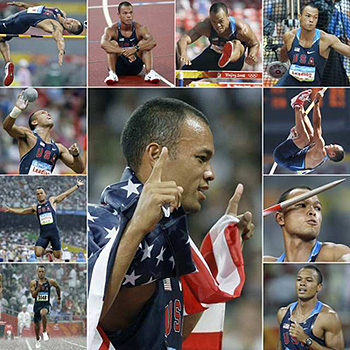
An honourable mention is due the Olympic decathletes, like Brian Clay (pictured), whose multi-sport discipline of running, jumping, throwing and vaulting (an amazing combination of movements) requires them to have a truly impressive combinbation of strength, speed, stamina and agility.

Okay, so I’ve succeeded in arguing that actually some Olympians do qualify as really fit – not my original intention. I still stand by the argument that, very often, the requirements of elite sporting performance are incompatible with a Darwinian interpretation of fitness. Given that, let’s return to what does qualify as fitness, or what does “greater tolerance to shifts in environmental parameters and biologically mediated challenges” really mean? Can you cope with unexpected challenges to necessary or normal activity? (I wrote about how Pilates relates to this here).

If you’re a slight framed woman driving an Audi Q7 around London’s streets (yes, I’m a cyclist), and an electronic malfunction means that your power steering is disabled, can you control your vehicle? If you live on the 6th floor, and the lift is out of order, can you get your 20 kilos of groceries upstairs to your home? If you’re a 70 year old out for a stroll and some lunatic on a bike appears from nowhere heading straight for you, do you have the speed and agility (and balance) to get out of harm’s way? I’m sure we could come up with infinite examples of such scenarios. An answer of “yes” would suggest that, having a greater tolerance to …, you are more fit than some. Let’s not say that a ”no” answer means that you are unfit, rather that you could be fitter. The truth is that many, many people will get by, and quite possibly even thrive, without the skills to make it within the prehistoric framework. I would suggest that this only serves to show that our species is weaker than it once was.

Pilates for….what, exactly?

February 10, 2012 — 1 Comment

(The first thing I feel I should point out is that I’m writing this as a Pilates teacher trained, and practicing, in the UK. Other Pilates teachers may not recognise some of the scenarios I’m describing.)

Pilates called his system Contrology and in Return to Life he wrote:

“Contrology is designed to give you suppleness, natural grace and skill that will be unmistakably reflected in the way you walk, in the way you play, and in the way you work. You will develop muscular power with corresponding endurance, ability to perform arduous duties to play strenuous games, to walk, to run or travel long distances without undue body fatigue or mental strain.”*

It is clear that he intended his method to be a preparation for other ‘stuff’ – for life, in fact. Herein lies my frustration with a lot of what I see in Pilates studios and mat classes. Not to mention the kind of comments I hear, and see in social media from my peers.

I have heard American teachers insisting that, although injured people went to Pilates’ studio, and clearly got help with their injuries form the man himself, Pilates as an exercise method is intended for fit people. In the UK it seems that we have been somewhat hamstrung by the general impression that Pilates is for people who are injured, or in pain. This has been propagated by the media, and doubtless encouraged by teachers who want to boost their business by appealing to those people who may not feel that they can manage ‘normal’ exercise. Not to mention that many of us, myself included, took up Pilates to try to deal with chronic pain of some sort, and became evangelists for the method because it is has the capacity to change lives.

What’s the problem with that? On the face of it, it’s a brilliant thing, and I have been nearly moved to tears on a number of occasions when I’ve seen people discover that they’re able to do more than they believed possible. Unfortunately, what I seem to see all to often, is people doing Pilates weekly (or even more frequently) who have plateaued at a reduction in their pain, and failed to move forward from there. The promises contained in the quote above have little or no relevance to them, and this is a tragedy. Instead of feeling empowered to do more, it seems as though they and/or their teacher/s have created an invisible ceiling for them, that they are terrified to try to break through. What seems to be left then is an emotional attachment to Pilates, a belief that they cannot function without it, yet no desire for, or belief in the possibility of achieving more (playing strenuous games, for example).

As teachers we often have a difficult job encouraging clients to expect more, and I fear that sometimes we, knowingly or not, succeed in holding them back, or at least allow them to ‘aim low’. I would suggest that the first lesson of Pilates ought to be “You are responsible for your own health” – a notion that seems to be systematically undermined in our society. I have seen advertisements for Pilates workshops that describe “using Pilates on our clients”, and I have heard clients saying “[insert teacher’s name] has been working a lot on my shoulders”. As soon as we allow ourselves to take the client’s personal responsibility from them, we have disempowered them, and greatly reduced their chances of enjoying the kind of results that Pilates wrote about.

It seems blindingly obvious that the underlying message of the passage quoted above is that Pilates is not an end in itself. I absolutely endorse the idea of Pilates as a lifelong practice, but not for its own sake. We often teach people to move slowly, in order to help them move with control. This is just a part of the journey, and not a rounded preparation for life outside the studio/class. We may well give people exercises with relatively low loads, in order for them to sense how they can transfer load from their limbs to their centre – fantastic! But not enough if we really want to make people fit and strong – and if Pilates isn’t about trying to help people to be fit and strong then we’ve seriously lost the plot.

If I try to answer my own question (Pilates for what?) I have to say (however corny it sounds) “Pilates for life” – not for ‘relaxation’, ‘feeling good’, ‘Pippa’s bum’, ‘weight-loss’, ‘core stability’ etc.  I want to stand for Pilates as a means to deal with all the stuff that life puts in our path, good and bad, as well as we possibly can.

*I have the impression that a lot of teachers these days have a rather dismissive attitude to Pilates theories, preferring to believe that we have a much better understanding of things with the advances of science since he was writing. Every time I look through Pilates’ writing, I am delighted to discover how often he was spot on. I think this may relate to my previous post – a lot of his ideas still make perfect sense because they fit within the framework of evolutionary biology.

“Why boast of this age of science and invention that has produced so many marvelous wonders when, in the final analysis, we find that man has entirely overlooked the most complex and marvelous of all creations: himself?”
Joseph Pilates, Your Health (1934)

The motivation behind this post is an effort to reconcile my career as a Pilates teacher with my growing enthusiasm for the Primal/Paleo lifestyle, and to try to discover how much synergy there is between the two.

This first post will mostly be an attempt to discover hints of a primal approach to human health in Pilates’ own writing, specifically “Your Health”, published in 1934.

My understanding of the Primal approach to living boils down to simple guidelines related to nutrition, exercise, sleep and sun-exposure. (A fuller list can be found here). In essence, the idea is to use the lives of pre-historic humans as a framework on which we can model our own behaviour. We are apparently genetically virtually identical to our paleolithic ancestors, and will achieve the best health by eating, moving, sleeping etc. in the way that archeology and anthropology suggests our ancestors did.

Much of the output of blogs, books, and podcasts from the primal/paleo community are intended to help people suffering from the symptoms of metabolic syndrome (obesity, insulin resistance etc.), and diseases/ailments related to chronic and or systemic inflammation (degenerative joint conditions, gastro-intestinal problems, multiple sclerosis etc.).

The primal/paleo philosophy is that what is generally recognised as ‘normal’ for old age – steady physical decline, illness, disease etc. may be usual, but are not normal for our species. By following the guidelines mentioned we are capable of living to old age without suffering substantial physical (or mental) deterioration – one of Mark Sisson’s ‘slogans’ is “Live long, drop dead”. The advice on how to stay fit and healthy for as long as possible typically comes down to addressing nutrition, exercise, sleep and sun-exposure.

Pilates was obviously writing at a very different time, and the health problems that our society faces were quite likely unimaginable in the 1930s. Nonetheless Pilates clearly wasn’t happy with the condition of many of the people he saw around him, and certainly had a lot to say about health and longevity. He saw “Tuberculosis, heart disease, posture problems such as bow legs, knock knees and curvature of the spine, as well as a veritable legion of other minor ills..”. He was concerned with both the physical and ‘moral’ health of humanity:

“As civilisation advances, the need for prisons, lunatic asylums and hospitals should steadily decrease. But is this the case in our era? Certainly not!”

He was writing at a time when a lot of the working population of the United States were probably transitioning from more manual work to more sedentary work but with still much more balance between the two than is the case now. Some of his ideas, and some of the exercise repertoire that he devised may seem inappropriate now, but it’s quite possible that those things made more sense for his time.

Whilst he was certainly concerned with sleep quality, going so far as to design a bed, his primary interest was clearly exercise, or movement. Whilst contemporary pilates teaching may well have a slightly different emphasis, Pilates himself was promoting exercise that required, at the more advanced level, a combination of gymnastic skill, flexibility and strength. Typical workouts suggested by the Primal/Paleo crowd often involve those same combinations.

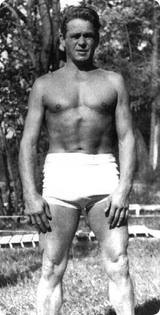
Joseph Pilates, aged 54, working on his Vitamin D levels

Frequent sun exposure and supplementing with Vitamin D are common recommendations in books such as Robb Wolf’s “The Paleo Solution”, and other Primal/Paleo media. Statistics suggest that, in the USA, something like a third of the population are deficient in Vitamin D and it’s safe to assume that the figures for the UK are similar, if not worse. The photograph on the left shows Pilates in what was apparently typical attire for him. In “Your Health”, though he doesn’t mention Vitamin D specifically, he lauds the ancient Greeks for preferring “to more or less expose their bodies to the invigorating air and revitalizing rays of the sun…”.

Pilates’ method is often referred to as ‘mind-body’ exercise, and he was convinced of the relationship between a healthy body and a healthy mind. Those relationships are less explicit within the Primal/Paleo world, yet there is a lot of discussion over the negative effects of, for example, over-production of cortisol on both a physical and mental/emotional level. In addition, via podcasts and articles, I have come across numerous mentions of links between diet and mental health, including a link between wheat consumption and schizophrenia and apparent links between poor insulin sensitivity (see ‘metabolic derangement’ above) and Alzheimers, leading to the suggestion of a Type 3 diabetes.

One significant gap in any connection between the two philosophies is that, as a part of his exercise regime, Pilates was especially concerned with ‘correct’ breathing. He believed that a great many people didn’t know how to breath properly, and that the action of fully filling and emptying the lungs has great benefit for ridding the body of toxins and maintaining vigour. I have yet to come across any specific mention of breathing habits in the ‘paleosphere’ but I think this relates to the notion that we have lost touch with our ‘natural’ selves, and therefore need to be retaught the most basic of human activities. This certainly fits within my understanding of the Primal/Paleo philosophy.

Pilates didn’t seem to be much of a one for going to the doctor. Concerning preventing or curing the ills of society in the 1930s, he wrote: “Can this be done through medicine? No! It can be done by following basic health rules and a simple exercise regimen,”. Again, there is some synergy here, as the wealth of shared information amongst the P/P community indicates – with many people eschewing conventional medicine and seeking to heal a variety of problems from autoimmune conditions to skin problems to metabolic syndrome and beyond, by means of lifestyle changes – very often dietary changes in particular. This is another area where Pilates and the Primal/Paleo camp don’t appear to have much in common, yet I’m inclined to argue that, had Pilates been alive now, he would have had a lot to say about nutrition. The so-called ‘Green Revolution’ was most pronounced in the years immediately after Pilates’ death (the term was first used in 1968, Pilates died in 1967). This went hand in hand with the acceleration of industrial food processing (a somewhat depressing timeline can be viewed here), leading us to the current situation in which we can make a choice when shopping, if we wish, to buy food, or food products. Inevitably, the massive advertising budgets are behind food products, rather than real food. I believe that Pilates, on the basis of much that he wrote to do with mankind in his/her natural state, would have abhorred the state of general nutrition these days, and would have been urging his clients to follow a dietary regime that looked a lot like Primal/Paleo eating.

In essence Pilates was a celebrator of the wonders of the human organism, and a proponent of living in a way that optimised the health and fitness of said organism. This seems to me to be exactly aligned with the more recently developed Primal/Paleo philosophy, which has more reference to evolutionary biology (and scientific studies), but the same underlying promotion of physical health and longevity.