Archives For November 30, 1999

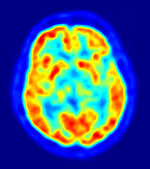
150px-PET-imageA recent, soon to be published study by the prestigious Centre for the Understanding of Nutritional Technology and Science has found that consumption of more than two servings of tofu (a soybean derived food product) per week may lead to a loss of IQ.

The study, conducted over a number of years, looked at the effect of varying degrees of tofu consumption on subjects’ scores in standardised IQ tests. Even when allowing for other factors that have been previously indicated to negatively effect intelligence, the results were “damning”, according to the study’s conclusion. In an interview, a representative of the Centre declared that he and his team are satisfied that they have achieved a significant breakthrough in our understanding of tofu, and have proven beyond doubt that, when consumed in greater than normal amounts, it does make humans more stupid. He added: “We have yet to prove a link between tofu and obesity, but our research continues.”

I’m sure that you will be aware of a number of stories that have made the news in recent years, linking consumption of certain foods, particularly red meat, to various diseases. If you want to read rebuttals of news stories like Red Meat Causes Cancer, or the more recent High Protein Diet as bad as 20 Cigarettes per Day, or simply to read about the problems inherent in these kinds of studies, you can do so here, here and here. This is the territory of people with degrees in medicine or biochemistry, neither of which I have. Instead here are a couple of questions that we should all be asking ourselves when faced with news stories that make these kind of alarming food related claims.

The first is, what’s the agenda? As the articles I linked to above point out, epidemiological studies (that look for patterns, or associations) almost inevitably start out looking for specific patterns – in other words, researchers don’t set out to see if they can spot any patterns at all, they go looking for a specific one. If you go looking for a specific pattern the chances are that you will lean towards finding evidence to support it. Epidemiology might support a hypothesis, but never proves it. T. Colin Campbell, one of the authors of the “China Study”, is well known as an advocate for a vegan diet, and (to quote Wikipedia): “The authors conclude that people who eat a whole-food, plant-based/vegan diet—avoiding all animal products, including beef, pork, poultry, fish, eggs, cheese and milk, and reducing their intake of processed foods and refined carbohydrates—will escape, reduce or reverse the development of numerous diseases.” 

So, if I write a story about the link between tofu consumption and reduced IQ (let’s be totally honest, and in case you didn’t guess, I made that up), you would need to ask yourself why I went looking for such an association in the first place. Perhaps I’m some kind of omnivorous fundamentalist who thinks that soy products are rooted in evil….

The second, and perhaps more significant question is, (to quote Robb Wolf) “What is the mechanism?” Unless there is a viable explanation for why heavy tofu consumption causes a loss of IQ (I just had a thought – imagine if my made up story turns out to be true!), then it’s simply an association that may be a complete coincidence. A favourite analogy is ‘Fire engines cause fires’ – because studies show that there is a strong association between buildings on fire, and the presence of fire engines. Or even better, if you didn’t follow the link to Dr Briffa’s article above: ‘ice cream causes shark attacks’.

Who can blame researchers who want to catch some headlines? Both of the UK broadsheet newspapers that carried this story had some caveats, if you read to the end, but the headlines and the accompanying pictures are what stay with you (do you think tofu seems more sinister when I include a picture of a brain scan?) It’s too bad that the news media we appear to want is that which scares, rather than informs.

When I was very young there was a radio programme called “Listen with Mother”. We didn’t have a television, and I listened to this nearly every day (with my Mum, of course). Without fail, the show began with “Are you sitting comfortably? Then I’ll begin.” (I’m not sure whether it’s a positive or a negative that this is etched in some recess of my brain).

These days, with the increasing number of studies suggesting that sitting is bad for us, it seems to be a particularly interesting question. The answer may well be “Hell, yes!” (“I’ve got this fantastic well stuffed, reclining, cocooning, i-pod docking super-sofa and I’m as comfortable as anyone ever has been.”) Of course sitting is comfortable, or certainly can be. And, it turns out, it shortens your life, makes you fat, possibly metabolically deranged, possibly pre-diabetic – never mind the possible reduction in range of hip movement.

However, I’d like to leave the bulk of the anti-sitting stuff aside, valid as it is. It seems to be getting a reasonable amount of attention. Instead, I’d like to concentrate on the “comfort” part of the equation. A little while ago I saw a Tweet from @NocturnalOutpos: “Our lust for comfort is the biggest thief in our lives…”, which resonated for me. I think there can be no doubt that the technological advances that have given us easier access to greater comfort have also weakened us as a species, or at the very least made us less resilient (Nassem Nicholas Taleb would say ‘more fragile’).  (Back to) sitting =  more hip dysfunction & back/knee problems, for example. Controlling every aspect of our living environment makes us less well able to cope with the unpredictable. Can we survive without electricity and telecommunications. Most end-of-the-world disaster movies that I’ve seen assume that we can’t (at the same population level).

Evolutionary psychologist Satoshi Kanazawa writes: “All living organisms in nature, including humans, are evolutionarily designed to reproduce. Reproductive success is the ultimate end [goal] of all biological existence.” So, yes, having children is pretty much our reason for existing as a species. The hunter-gatherer existence of our pre-agricultural ancestors would have had its own pragmatic population controls. It is simply not practical to live that semi-nomadic life with lots of children tagging along, and the food supply would have been a limiting factor.

When the agricultural revolution came along things became more comfortable, in that it was possible to stay in the same place, procuring food was no longer everyone’s task, and food became more abundant (though less nutritious). Consequently it was possible for the human population to explode – all the natural population constraints of the HG existence were lifted. Terrific. As a result we now enjoy all the fruits of civilisation, both positive and negative. Negative in that our numbers, ingenuity and technology have allowed us to overcome or resist many of (what I perceive to be) Nature’s attempts to maintain some balance by keeping our numbers in check.

I’m writing this sitting in a cafe on a Saturday morning, as it fills up with people, especially families. It’s noticeable how many couples have several children, clearly born in relatively quick succession, and the part of me that is certain that there are already far too many of us on the planet can’t help inwardly asking ‘Why?’ Why are you having all these children? (In this instance ‘all these’ denoting more than two). And the answer that I come back to is, we are too comfortable. It’s too easy to procure food, shelter, water and energy, so we trick ourselves into thinking that what may be sustainable in at a local, insular level is equally sustainable for humanity as a whole.

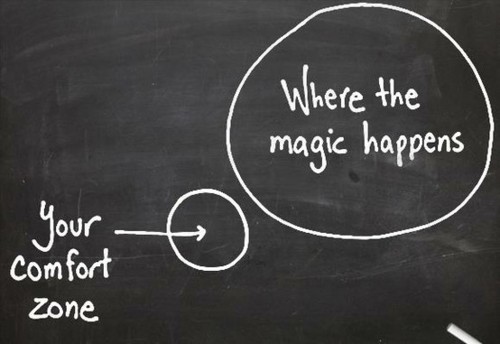
where-the-magic-happensOn a less ‘end-of-the-world’ note, it’s common to talk of one’s ‘comfort zone’ these days. It’s not an unusual idea that we need to leave our comfort zone to make changes, or to achieve more. Being uncomfortable thus is the route to progress, perhaps success, or becoming stronger. And the inverse is true. Comfort makes us weaker. Comfort encourages stasis. Comfort anaesthetises.

I’ll still be sitting comfortably on the sofa for a while this evening, but more fool me if I do so for long.

courtesy of encyclopaedia.wikia.com

courtesy of encyclopaedia.wikia.com

I recently wrote a post which was in response to a review of “Becoming A Supple Leopard” by Kelly Starrett. The reviewer took issue with both the lack of reference to scientific studies within the book, and Starrett’s failure to refer to current pain science (by looking only at postural/structural/biomechanical causes of pain). The same theme cropped up in an article called “Back Pain Myths: Posture, Core Strength, Bulging Discs” from the website ‘Better Movement‘.

“Back Pain Myths” states that the majority of physical therapy and corrective exercise done in the USA is based on incorrect assumptions, and concludes a consideration of the evidence for each ‘myth’ as follows: “..there is little evidence to support the idea that we can explain pain in reference to posture or that we can cure pain by trying to change posture..”; “…if a large percentage of pain free people have bulging discs, then how likely is it that a bulging disc is the cause of your back pain?”; and “..the current evidence states that there is nothing magic about core strength as means to prevent or reduce back pain…”. It is not surprising that some might take this as an attack on their practice.

There is no doubt that pain is a very complex subject, and that, especially in the case of chronic pain, the sensation of pain may not be caused by an injury, postural fault, or structural defect. It seems to be clear too that there are many people who have a disc bulge (or several disc bulges), without any symptoms at all. If nothing else this would seem to be good grounds not to rush into a surgical procedure if you are diagnosed with a disc problem. I can’t argue that Todd Hargrove (the author at Better Movement) doesn’t make some legitimate points – it is always good to have our beliefs and assumptions challenged – and we shouldn’t fall into the trap of letting popular wisdom become dogma.

A typical example of the ‘Back Pain Myths’ content is reference to various studies that fail to show any link between poor posture and pain (and it is interesting to read that other studies show a stronger correlation between back pain and stress levels, job satisfaction, exercise etc). Hargrove does refer to a study that seems to suggest a link between poor posture and pain, but hastens to remind us that: “it is important to remember the rule that correlation does not equal causation“. I like this mantra and am inclined to repeat it quite often myself. However, it is perhaps also worth mentioning that non-correlation does not equal non-causation – if a study fails to find a link between one thing and another it does not mean that there is none (I think that this idea is more normally expressed as: absence of evidence does not equal evidence of absence).

Again, we’d be foolish to pretend that someone’s pain isn’t an intricate tapestry, but I’m not inclined to feel that the foundation of the way that I work is being critically undermined by articles such as this. Dysfunction, poor movement patterns and stabilising strategies may not cause someone pain now, but they may cause tissue damage that could result in pain at a later date, or have a knock-on effect on a nearby structure that may become the cause of pain. I know, there’s a lot of ‘may’s in that last sentence, and I believe that’s partly because it’s very difficult to conduct meaningful studies on humans. That is to say, it is probably impossible to account for every variable between study subjects (even if we were to be able to treat humans as we treat beagles, chimps etc.), so we cannot expect any studies of pain triggers, or potential treatments to do better than show some correlation – and we know the rule about that.

I believe that the majority of studies that have been conducted would seem to indicate that exercise of nearly any kind (shall we just say ‘movement’?) is helpful for back pain sufferers, and one kind of movement doesn’t seem to be better than another. I don’t think it matters that we cannot prove the efficacy of a movement discipline, if the result is that people increase their awareness of their own bodies and thereby move and position themselves in a ‘better’ way than they were previously able to. Another thing that would be very hard to study is how the sense of empowerment from a movement practice might impact someone emotionally or psychologically, and thereby have an effect on pain sensation. Failure to prove these things does not make us charlatans.

To return to ‘Back Pain Myths’, I have to acknowledge that Hargrove’s article finishes with questions: “why do these approaches seem to work; how can so many people be wrong; and if these aren’t the true sources of pain, then what is?” So, despite the lack of science, he acknowledges that ‘these approaches’ (from the article we must assume that he refers to making postural improvements, surgery, and core stability training) seem to work. Interesting… Reading further, Hargrove turns out to be a fan of Eyal Lederman, who wrote a famous/infamous article entitled “The Myth of Core Stability” which, for me, speaks volumes about his outlook. You can easily find “The Myth of Core Stability” with a search of the internet if you wish (I tried to include a link but each time I tried to open a page I got an automatic download and, trust me, I’ve more copies of this article than I need). Lederman does an, apparently, able job of rubbishing the notion that there is such a thing as core stability, provided you accept that he fails to actually define what ‘core stability’ is, and doesn’t include an explanatory quote from any of the practitioners whose work/theories he questions. (I’m no lover of the term ‘core stability’, and I suspect this is true of most Pilates teachers. At the same time, I can’t fault anyone for trying to understand and explain how our brain controls our muscles and movement. I’m inclined to think that they are engaged in trying to find explanations for things that Joseph Pilates, for example, recognised as being true without the need or equipment to figure out why.) Lederman’s article is full of scholarly references, and he undermines the theories of those he calls ‘CS practitioners’ by means of those references to conflicting evidence. That SCIENCE trump card again. (One of those studies, at least, involved methods of testing trunk stability hilariously far removed from a ‘real-life’ situation).

Hargrove is a Rolfer and Feldenkrais practitioner. Lederman is an Osteopath. I do not wish to disparage any of these practices, but/and I’ve found it very difficult to track down any proof for their efficacy, or superiority to other practices, on PubMed, or any other websites. Yes, pain is undoubtedly a complex subject, and it is a very good idea for anyone working with people in acute or chronic pain to be aware of current theory. We cannot overlook the psychological/emotional component to, particularly, chronic pain. A very recent experience of mine (anecdotal, sorry) seemed to show that helping someone to understand how to effectively stabilise their midline (core, if you wish) had a positive impact on their confidence, and sense of self-worth, which had been seriously undermined by back pain. Yes, it only ‘seemed’ to help – I cannot prove it, and I don’t suppose the person in question would feel the need to have proof.

If people may be being routinely harmed by a practice then there is clear reason to question it. Does this mean that an unproven movement practice should be avoided, or that it is invalid? Er, NO.

Prove it!

December 1, 2013 — 1 Comment

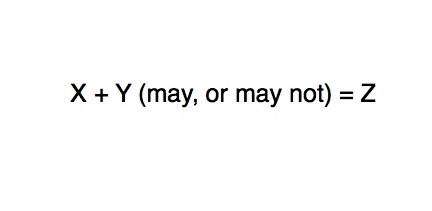
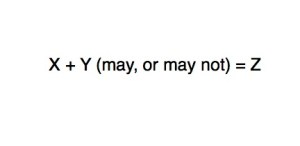
X YI recently came across “Back Pain Myths” via pilatestree.com, from a website called ‘Better Movement’, and a review of Kelly Starrett’s book ‘Becoming a Supple Leopard’ from a website called ‘Exercise Biology’, that both use science, or the absence of it, to question, or indeed attack, the beliefs and practices of many practitioners working within the sphere of exercise and rehabilitation. Somehow it feels as though this is a popular subject at the moment.

To paraphrase outrageously, the thrust of these is that if scientific studies cannot be found to support an idea, the idea must be wrong. “Back Pain Myths: Posture, Core Strength, Bulging Discs” (to give it its full title) sets out to show that anyone who has suggested that poor posture, lack of core strength, or bulging discs are a likely cause of someone’s back pain has not kept up with the science, and is barking up the wrong tree. (More about ‘Back Pain Myths’ in a post to follow). Our man at Exercise Biology levels the same accusation at Starrett: “He is literally taking your hand and walking you back to the dark ages of physical therapy of the 1950’s, when we used to believe pain comes from joint, tissues, bad posture and movement.” (Good thing that the OED had revised the definition of ‘literally’ to include ‘metaphorically’ as one of its meanings). To be fair, the book’s subtitle: ‘The Ultimate Guide to Resolving Pain, Preventing Injury, and Optimizing Athletic Performance’, leaves Starrett open to this kind of critique (if you are deliberately obtuse and overlook the fact that the book is manifestly about all three things combined, and not just resolving pain).

I don’t suppose that it will be news to many of us in the Pilates world that the causes and manifestation of pain are complex areas, and that there is strong evidence that people can have, for example, multiple disc bulges and no pain. Many of us may be familiar with the work of Butler and Moseley, who wrote the excellent ‘Explain Pain‘, and will know that (oversimplified) pain is a sensation produced by our brain, based on information it has received from somewhere in the body, that it has filtered through near enough every sensory input (physical experience, anecdotes heard, films watched etc) it’s ever received. Small wonder that experience of pain seems so highly individualised.

The International Association for the Study of Pain defines pain as: “An unpleasant sensory and emotional experience associated with actual or potential tissue damage, or described in terms of such damage.” So, the role of pain is to alert us to the likely need to change our behaviour, which seems pretty straightforward, and supports the idea that a poor position could indeed trigger a pain response. Of course, it is complicated, especially in the realm of chronic pain, and when someone experiences pain with no identifiable symptoms. Whilst I am familiar with, at least some (Butler/Moseley), current pain theory, I’m not ready to dismiss the possibility that how someone moves and holds themselves may have a bearing on the inputs that their brain receives. According to Anoop Balachandran (Mr Exercsie Biology), who is a fan of the ‘biopsychosocial’ model of pain, the biomechanics (usually termed PSB: postural-structural-biomechanical) model of pain “is now outdated, unscientific and incomplete..” Incomplete it may be, but if someone has pain that is clearly mechanically derived, and resolves the pain by changing their mechanics, that can’t be dismissed. (Nor would it somehow serve to disprove the idea that there is a valid biopsychosocial model of pain).

I don’t want to give into what may be flawed logic, but I’m sure that many of us will have seen the positive outcomes achieved by helping people to understand and change poor posture or movement patterns. I have no studies to fall back on to prove it, and accept the fact that we cannot prove that Pilates, for example, works. A solution that appears simple can still be a solution. Balachandran writes: “I wrote an article back in 2005 about the myth of posture and pain and ended the article saying Now close your eyes, take a deep breath, slowly slump – and savor the freedom of movement”.” He ‘knows’ that this is a sound thing to be saying, because no-one has yet conducted a study that can show conclusively that there is a relationship between posture and pain. I ‘know’ that it’s a ridiculous statement, because I’ve never seen anyone moving well, or freely, from a slumped position. I know that I went from being a chronic pain sufferer, to being pain-free because I learned better movement patterns, and better positioning strategies. I know that my joints fitting together as well as possible, and the surrounding soft tissues being supple and elastic will help me to avoid dysfunction – and I’m positive that, pain or no pain, that’s a good thing. To quote him again: “The more you talk about biomechanics, joints and movements, the more you are raising the threat level in the brain and making the pain chronic. This is exact reason why current pain science involves educational sessions to change people’s belief about the role of their muscles and joint in pain. Just changing the beliefs about pain has been now shown to lower pain, disability score and improve ROM and movement.” It may be that my beliefs about pain were changed during the first year or so that I took Pilates classes, I’ve no way of knowing that. It may be that counselling would have had a similar result, but we cannot prove it either way. A movement practice, and the changes in habit that followed, in my experience, resolved my back problem. I don’t need to prove whether it was a mental or physical change – it’s not provable – and it doesn’t matter. The practice was empowering to me in some way, maybe many ways, and that’s all that matters.

Ironically, Balachandran refers his readers to this interview, which is fascinating, and also includes the affirmation that Balachandran’s beloved BPS (bio-psycho-social) model of pain actually incorporates the PSB model of pain that he derides, as we saw above, as “unscientific” and “outdated”. His scathing review of ‘Becoming a Supple Leopard’ hinges on it being unscientific – given that Starrett doesn’t mention BPS, and that there is “no single scientific reference...” included. Ah, SCIENCE, the trump card. Balachandran makes it clear on his blog that he favours an ‘evidence-based’ approach to fitness. I believe that the only evidence that can be considered to prove anything comes from a randomised, double-blind study. I’m given to wonder what exercise we can undertake whose efficacy has been proven by studying groups of people, chosen at random, some of whom are undertaking the exercise without being aware of it, and supervised by people who don’t know who’s exercising and who isn’t. Thus, if he’s not basing his exercise on anecdote or observation, he is probably not exercising very much.

I’m not seeking to defend Starrett particularly (though I do think that BASL is a very useful resource), but a superficial reading makes it clear that the primary subject is pain that can be related to movement dysfunction, and that the evidence that he bases his work on is the success that it appears to have over his years of practice as a coach and physio. Isn’t it the case, in the realm of fitness (movement), that anecdote and observation are as reliable evidence of the value of a practice as any other kind?

Efforts to increase our understanding of how the human body works must be helpful, and science doubtless has much still to teach us. Particularly if we are working with people who have long-term chronic pain (especially that which doesn’t appear to have any biomechanics cause), it is helpful to have some understanding of the complexities of the biology of pain. That should not equal throwing the baby out with the bath water.

Starrett’s tagline for his work, attached to all the free material that he published to the internet long before the book, is “All human beings should be able to perform basic maintenance on themselves”. Listening to him it’s easy to believe, financial rewards aside, that he is motivated to try to make a positive difference to people’s lives – to make the world a better place. Perhaps those of us in the Pilates teaching profession all share that same desire.

Is the motivation to write a review of this book (which carries an implicit critique of any of us who’s work is often centred on the PSB model of pain) the desire to educate, to advance debate, or the desire to build a reputation?

wonderwoman_and_superman_wallpaper-1024x768

Image courtesy of hdwpapers.com

I would generally be the first to agree that the world looks in bad shape at the moment. In spite of this, and Matt Ridley’s ‘The Rational Optimist’ it seems evident (certainly from the perspective of non-human populations) that there are too many humans on the planet. Social injustice, the tsunami of obesity, environmental catastrophes…the list could go on for a while, and lead us to conclude that the outlook is very bleak.

And yet we are living in an era of unprecedented access to information – to the extent that I can hardly believe what’s available to me at little to no cost. Of course, we have to exercise some discretion, as some of the free information that’s available may be less than entirely reliable. Perhaps it’s safer/more accurate to say that we have unprecedented access to expert opinion, and the beauty is that it appears that applies to almost any subject one can imagine. For instance, my particular bent is for information in and around the spheres of primal lifestyle, ancestral health, functional medicine, paleo nutrition, optimising human performance, exercise physiology, weight-lifting etc. If, however, your interest is in antiquarian books, veganism, numismatism, natural history, chemical engineering…. I’m sure that your interests are being equally well served. 

The torrent of interesting material is sometimes overwhelming, and I’m rapidly coming to the conclusion that downtime in front of the television will have to go in order for me to keep up with all the reading – not to mention all the ‘watch later’ YouTube videos. TED talks are one of the best examples of our easy access to expert opinion. Some of my favourites are: The real reason for brains; Why things hurt; Why bodybuilding aged 93 is a great idea; Minding your mitochondria (or, how I cured my MS). Most of these talks were not found through my own searching, but through social media which, despite all it’s flaws, I have to concede is a phenomenal tool. In the main, I use it to ‘follow’ various people whose work and opinions I’m interested in, many of whom will regularly post (aside from their own writing) links to videos, details of scientific papers, links to other interesting websites, and so on. (This is also how the volume of stuff to try to keep up with spirals beyond my reach).

The other aspect of social media that’s especially exciting is that we can get instant feedback on ideas. For example, for convoluted reasons, I was reading an issue of ‘Power‘ magazine recently (yes, there’s an article by Kelly Starrett in there) and one of the powerlifters being interviewed was talking about the value of Facebook in developing a new training system. He can post training ideas and get feedback quickly and directly from the people who are trying out his ideas – it’s like simultaneous market and scientific research, in a way that would have been impossible 10 years ago.

Podcasts are another source of joy for me, particularly on long car journeys. There are probably some that you have to pay for, but the ones I’ve wanted to hear have been free. I have learned about nutrition, biochemistry, business management, teaching/coaching, evolutionary biology, neurology, and on and on – all by listening to episodes of not more than 6 different podcasts. On top of this, listening to various people talking on these podcasts has led me to authors whose books would otherwise not popped up on my radar: John Yudkin, Atul Gawande, Nassim Taleb, Tim Ferris, Weston Price, Dan John. I’ve not included links to all of these because you can easily look these people up if you’re curious. The point is that there is quite possibly information about subjects that you’re excited by freely available if you go looking for it.

It’s also easier than ever to ‘self-quantify’, to measure significant markers of lifestyle – tracking exercise, food, sleep etc. It’s quite possible that some people use the gadgets, and do very little with the data that they’re collecting (which might be considered a waste of money) but you could certainly use the data to conduct your own experiments into what changes in your lifestyle have positive or negative effects on you sense of wellbeing. In the UK we are behind the US a little, but hopefully it won’t be too long before we will have access to something like WellnessFX, that allows you, at relatively low cost, to get very detailed information about your own health markers, well beyond the readings from a conventional health check.

The short message: access to information to help you become amazing, to fulfil your genetic potential has never been so accessible. Do the right thing.

What does fit weigh?

September 28, 2013 — Leave a comment

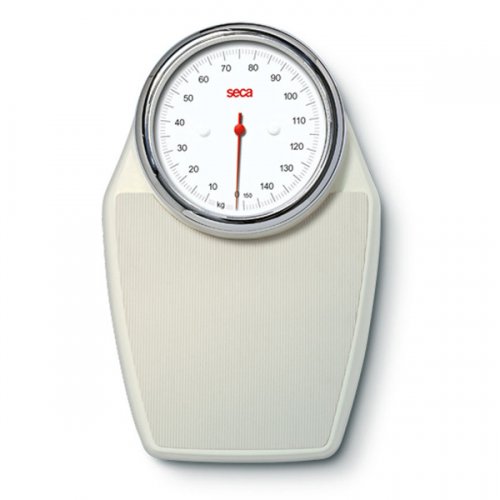
3_seca-760_ecru_white_detailMy urge to write often seems related to the me coming across two colliding ideas, or if not colliding, at least divergent ideas. In this case, I’ve recently started reading the excellent “The Paleo Coach” by Jason Seib, and also seen snippets/chunks of the series “The Men Who Made Us Thin” on the BBC, written and presented by Jacques Peretti.

Peretti’s TV series offers up some extraordinary insight, my favourite moment being when the former CFO of Weight Watchers in the United States almost gleefully pronounces that the company he spent 20 years working for was a good business model because their product didn’t work, but kept people coming back and paying for more. It was if, instead of being interviewed by a journalist, he was making a secret presentation to potential investors.

Overall, the series seems to be a sincere attempt to uncover why so many people are becoming obese, and what solutions, if any, are effective. Peretti points out a number of misleading generalisations, but makes plenty of his own in the process. The most striking thing for me in all that I saw was this comment: “Personally I think people should stop worrying about their weight and focus on being healthy and happy, at any size.” This seems to me to highlight the degree to which our thinking about health has been torn away from any grounding in evolutionary biology, and outright bizarre. If your brain and body are under the impression that your situation is so stressful, or that a time of famine is imminent, and that you need ample stores of fat, is there any possibility that you are healthy?

It’s widely accepted that being fat is unhealthy, yet it seems that the opposite extreme has become the definition of healthy. There is no middle ground – Fat is bad, ergo skinny is good. When skinny is patently unattainable (not to mention ‘unhealthy’) the response is to celebrate being too fat, as in “I’m happy the way I am.” There may be a case to say that, in some sections of the UK media, the pressure to be happy the way you are is nearly as great as the pressure to look like someone else a good deal smaller than you. The idea of being fat and fit is bound up somewhere in all of this. For Peretti, the fact that two obese women, who had some previous experience, could keep going in an aerobics class longer than he could was a sign that fat and fit are not mutually exclusive. Overall, the message seemed to be that nothing is truly effective in combating obesity long term – dieting doesn’t work, exercising doesn’t work, surgical intervention doesn’t work etc. Not great news for the concerned viewer who really wants to change themselves.

Then I picked up Jason Seib’s book, and was delighted. Having ‘Paleo’ in the title means I know he’s going to be talking about an ‘ancestral’ model for living now. In other words, taking the physical activity and nutrition of our ancestors as a template for how to live now. This is another way of saying that he uses evolutionary biology as the basis for his assertions about health and fitness (more of ‘health and fitness’ anon).

It fits that our concerns about our size and weight are related to how other people perceive us, or how attractive we are. Using that evolutionary model, we are wired to propagate our own genes, and mix them with other genes that are going to be resilient, robust etc. From that perspective, what attracts us to others is their appearance of health – “Does this person have what it takes to survive and flourish, and produce children that will do the same, in this adversarial world?” Just as excessive body fat won’t signal a promising mate, nor will being very skinny. In other words, as life has become easier and easier, we have developed some twisted ideas about what the roots of attraction are.

Seib argues that people who begin a diet, or programme of exercise, with aesthetic goals are largely bound to fail. That said, it’s not unreasonable to have a goal of fitting into clothes that you wore a couple of years back, or to want a smaller waist circumference, BUT weight per se is a red herring. You might change your body composition significantly, effectively exchanging stored fat for muscle mass, and not lose much weight. The whole notion of ‘losing weight’ is misguided in fact. Bathroom scales tell us next to nothing about how healthy we are. I know someone who has recently succeeded in losing weight, and I’m certain that, as well as shedding some body fat, she has also lost muscle mass. Did anyone’s health ever improve as they got weaker?

As an aside, Seib refers to research that indicates that yo-yo dieters become more efficient at storing body fat. In other words, if you get into a cycle of dieting to lose weight, and then regaining that weight, then you are likely to become progressively fatter. I can’t articulate how or why, but this is surely a natural response of the human body to the stress of deprivation and signalling the need for storing greater energy reserves.

The solution of “The Paleo Coach” is to have a goal of health, rather than a number that you read on the scale. If you take the necessary steps to be as healthy as possible then aesthetic goals will be achieved as a by-product – again, we’ve evolved to find the appearance of robust health desirable. This brings me back to the ‘health and fitness’ point. Under the heading of “What is fitness?” the CrossFit Training Guide (yes, CrossFit, again) contains this line: “We have observed that nearly every measurable value of health can be placed on a continuum that ranges from sickness to wellness to fitness.” This is to say, health and fitness are not separate – fitness is the optimum state of health. If we accept this idea then the notion of “happy and healthy at any size” is exposed as a nonsense.

Bathroom scales can tell you how heavy you are, they cannot tell you how healthy you are (I know there are some that purport to measure body fat but since one such scale told me that I was borderline morbidly obese I doubt their accuracy). Unless you’re wanting to go on, say, a theme park ride with a weight limitation, or wondering if the lift can cope with one more body in it, what you weigh is of minimal significance – your fitness will take care of your weight.

Oh, and don’t settle for wellness (“How are you?” “Oh, fair to middling.”) – is that really going to be good enough for you?

Dear Pilates Teaching Colleagues

UnknownHaving browsed through Peter Fiasca’s book “Discovering Pure Classical Pilates” a couple of years back, I was slightly embarrassed for him. The excessive use of bold type to underline key points concerning heretical misinterpretations of Pilates, and the somewhat polemical subheadings (“The Great Decline: Derivative Styles of the Traditional Method”), smacked of someone losing their marbles.

I’m beginning to have sympathy with his position (perhaps I am losing my marbles), though our viewpoints differ a little. I’m not fanatical about teaching only ‘classical’ Pilates repertoire but I’m with him when he says “Pilates is not physical therapy”. If not losing my marbles then at least I’m becoming less temperate with regard to the realm of Pilates teaching. Sure, we all have different backgrounds, different influences, loves, hates etc. but I’m writing this to ask if we can agree on a few basics.

Such as:

Pilates is not magic, it’s a system that facilitates teaching good movement.

Pilates is therapy only in as much as movement is therapy.

We teach, clients do – in other words, we don’t do Pilates to our clients.

If our clients believe that they can only do Pilates in our presence we have failed.

We don’t work on our clients problems, they do that.

What clients do in their classes is based on what they need, and what they want. If they ask “What do you want me to do next?”, we’ve given them the wrong impression.

Unless we have medical qualifications, we do not diagnose, or treat.

It’s not our job to determine which specific muscles are culpable in, say, an asymmetry (so it’s not appropriate to be saying, for example “Your left obliques are weaker then your right”).

We have the chance to ‘set the bar’ of what’s possible for our clients, and we should set it high.

We have the tools to help people to be better – if there’s no sign of that happening over time then we should be directing them elsewhere.

We should be practicing what we teach – all the time.

We should be taught by another teacher, regularly.

Oh, and perhaps most importantly, strong is not a dirty word.

My Primal moment

August 21, 2013 — Leave a comment

The story that follows is nothing compared to the stories of hundreds of thousands of people who have experienced danger, disaster, war etc. That said, it felt like I learned something useful about myself, and it also felt as though it justified the changes I’ve made to my lifestyle in the last couple of years.

Here goes:

IMG_1388

The view, on a good day…

I was recently on holiday in Southern France with my wife’s family. We were staying in a house that is about 350m above sea level, on the side of a hill (mountain?) that is 1050m above sea level. There’s a rough but easy to follow path from the house to the peak, and 3 of us set off to the top one afternoon.

Clouds had been building up, and after only 5 minutes or so we could hear a sound like a strong wind through the trees, that turned out to be a wall of monsoon-like rain coming toward us. Prudently we turned back, but set off once again after the rain had passed, only 10 minutes or so later.

Around the point that we had previously turned back, all 3 of us wearing shoes, shorts and nothing else, passed a family coming down the path, wrapped up in waterproof jackets and looking miserable. I’d be lying if I said we didn’t feel amused by the contrast between our party and theirs, though that was tempered by discovering some of the hailstones that had fallen earlier, probably on that poor family.

IMG_1399

My brother-in-law has spent many summers exploring the area so, when he suggested deviating from the main path to make a more circular than out-and-back journey, we had no doubts about the idea. This is a beautiful part of the world, there are stunning views to admire, and on this morning there was the chance to see the impact of heavy rain on the landscape, some paths still being mini rivers.

Around the time that the sky was turning particularly blue-grey, it was acknowledged that we had missed our uphill path, though on the hillside what appears to be a path can quickly disappear into the undergrowth. The solution was to simply head upwards, negotiating the vegetation in the way. So far, so undramatic. When the rain started we experimented with sheltering under trees and scrutinising the pallor and movement of the clouds, confident of a break in the rain. It didn’t come, so we decided that being on the move was better, and carried on uphill. It had already crossed my mind that I wasn’t feeling the need to hold F (my brother-in-law) responsible for our predicament -weird.

It seems counterintuitive but the vegetation became denser the higher we got, and the way (not path – definitely no path) got steeper. Did I mention the rain was unrelenting? So the purchase on mud/stones/roots was increasingly tricky. I’d had my favourite eggs, bacon and avocado breakfast, and was feeling energetic and strong. P, the youngest of our party, is what I might (in a judgemental moment) call a ‘sugar-burner’ – bread and jam for breakfast. He’s young, and was raised that way, so the choices he makes are more habit than real choice. Anyway, P was beginning to shiver, and the novelty of our situation had evidently worn off. (I later discovered that, in the conditions, his shoes were disintegrating from the inside out, so his crappy breakfast may not have been entirely to blame for his mood).

F was regularly assuring us that we were nearing the top so, of course, it felt as though we weren’t. Amazingly, the rain became more intense and we decided to try to shelter again. This was when I had my ‘epiphany’. Squatting under a tree, with hail cutting through the leaves of our ‘shelter’, and with rain water running into parts of my body that even a shower won’t always get to, I was amazed at how I felt. Again, I wasn’t blaming anyone else, and in years gone by I know I would have been angry with F for leading us to this point. I was reminded of scenes from ‘Platoon’ when the grunts are sitting in the jungle drenched under the incessant rain (yes, I do know that we were in no danger of being shot at). I wasn’t cold (daily cold showers paying off?), instead feeling incredibly resilient. I was a bit concerned about P, whose shivering was intensifying, but at the same time I knew that I was strong enough to carry him to safety if I had to. Our situation was ludicrous and, again to my surprise, I wasn’t at all dispirited.

Deciding once more that we were better off on the move we set off for the ridge, where the vegetation disappears. There is a track running the length of the ridge which was a river a few inches deep at this point. Our way back meant following the track a little more up hill before meeting the path back down to the house. We jogged our way to the top of that path, and then sped up on the descent. Now the rain eased. The path is rough, alternating from stones to gravel, clay to chalk, and with roots here and there to add spice. Once running it was hard to stop, and I have rarely felt as invigorated as I did then – concentrating hard on each footing and feeling agile and powerful. Some 4 hours after we set off we arrived back at the house with, for me at least, a feeling of triumph.

Again, I’m well aware that this isn’t a tale that involves much peril, or endurance, and we all came out of the experience unscathed. Nonetheless, it felt to me that 2 years of ‘primal lifestyle’ had made me better able to cope with adversity. I’m better nourished; stronger; more resilient; my immune system is stronger; and, perhaps most importantly, I’m aware of how empowering it is to, instead of blaming someone else, own responsibility for my actions and any resulting predicament.

Thanks for reading.

The line above is paraphrasing Jaap van der Wal, who is an embryologist, and anatomist. (If you want to go deep into his theory, you can watch “The Architecture of Connective Tissue as a Functional Substrate for Proprioception in the Locomotor System“, or you can go on a slightly easier ride here.) I like this line a lot, perhaps because it resonates with my somewhat contrarian nature, and because the lecture by Dr van der Wal that I attended was both exciting and compelling.

I have used this idea to argue, in a workshop entitled ‘Pilates Made Simple’, that Pilates teachers should be cueing movement rather than muscles. This seems to be a widely accepted idea in the world of strength and conditioning, but not so much in the world of Pilates teaching. I was presenting this workshop last weekend and, as expected (because of the company I was in), whilst the idea of cueing movement instead of muscles wasn’t contentious (I think), the ‘brain doesn’t know muscles’ line met with some reasoned resistance. Specifically, someone with a much deeper understanding of anatomy than mine pointed out that brain’s homunculus – its representation of our body – is partly formed by feedback that it receives from receptors within muscles. This caused me to revise my thought process – or perhaps I should say think a little more deeply/carefully about what I mean.

Here’s what I’ve come up with so far. ‘Our brain knows that you’ve got muscle, but it doesn’t know that you’ve got muscles…’ – that is to say, the ‘picture’ that our brain has of our body (which van der Wal says is based upon ‘fascial architecture’) is nothing like the pictures of muscles that we see in anatomy books. So, your brain knows that there is muscle tissue in the area of your arm that is responsible for moving your wrist closer to your shoulder because it knows the area to stimulate to produce wrist-toward-shoulder movements. Your brain does not ‘know’ that you’ve got a bicep brachii muscle, and a brachialis muscle etc. Again, our brain’s representation of our body is based around fascial architecture, and muscle fibres can be viewed as ‘just’ the elastic parts that move the parts of that architecture in relation to each other.

It follows, for me, that any notion that we can selectively fire muscles is largely an illusion. I know when I fire my bicep, because I’ve learned my musculosketal anatomy, and I can see the bit that’s called biceps changing shape. However, I don’t know what else is working, and I doubt that I’m able to isolate my bicep to make that movement. In other words, if I think ‘shorten my bicep’, my brain ‘knows’ what that looks like, translates it into a movement, and sends the message out ‘move wrist toward elbow’.

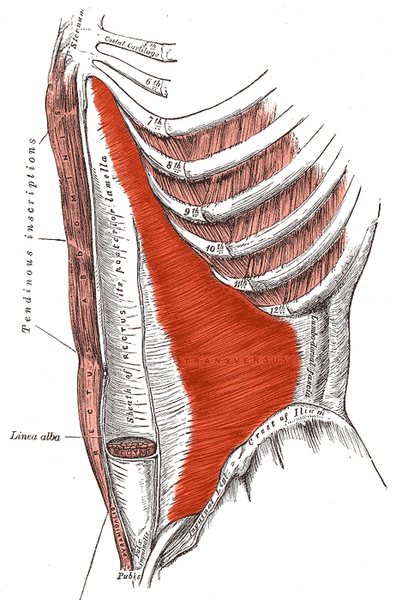
396px-Transversus_abdominisIt seems that one of our favourite muscles to work in Pilates is the transverse abdominis. It’s function is apparently so critical that you can find plenty of online instruction on how to isolate it. ‘HolisticSam’ of http://endyourbackpainnow.com  presents one such example on YouTube. And yet, according to Grays Anatomy “It may be more or less fused with the Obliquus internus or absent.” So it could be that HolisticSam is training  someone to isolate a muscle that they don’t possess. And if that person doesn’t have an identifiable transverse abdominis, does this mean that they cannot stabilise their lumbar spine? Of course not, because their brain doesn’t know how to ‘contract transverse abdominis’, but it does perhaps know how to ‘stiffen lumbar spine’, or maybe ‘ maintain relationship of ribs to pelvis’.

It also seems to me that if we had full conscious control of our individual muscles, then there ought to be far fewer problems with imbalances, asymmetries, and movement disfunction – and those problems should be easier to sort out. This may need further consideration, and it also seems to relate to another bald statement (this one I will claim as my own): ‘Poor muscle balance doesn’t cause poor movement, poor movement causes poor muscle balance’.

As ever, I’d be very happy for a debate to ensue…

Better Than God?

June 5, 2013 — Leave a comment

Most people, if you stopped them in the street to talk about nutrition, would probably know that butter and saturated fat are bad for you. They may well also know that those fats will raise your cholesterol level, and that high cholesterol can kill people. They may well also have some ideas about what constitute healthy fats. After all, this information has been very well disseminated by governments, medical professionals, news media, and producers of healthy fat and cholesterol lowering products.

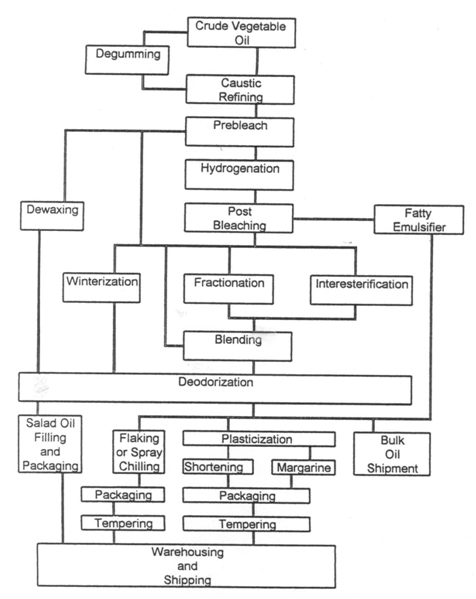
I know how easy it is to make butter. I made some once when I was overzealous in my cream-whipping, trying to impress someone. Margarine, or Benecol (“Benecol is a range of foods that contain a unique patented ingredient, Plant Stanol Ester, that is proven to lower cholesterol. Benecol is available in a variety of delicious products including yogurts, yogurt drinks and spreads.”) is a different story – I’ve no idea where to start, so I looked it up, and apparently making margarine goes something like this:

It appears that olive oil is also relatively simple to extract from an olive. Certainly the process is mechanised these days, but it’s easy to find instructions for the home enthusiast, requiring nothing more complicated than millstones… It’s also pretty easy to render lard – animal fat, heat, a pan, a jar and some cheesecloth are all that’s required.

Vegetable oil, or seed oil is, like margarine, a different story, as this video shows. In the US they call it ‘canola’, in the UK we call it ‘rapeseed’. (You may not fancy watching the whole thing. If you do, listen out for key words such as: ‘solvent’, ‘chemical extraction process’, ‘wash with sodium hydroxide’*, ‘bleach’. You’ll be glad too to hear that they deodorise the final product…)

It’s pretty much the same process that’s outlined in the flow chart. (Clearly not instructions for making Benecol, because there’s no mention of adding those plant stanol esters….)

What, might you ask, has this got to do with God? You can say God, if you like, or you might choose Mother Nature, for the sake of this particular argument. I’m inclined to simply call her Nature. And here’s my point: someone who is very dear to me is a regular consumer of industrial food products like Benecol margarine, and also happens to be a practicing Catholic. He eats Benecol on his bread (there’s a whole other problem) because medical professionals, and advertising have told him this is what’s best for him, and because I’ve got no credentials for getting into an argument with his doctor.

I don’t practice any religion, so I’m guessing how the thinking might go. At the same time I believe that human evolution has been intimately entwined with us making use of the things that nature provides us with, just as is the case for most living things. Predatory carnivores pick their food from herds of herbivores, antelope graze, killer whales eat seals, seals eat fish (some of the really mean ones eat penguins!), many fish graze on algae etc. Technology changes many things for us – it’s very much easier for us to control fire the it used to be, we don’t need to hunt wild animals any more because we’ve learned how to corral and domesticate them. That list can go on and on. The thing is that technology tends to make life easier for us, and tends to generate revenue for the inventor and/or manufacturer. It doesn’t necessarily make us better (Yes, this was last week’s subject.) And when we’re talking about fat, we’re talking about nutrition. Say it out loud: ‘NUTRITION’ – that which nourishes us. There’s hardly anything more important than this in our lives. If we make changes to how we nourish ourselves, surely they should be based on making us better – not based on making life easier, or generating huge profits for industrial food corporations? (By the way, isn’t it weird that the same company that makes Cornetto, also makes Comfort fabric softener?)

Back to my Bencol eating, Catholic friend. Because it feels cruel, I’ve resisted saying to him: ‘God has given us all this bounty with which we can nourish ourselves. Do you really think that we can manufacture better nourishment in a factory, using enormous resources of energy, chemicals and precious water, than God has seen fit to make easily available to us?’ Again, I’d rather be talking about ‘Nature’ than ‘God’, but that’s largely irrelevant. What kind of arrogance leads us to believe that we are somehow different from any other lifeforms on the planet, and that despite millennia of successful nourishment, garnered with the assistance of  some simple hand tools, and fire, we can ‘create’ food that will do a better job of nourishing us?

Of course the real truth is that it’s probably a combination of greed and fear that leads us to the point where we believe that readily-derived-from-nature is bad, and chemically/industrially manufactured is better. However, if we can strip that away (tough, because fear is what drives capitalism so well) then perhaps we can see that it is vanity and arrogance that tricks into thinking that we (or our doctor) may know better…

Special bonus video (reward for perseverance)

*Yes, it’s caustic soda, but don’t worry, it’s of a higher grade than the oven cleaning or sink unblocking kind.