Archives For November 30, 1999

I’m not warmed up yet

August 10, 2014 — 2 Comments

html5-canvas-thermometerWhen approaching a maximal effort (or close to max effort) challenge like a one rep max dead-lift, something imposing an endurance demand like running a 10K race, or maybe a CrossFit type ‘metcon’ it’s almost certainly a good idea to have some kind of warm-up. Something to literally warm you up – raise your body temperature, begin to elevate your heart rate, dilate your blood vessels etc. I doubt that there are many professional athletes of any stripe that don’t have some kind of warm-up prior to an event that will likely require their maximum effort.

We may disagree about this, but I don’t believe that Pilates is something that should or does impose this sort of physical demand. Rather, if we consider it only as exercise, I think it is a program for general physical preparedness. I’m not saying that I find the entire Pilates repertoire easy (some exercises remain beyond my reach), and much of the repertoire makes me work hard. Sweat, even. As a teacher I’ve always instinctively felt that I (and by extension Pilates teachers in general) should be able to demonstrate any exercise at any given moment that the job requires. (I accept that there are excellent Pilates teachers who may not be able to demonstrate certain things for good reason – spinal fusion, for example. I am not writing about them.) I don’t know exactly why I felt that way, I just know that it always seemed a bit daft to me on the many, many occasions that I’ve heard a Pilates teacher saying that he/she cannot demonstrate a particular exercise for their client/s because they were “not warmed up”.

This feeling, or instinct was brought into focus for me recently, when attending Ido Portal‘s ‘Movement X’ workshop. In the context of talking about mobility vs flexibility (An interesting discussion. I’d suggest researching his thoughts via his blog posts, or videos.) Ido asked us to imagine a Taekwondo practitioner being assaulted in a bar, and asking his assailant to wait for a few minutes while he warmed his hip joints up, in order that he could kick him back. In other words, what is the point of a physical practice if the fruits of that practice aren’t available to you all the time?

If a particular Pilates exercise is valuable, worthwhile, then it should be available to you at any time. If its not available to you, without a warm-up first, is there really any point to it?

courtesy of Pilates Style
courtesy of Pilates Style

2013-09-24-HeidiPowellOvrheadPressPrego

Courtesy of Huffpost

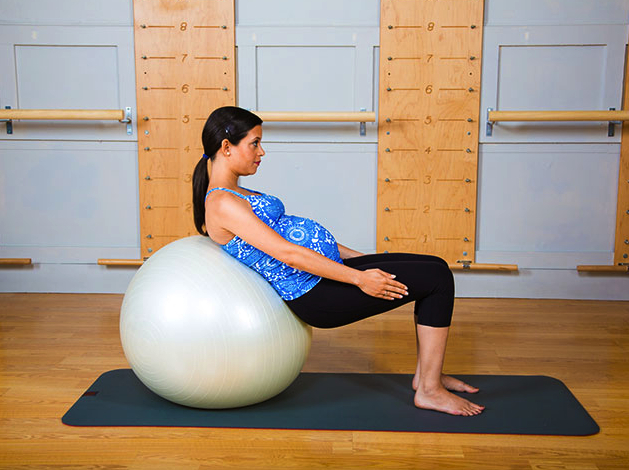
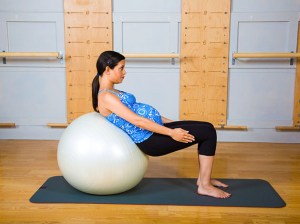
One doesn’t have to look far to find many testaments to the value of Pilates during pregnancy. Though it has not received a specific endorsement from any UK health authority (RCOG for example), I doubt that there are many Pilates teachers who would tell a mum-to-be that Pilates wasn’t a good idea. Searching for ‘risks of Pilates during pregnancy’ doesn’t yield many results.

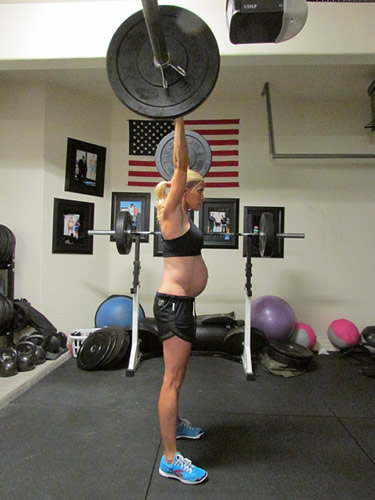
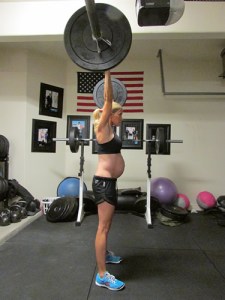
Equally, though perhaps less numerous, there are a number of women who will attest to the value of (appropriately scaled) CrossFit during pregnancy. Indeed there is a website, and social media pages and websites for ‘CrossFit Moms’. In this instance the doubters are a bit more vocal. While they may be largely lay people, photos of a heavily pregnant CrossFitter doing weighted squats caused a storm of controversy, with commentators declaring that she was endangering her baby, and that this activity should be regarded as child abuse.

I am an enthusiast for both of these exercise modalities, but recently I’ve had cause to reconsider my beliefs around pregnancy and exercise.

I’ve also had cause to wonder, prompted by social media threads in particular, about the prevalence of pre- and post-natal sacroiliac joint problems and symphysis-pubis dysfunction. Of course, the release of relaxin, not to mention hyper mobility, will have an impact on joint stability. We know that relaxin is released for a reason, yet it seems a very inefficient (thus unlikely) natural response if it causes lasting problems. I don’t believe in the ‘we just spontaneously break’ model of health that we generally adopt in the developed world. Something about our inputs, or our environment causes ill health – whether it’s joint problems or heart problems, for example. If we are (symptomatically) hyper mobile I suspect it’s because something in our diets, or parents diets (inputs) led to changes in collagen structure leading to lax connective tissues. There appears to have been a variety of research around the subject of diet and collagen (a protein), particularly in relation to caloric, protein, or cholesterol restriction – here’s a study on rats, if you fancy it. Thus, pelvic instability is not a random luck of the draw occurrence, but has an underlying cause. This is not an attempt to lay blame on anyone who has suffered with this problem – rather, to suggest that they have been unfortunate in their genetic inheritance and expression; or have not received the best guidance.

To get back to comparing exercise, first off, what are the most important exercises, or important muscles to be worked during pregnancy? Pelvic floor, right? You’ve got to do your pelvic floor exercises, for heaven’s sake! I’ve certainly done my fair share of teaching PF contractions to pregnant clients.

And then, last year, I watched Jill Miller’s webinar on CreativeLive, which featured the excellent Katy Bowman, as she put it, ‘dropping the Kegel bomb’ (Kegels is the term used in the US). She asserts that the most effective, and balanced way of keeping one’s pelvic floor toned during pregnancy is to squat, and to walk. We might say ‘practice natural human movement patterns’….Her argument is that, while they may be appropriate for some women, isolated pelvic floor exercises may lead to excessive pull on the inside of the sacroiliac joint and consequent imbalance/instability. Squatting would give more balancing posterior support, and both walking and squatting would help to keep tone in pelvic floor muscles.

And what are the issues around Pilates and pregnancy? We encourage pregnant clients at our studio to work with the apparatus, rather than doing mat classes. We’ve had great results and have had plenty of women coming to class right up to the end of their pregnancy. That said, during their second, and especially in their third trimester, a lot of their class doesn’t look much like classical Pilates. We don’t encourage participation in mat classes largely because of the restrictions in lying down (though I’d be the first to agree that guidelines on this are heavy handed, and that a woman’s body will most likely have a way of telling her to stop if lying down is causing vena cava compression), and herein lies one of the fundamental drawbacks of Pilates, especially in the classical practice – there’s a lot of lying down. I know of Pilates teachers who have had terrible problems of pelvic instability during pregnancy. There was a heated debated on a Facebook forum recently about the rights and wrongs of allowing a pregnant woman to participate in a Pilates mat class. Another recent post on the same forum was from a Pilates teacher in her third trimester, unhappy that her workouts feel incomplete because she can no longer follow the sequence that she’s used to. Advice from her responding peers ranged from suggestions for standing (Pilates) work, to taking walks and enjoying nature. Great suggestions, yet I fear that they may fail to address the problem of the lady’s frustration – her workout has to change completely. Is there an issue with the scalability of Pilates? Or the scalability of a ‘classical’ approach to Pilates? Mari Winsor’s book, ‘The Pilates Pregnancy’ is a case in point, with a number of reviews on Amazon commenting that the sequence of exercises varies little from one trimester to the next, and that she doesn’t offer much in the way of modification. In the third trimester she suggests the Hundred with bent knees and feet on the floor, or kneeling up if lying down is too uncomfortable.

Lying down isn’t just a problem from the point of view of possible restriction of blood flow, but also because it doesn’t train the muscles and soft tissues around the hip joints and pelvis to handle to take the increasing load of the growing baby. Indeed, would it not be better to be loading these joints (hip & SI) before conception, and in the early stages of pregnancy, in order to have a strong/stable foundation for the certainty of increasing load?

Here’s where the CrossFit mums-to-be that I know of step in. (Firstly, let’s be clear – I’m sure that many women have had happy and healthy pregnancies and deliveries with Pilates as their exercise companion). The wife of my first CrossFit coach is due in a matter of days, and still doing pull-ups. Another lady that my current coach is training, who is expecting twins in three months, is still deadlifting and squatting with weight – and maintaining that her back has never felt better. The beauty of the exercise methodology that they are following is that it can be scaled to fit their changing needs, without having to change the exercises themselves, and there are articles, in addition to the website mentioned above, to guide mums-to-be and coaches alike. In other words, they can squat throughout their pregnancy – the load and the range needs to change but the activity remains the same. High intensity workouts can be left ’til later, so there’s no need for any stopwatches, but there’s lots of scope for strength work (indeed, it doesn’t matter whether it’s called CrossFit or strength & conditioning). A lot has been written about the community aspect of CrossFit, and one of the benefits of this scaleability is that it means that pregnant women do not have to miss out on their fitness community, and the potential disempowerment of ‘I can’t do what I used to’.

I’m not really advocating that everyone pregnant gives up Pilates and signs up at their nearest CrossFit gym. I just wonder if there isn’t (sometimes) something missing from Pilates that needn’t be. Or maybe there’s a middle ground. I’ve never seen film or photographs of Joseph teaching a pregnant woman, and I don’t remember any reference to pregnancy in his writing. Perhaps he never intended pregnant women to use his method. If, like me, you believe that Pilates is about moving well then many activities can be approached with a Pilates sensibility, perhaps to the significant benefit of women both pre-conception and during their pregnancies.

people-spring-lift-ecard-someecardsI’ve been involved in a discussion lately on https://www.facebook.com/groups/pilatescontrologyforum/ around the subject of why we teach spinal flexion in Pilates. As is often the case, this discussion began to deviate slightly from the starting question, leading into other (for me) interesting territory. Namely, it made me wonder if there is a consensus within the Pilates teaching community as to whether Pilates is itself a functional movement/exercise discipline.

It’s helpful, if not necessary, to define what one is discussing – and so I realise that I have accepted in my own mind a rough definition of functional movement, derived from who-knows-what varied sources, that seems to make sense. If I have to pin it down, my definition would go something like this:

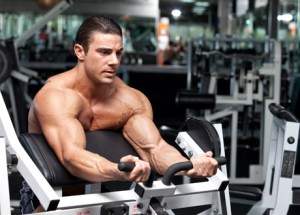
Preacher-Curl1A functional exercise is one that teaches, or reinforces a movement pattern that is useful, and health enhancing, beyond the execution of that discrete exercise.
For example, I would consider the Hundred to be functional because (amongst other benefits) it requires the maintenance of spinal stability under load (from our legs), and also the ability to disassociate our shoulder joint – to move our arms in our shoulder joints without uncontrolled spine or scapular movement. Both of these being very useful in a variety of scenarios (dare I say “fundamental movement patterns”?) I wouldn’t consider a bicep curl as pictured above to be functional, because the machine removes any requirement to create stability, or to transfer load into the centre (free-standing curls would be a different story, of course).

The Facebook discussion reminded me that there are other definitions. For what it’s worth, CrossFit has this definition, and if we turn to Wikipedia they do not have a page for functional exercise but will direct you to ‘functional training‘, which ties in to occupational therapy. Within the discussion, the thing that was slightly jarring for me was the idea that Pilates might not fall into some people’s idea of ‘Functional’, since it seems (generally speaking – more on that later) to fit that description very well.

I’m not a fan of ‘evidence-based’ exercise, because I think it’s naive to imagine that we can ever prove (to meet standards of proof in controlled studies) the efficacy of any given exercise. There are too many variables that cannot be controlled for when comparing even a small number of people practicing the same movement. At the same time, I think applying what, if we were clinicians, we might call ‘clinical reasoning’ to exercise selection is essential. Let’s call it ‘reasoned Pilates’ for the moment (for the record, I am not trying to create a new sub-genre – there will not be a trademark application). Teaching reasoned Pilates means, with your observation and your client’s input, assessing what they need most, choosing how to implement your assessment, and then evaluating whether your choice was successful. So if someone is kyphotic, and is new to Pilates, giving them the Swan Dive on the High Barrel may not be the best choice. The short version of all this is that I want to be able to explain why I’m teaching anyone anything, beyond “that’s what’s next in the sequence”, or “that’s how I was taught it”. In other words, “What’s the point?”

All that said, I do agree with a contributor to the forum referred to above, who said something along the lines of “sometimes people ask too many questions, instead of just doing the work”. I do think it’s often possible that doing the work will lead you to the answer to your question (“Why is it done this way?”, for example). I have heard Romana, on the excellent images“Legacy Edition” DVDs, quoting Joseph answering “What is this good for?” With the wonderful response “It’s good for the body.”I’m not suggesting that clients should be constantly questioning why they are doing things, and their teachers constantly explaining everything. Rather, I hope that they find the answers for themselves whenever they can, and that I have the understanding to explain the ‘why?’ if I have to. I believe I have a better chance of being an effective teacher if I have that understanding.

As an aside, I’d much rather be described as a ‘teacher’ than as an ‘instructor’. The first definition that my dictionary gives for instruct is: “to direct to do something; order”. The first definition that it gives for teach is: “to help to learn; tell or show (how)”. I think that the element of reasoning may be the thing that distinguishes between an instructor and a teacher.

‘Reasoned Pilates’ fits with my perception of Pilates as something that makes you better at other things, rather than Pilates as a thing to be good at. I don’t believe that Joseph Pilates complied the exercises in ‘Return to Life’ for people to practice in order to become very good at doing those exercises. The point was to practice those exercises in order to enhance one’s health (No?). I know that there are people that consider Pilates to be an art form, but I can’t call myself one of them. Seeing someone display a high level of competence in anything is usually enjoyable, but I find the many videos, that do the rounds of social media, of people working on the Reformer (perhaps with dramatic lighting) to be somewhat tiresome. (Equally, photos of lithe bodies on exotic equipment adapted from Pilates apparatus, rather than “Looks beautiful”, make me think “But why? What’s the point?”. It’s as if Pilates is being practiced for someone else other than the practitioner.

Another element to the consideration of ‘functional’, that I was reminded of whilst trying to follow some of the Reformer work demonstrated on the aforementioned DVDs, and may have been missing from the definition I offered above, is fun, or feeling great. It’s sort of covered by the ‘health enhancing’ idea, I think, but deserves its own mention. Something that makes you appreciate, or helps you bask in the joy of whole body movement surely performs a valuable function? To return to the bicep curl analogy, I’m no body builder, but it’s hard for me to imagine that anyone ever had much fun doing sets of bicep curls. Yes, viewing the hypertrophic results in the mirror afterwards may result in a flush of pleasure, but actually doing the sets of curls? Surely not. I don’t know whether the response to doing the various rowing exercises on the reformer was musculo-skeletal, hormonal, emotional, or what. It felt marvellous.

If you think that Pilates doesn’t fit under the heading of functional movement, or functional exercise, I’m sorry, but I don’t understand.

How will you age?

April 21, 2014 — 4 Comments
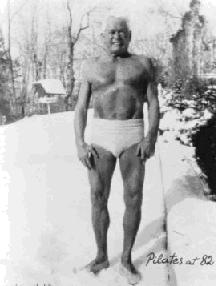
Joseph Pilates, aged 82

Joseph Pilates, aged 82

I’m currently reading the intriguing “The World Until Yesterday” by Jared Diamond, some of which compares the attitudes toward, and treatment of older people in Western societies to that of ‘traditional’ (think tribal) societies. Diamond makes reference to the role that older people play in advertising in western, or westernised societies – their appearance in advertising typically reserved for medicine and supplements, ‘mobility aides’ (Stannah chairlifts, perhaps), or maybe to fulfill the role of Grandparent to a cute child. They are rarely seen promoting products that we might all consume – off the top of my head – pizza, mobile phones, chocolate, toilet paper, rum, coffee, cars….

What does this tell us about our attitudes toward people over, let’s say, 65? Another fascinating insight into this subject came when watching a clip from Britain’s Got Talent.

I’m including the clip, in case you haven’t seen it, because it seems to have the effect of filling people with a sense of joy. Now, I’m as cynical as the next hardened cynic when it comes to these shows – I think it’s pretty obvious that the ‘judges’ have been primed for what’s coming, and things are choreographed, down to Simon Cowell looking bored and buzzing early. So what is there to enjoy? Again, it seems to me that most of, if not the entire audience have an extraordinary emotional response that looks to me like unbridled joy. Then there’s Paddy herself, who is evidently not only a powerful personality but also physically remarkable – strong, agile, mobile, quick, and with impressive coordination.

And yet, I’m left with a question – a niggling thought. Why is she exceptional? Why does the sight of this elderly woman demonstrating strength, skill, agility, and coordination get us so excited. Obviously the answer is that she IS very unusual (but as the videos below illustrate, she is far from alone). So the question should really be, why SHOULD she be exceptional? How is it that we have been conditioned to believe – to know, even – that old people are inherently decrepit? And when does that built-in physical obsolescence start to take effect – sixty? Or seventy? I have clients in their early sixties who are convinced, indeed resigned to the notion that they are now too old to do certain things; and that their age means that they have to accept that their body necessarily fails them.

In ‘The World Until Yesterday’ the author makes reference to tribes that traditionally killed old people, or left them to fend for themselves (amounting to the same thing). Until the 1950s the Kaulong people of New Guinea practiced the ritualised strangling of widows – when her husband died the widow would call upon family members to strangle her! (While there’s obviously one to be had, I’m not going to get into a discussion of misogyny here). Other tribal societies have traditionally revered their older members for their wisdom; for having the most refined skills; or as care-givers for the youngest in the tribe. Western society’s attitude toward its older population falls somewhere between the extremes. Happily, there’s no ritualised killing, but there’s not necessarily much reverence either. How much of that is because, as younger people we have been conditioned to expect little from old age (the very phrase ‘old age’ appears to be inappropriate in this context – a symptom of the problem). When we reach 60, or 70, or whatever it might be, we know what to expect. And yet, Paddy apparently didn’t receive that kind of conditioning, or was able to shrug it off.

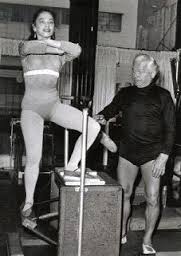
As a Pilates teacher, I have one of the best role models to follow in terms of expectations for older age. It would seem that Joseph Pilates did his best work form the age of 50 onwards, and remained strong and vigorous until his death. I cannot find a clip to include here but the “Romana’s Pilates Ultimate Mat Challenge” DVD includes footage of Romana Kryzanowska, aged 82 (I think) doing the hanging on the Cadillac and describing it as her “daily loosener up-er”. We know what’s possible – as a profession we have excellent examples – and yet, how many of us (Pilates teachers) have been trained to think that the Roll Up, or the Roll Over are contraindicated for ‘the elderly’? I’m not advocating a lack of care or caution, but wondering if we have an instinct to set the bar too low (Yes, I’ve been here before). I know that for someone with osteoporosis, to collapse in their spine as they go into the Roll Up, or Roll Over, could be dangerous, but we wouldn’t teach anyone to collapse in their spine in a Roll Up, would we? Because that’s not what Pilates is about. So whilst it may not be the best idea to introduce that exercise to an older person in their first session, or even in their tenth session, isn’t their the possibility that, in time, the eccentric control that this exercise requires could be just the kind of stress on their bones that will make them stronger.

Here are some more links/video clips of people ‘who should know better’ being physical. If we share enough of these perhaps we can begin to reshape prevailing notions of what growing old means….


http://www.bbc.co.uk/news/magazine-27117769

‘The Hip-Operation Crew’ from New Zealand – the oldest hip hop dance crew in the world.

The amazing Olga, she’s just moved up into the 95-99 age group for Masters track & field


Pilates vs. Evolution

April 16, 2014 — 3 Comments

What should I call it?

What should I call it?

I imagine that the great majority of teachers and/or practitioners of Pilates would agree, that it is alive – that Pilates is a living thing. All living organisms must be able to adapt to changes to their environment (or move to a different environment) to avoid extinction. Thus, I would contend that, Pilates has to be capable of adapting to environmental shifts in order to avoid eventual extinction.
Yes, here we are once again, musing on what Pilates really is/should be etc. It’s a subject that seems ‘to have legs’, very long legs perhaps (and how appropriate).

A recent post on a Pilates related forum invited discussion on “innovation in Pilates”, with fairly predictable results. Some comments endorse the idea of everything that one does informing everything else that one does, others decry the lack of respect shown to the originator, or worry that the public may be confused. The latter idea is particularly fascinating for me, in part because I think that ‘the public’ may not be that interested anyway. If I think of my job as teaching people to position and move themselves as well as possible (on another forum thread Sean Gallagher recently wrote: “…Pilates is a way of living in your body” which feels similar, if not better), then I do not see it as my job to teach people about Joseph Pilates, to make sure that ‘they’ know exactly what was devised by him, and what was not. The subject may well come up, but I’m more interested in honouring the marvellous tool that nature has given us (our moving body) than I am in honouring the man, much as I believe he was a genius.

Back to evolution (apologies to anyone who is troubled by this concept – I believe that its acceptance in the US is particularly limited). There’s no doubt that the environment in which Pilates resides, that’s to say our understanding of biomechanics, neuroscience and so on, has changed substantially in the last 46 years. It may be that you believe that Joseph was indeed 50 years ahead of his time, so still ahead of the evolutionary curve. In which case there may be no reason to look elsewhere for inspiration or more thorough understanding. For some of us, exposure to other modalities, or information that helps to refine our understanding of what’s important, may mean that we begin to incorporate into our teaching things that do not look exactly Pilates, as taught by Joseph. As an example, there have been a couple of instances recently when, within the first few classes, I have taught a deadlift pattern to clients (both of whom had young children, and back problems). This is because I believe that understanding this movement pattern is essential to their well-being, so that they do not have to choose between back pain or picking up their children. I may have mentioned that the deadlift is not strictly a Pilates exercise, I don’t remember. I don’t think it really matters, again, because of how I see my professional responsibility, and because I don’t think my clients are helped by making those differentiations.

I can see that this point of view may not sit well with some teachers, those that we might consider to be devoted to authenticity. They may feel that different disciplines should not be mixed together. As I may have mentioned in an earlier post, I have always been most interested in that area in-between. As an art student I was excited by the blurring of boundaries, between sculpture and furniture, say, or sculpture and architecture. At the moment I believe that it’s appropriate to refer to what I teach as Pilates, because the great majority of it is recognisably Pilates, and because I use the equipment a lot. It’s possible that at some point in the future less of what I’m teaching will be recognisably Pilates, and that may lead me to eventually try to find a different name for what I do. When I was training as a Pilates teacher one of my teachers was known for having his own versions of exercises, and we were encouraged to pin him down about which was original, and which was not of what he was teaching us. His mat classes were called Pilates classes, and whilst the original repertoire was in there, there were flavours of yoga, contemporary dance, and other systems too (and, importantly, in relation to the ‘confusing the public’ issue – they were busy classes, people came and moved, breathed, were challenged, and had fun). That was 12 years ago, and at some point it clearly made sense to give his teaching a new name, so that we now have Garuda. If James were still calling his work Pilates it would probably be totally inappropriate, and the creation of Garuda seems like a natural evolution of his teaching.

The person who posted about ‘innovation in Pilates’ is at the point of making his own equipment, that looks significantly different from Pilates equipment. I would agree that you can apply the principles of Pilates to other modalities, but would suggest that once you need to manufacture your own equipment to best express your work, it may be time to practice under a different banner. The question for me is where one draws the line, between teaching something that looks substantially like Pilates (as I write this I can picture the Pilates fundamentalists gnashing their teeth – sorry), and something which has strayed far enough from the original material that it no longer qualifies. I suspect that the answer may be (aside from needing to create your own equipment) that if you need to ask if you should still call what you teach Pilates, then you’ve probably strayed over that line.

(Image courtesy of http://www.dailymail.co.uk)


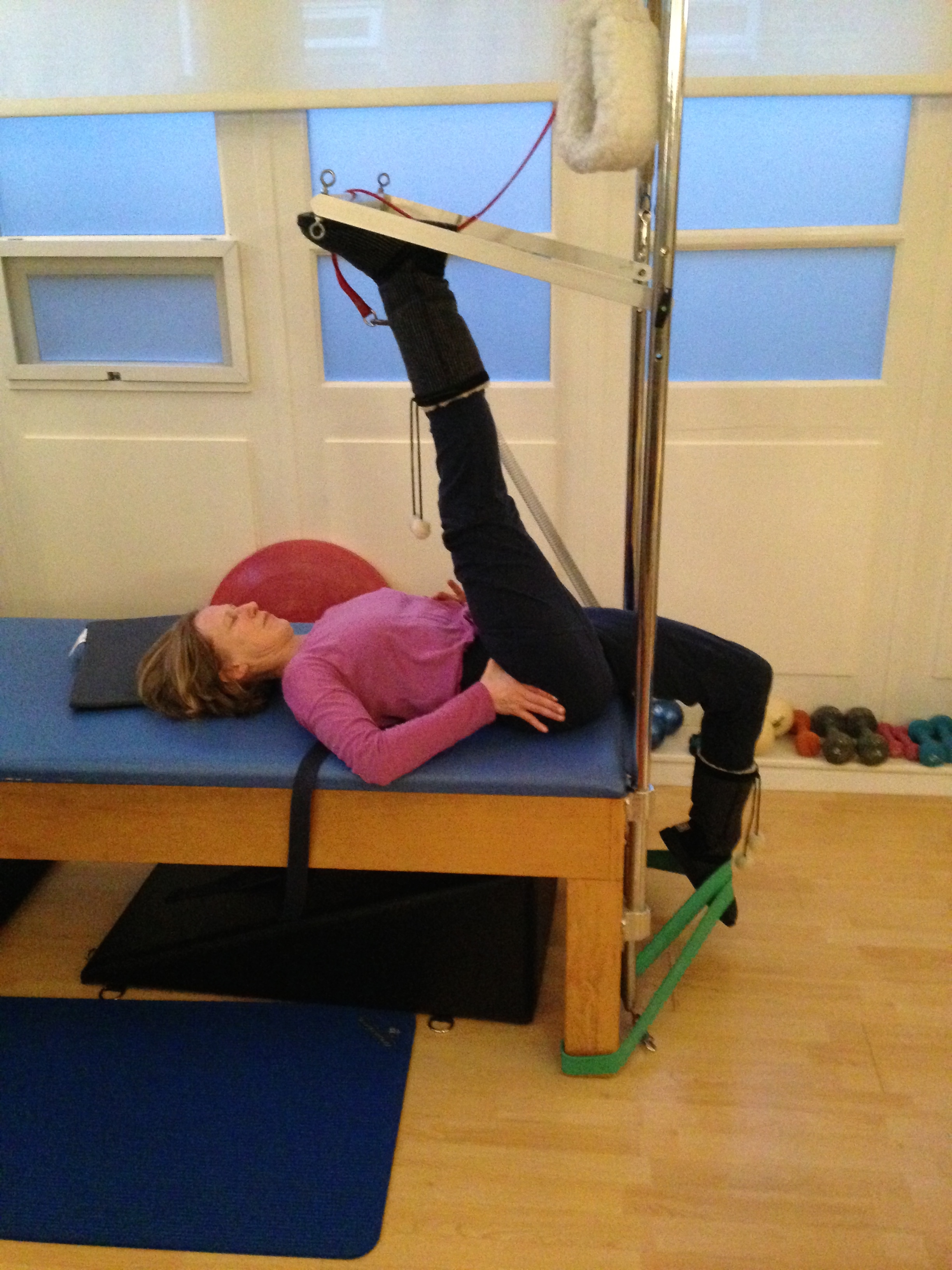
Ok, this is not really Pilates, or it didn’t start out that way. This idea started out because I was given a modified Thomas test to do as homework (to improve my shoddy hip flexor/knee extensor flexibility). I’ve done this in the past with an ankle weight on the suspended leg, but these days I cannot bring myself to believe in the efficacy of static/passive stretching. What better way to engineer the possibility of some contract/relax PNF-type stretching into the equation than my trusty jump stretch band? Putting out round the legs of the Cadillac seems to give the magic amount of resistance to both flex my hip and extend my knee against, and also gives me some proprioceptive feedback to help avoid too much abduction.

Then my lovely wife had the idea to add the bar and springs into the mix, making it look a bit more like Pilates. When did adding movement not help? If you’ve got the hamstring length this seems like a great idea to me (Ugg boots optional)…

Jump stretch band 3

The jump stretch band used not for joint distraction this time, but simply added resistance when trying to find ways to emphasise lengthening into a Rollover. This is perhaps similar to the Tower on the Cadillac, but with truly progressive resistance it presents a bit more of a challenge, both concentrically and eccentrically.

Thanks are due (again) to Patrice, for being the model/crash test dummy. Instead of getting her to try it twice, I should have got her to try again with a lighter band. We live and learn….

hack, noun : trick, shortcut, skill, or novelty method to increase productivity and efficiency


I learned about using ‘jump stretch bands’, or ‘pull up bands’ from Kelly Starrett, and have found them useful in a range of applications in the Pilates studio. I hope this will be the first of a few video posts around this subject.

Achieving ‘clean’ hip flexion, not involving some pelvic motion, can often be a challenge – and this is, of course, a movement theme that crops up in a lot of Pilates repertoire, on all of the equipment.

The obstacle usually seems to be anterior dominance, leading to a hip joint position that ‘closes’ and restricts that isolated flexion.

More and more, in our studio, we’re using bands to create distraction of the joint, allowing for a better ‘fold’ of the leg into flexion. After a fair amount of experimenting, we finally arrived at a set-up that allows for strong hip distraction without the band slipping off when the athlete is reaching toward hip extension.

Unprincipled Pilates

March 23, 2014 — 3 Comments

previewI’m afraid that I can’t find the original comment, so am unable to quote precisely (even if I had permission) something that I read in the thread of a Pilates related Facebook forum. The comment was written by a teacher, who appears to be considered something of an expert on all things Pilates related (in the particular forum, at least) and was along the lines of ‘Joseph Pilates did not teach principles, he taught exercises, in a specific sequence.’

This is a fascinating idea for me, not because I have a special allegiance to the ‘Whole body health; Whole body commitment; Breathing’ that I believe the PMA refer to as Joseph Pilates’ own guiding principles for Contrology, nor to the 6 principles that Friedman and Eisen presented in their ‘The Pilates Method of Physical and Mental Conditioning’, published in 1980. I think all 8 of these ideas have a valid place in the practice and teaching of Pilates. It is a fascinating idea for me more because the act of teaching almost seems dependent on principles, or is doomed to be rather dull, if not pointless, without them.

Ironically, I attended a class a couple of days ago that reminds me of this. It wasn’t a Pilates class (a more recently developed movement practice) that was distinctly unsatisfying because, it now occurs to me, it appeared to be devoid of principles. It seemed more like nice, but aimless choreographed movement (the teacher led the entire class with her back to the participants – viewing the room in the mirrored wall), and I’d rather save that for when I’m drunk on music and good company, perhaps with a little less choreography.

I’m not suggesting that principles of any sort need to be explicit in anyone’s teaching, but rather that there need to be some fundamentals, something that underpins the exercises/movements being taught. I think of all Pilates exercises fitting into (or straddling a couple of) three basic categories – Stabilising the trunk while moving the extremities; Sequential spinal articulation; Transferring load from the extremities to the centre (which, to me, is part of a circuit with the idea of working from the inside out). These, for me, (because they are invaluable movement skills) form the basis for teaching people to move (or position themselves) well.  And that is what Pilates is, to me, in a nutshell. Of course, this is personal, and I know that the practice of Pilates adds up to more than that for many people. For me, moving well and eating well are the ‘secrets’ to excellent health.

I’m very willing to believe that Pilates did not speak of principles when he was teaching (and perhaps this is what the post on Facebook I referred to was indicating), but I do not accept that they weren’t there. Perhaps that was part of Joseph’s genius – that he didn’t need to be explicit, because the work made it obvious. Whether you’re explicit about some underlying principles of your work or not, I would suggest that they need to be there, if what you teach is to have any meaning for your clients beyond the time they spend in class, or in the studio.

imagesFollowing on from a mention in part 1 of this post, I think that a lot of interesting things happen on the boundaries between disciplines. Kelly Starrett, who has influenced my thinking about Pilates a lot in the last few years, talks about the benefits of sports people from different disciplines talking to, and learning from each other (power lifters talking to gymnasts talking to rowers talking to olympic lifters talking to swimmers/runners etc).

The subject of the first post, and the comments that followed (thank you all for your interest and contribution) made me start to think that there is a problem inherent in classification – in trying to define or draw lines between things. Once again, I find myself a little conflicted – I love simplicity, but…

I’ve found the Classical Pilates Inc DVDs to be an invaluable resource, from the point of view of learning to put the correct name to an exercise, or checking choreography. I’ve learned to assume (who knows how/why) that what is usually referred to as ‘classical’ Pilates, is that which was taught by Romana Kryzanowska and her followers. The “Romana’s Pilates” DVD I have in front of me has the tagline “….the true pilates method as taught by Joseph Pilates”. As an enthusiast of simplicity I am drawn to the ‘this is the way it is supposed to be’ kind of presentation. From watching the DVDs, and taking class with Romana trained teachers, I know that Footwork on the Reformer should be done with all the springs attached, as should the Hundred.

And then again, I was watching part of another DVD the other evening (that is still available from Michelle Larson) of Eve Gentry giving a workshop in 1991. My understanding is that Eve worked alongside Joseph Pilates in New York for close to 30 years – longer than anyone of the other first generation teachers. At the beginning of the workshop she talks about what she learned from Pilates: “I learned about not using too many springs….” This is just one example and I’m sure there are plenty of other instances when the Eve Gentry approach to Pilates differs from the Romana Kryzanowska approach. Ironically, courtesy of this blog I now realise that it’s even more complicated than I thought – the classification ‘Classical Pilates’ requires sub-classification!

I’m not at all interested in entering a discussion about which one is better, or closer to Pilates’ original intentions.  I’m curious as to whether being more definitive about classification does more good than not. This gets back to the original question of what it means to call myself a Pilates teacher. I understand the value of being systematic, and holding true to the principles of rhythm and flow, and, ultimately, I believe (as Eve Gentry says) that I’m trying to teach a concept, not a set of exercises. The exercises are a vehicle for delivering/understanding those principles, and can represent a fantastic challenge for someone who is interested in exploring the limits of their physicality (I can see no need for inventing advanced repertoire). I also believe that Pilates himself would adapt/create exercises for individuals, based on his understanding of their specific needs. Whilst I wouldn’t try to compare myself to Pilates (though I not-so-secretly like to think it may be significant that I was born in the year that he died….), I often use other exercises to teach the principles to certain clients – because I think they will be more effective, or represent a more accessible route to understanding the concepts than a ‘classical’ exercise might. I’m back at the ‘Can I teach Pilates with a kettle bell? question from my previous post – can you teach Pilates with exercises that are not Pilates? According to the blog post that I linked to above, I should be acknowledging to whoever I’m teaching a non-Pilates exercise that I’m not actually teaching them Pilates at that moment. But I think Pilates is a concept, not a set of exercises! Isn’t it perplexing?

Here’s another way that I like to think about this – Can you be good at Pilates? If your answer is ‘Yes’, what does that mean? What does it look like to be good at Pilates? I routinely tell people coming to our studio that there’s no value or point to being ‘good at Pilates’. Who cares if you can perform Pilates repertoire beautifully (or however else we might define ‘good at’)? The point, for me, is to use Pilates to help people be good at, or find easy, everything else that they want or need to do. I think that my job is to teach people to move and position themselves as well as possible, and Pilates is the vehicle that helped me on this journey, and what I feel competent to teach to others.

I do understand the need to honour our heritage, and the original work of Joseph Pilates, and I’m grateful to those teachers and organisations who commit themselves to that. I also agree that a familiarity with the apparatus adds to one’s understanding of Pilates. Somewhat unconsciously, I provoked a bit of a comprehensive vs. mat teachers discussion, with the previous post that I wrote. I have no interest at all in supporting or defending diploma courses in Pilates that require very little actual practice of the method, or that offer certification in a short time. I remain uneasy about attempts to make a strong distinction between mat teachers and comprehensive teachers, because I think our job is to teach people to move well. We will, all of us, bring our unique life experiences to the teaching party and whilst many comprehensive teachers may enjoy an ‘edge’ from their experience of the Reformer’s resistance (and I think you’re a fool if you’re a teacher and you haven’t made an effort to experience the apparatus), I do not believe that we are all inherently better teachers of movement than teachers who are not certified in teaching on the equipment.

As an example, I learned more about working my upper back extensors when trying to squat while holding a weight overhead than I did in years of Pilates repertoire both in the studio and on a mat. That doesn’t mean that I give up on using Pilates to teach people back extension, it means that I’ve got something else up my sleeve AND that someone who has done overhead squats (my CrossFit coach, for example) may be at least as good as me at teaching someone to use their upper back extensors. That may be true of a Pilates teacher ‘only’ trained in the mat work.

So is my claim that my job, as a Pilates teacher, is to teach good movement legitimate?